Guide to rendering revisions and how many revision rounds a 3D rendering project should include
Guide

How Many Revisions Should a Rendering Project Include? A Buyer’s Guide

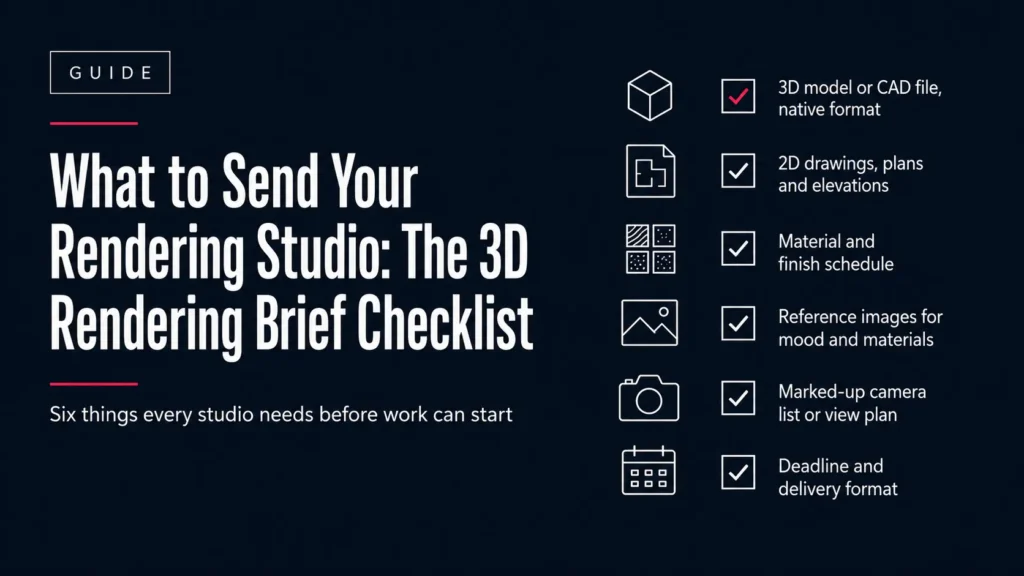
The render lands on a Tuesday. By Friday the client has fired back forty-one comments across three separate emails, and the studio replies that round two is now closed. Nobody ever agreed what a round was. Rendering revisions are the rounds of changes a visualization studio makes to a draft image after your review, covering lighting, materials, camera position, and staging before final files are signed off. They are not design changes, which alter the building itself and send the 3D model back to the beginning. The word “round” is doing quiet work in that sentence. Most studios sell you a number of rounds without ever defining what fits inside one, and that gap is where every argument starts. A revision policy is really a scope agreement wearing a different hat. Get it wrong and you pay twice. What are rendering revisions, exactly? A rendering revision is any change requested against a delivered draft that does not alter the underlying design. Move the camera two metres left. Warm the evening light. Swap the terrace paving from concrete to travertine. Add a couple in the foreground so the plaza reads as occupied. None of those touch the building. All of them touch the image. That distinction matters more than any number in your quote, because the moment a request changes the model rather than the picture, you have left revision territory and entered re-work. Re-work is a different job with a different price, and any studio that pretends otherwise is either absorbing the cost quietly or about to send you an invoice you did not expect. Most disputes in architectural visualization are not about quality. They are about which side of that line a request sat on. How many revisions does the industry actually include? Two to three rounds is the going rate, and it has been for years. Pricing guides across the sector land in the same place, and the cost of going past your allowance is remarkably consistent too. Look at the third row before the others. When a single image costs a few hundred dollars and an extra round costs a hundred or more, revisions are not a rounding error on your budget. They are a meaningful percentage of it. What studios typically include Typical figure What happens after Revision rounds in base price 2 to 3 rounds Billed hourly or per round Cost per additional round 100 to 400 USD Charged per image, not per project Per-image render price (2026) 249 to 2,500 USD Extra rounds can add 10 to 40 percent Time added per round 1 to 3 business days Compounds against your deadline Figures compiled from published 2026 pricing guides by RealSpace3D, Visualizee, Rapid Renders and Freedes Studio. Named for attribution but deliberately not linked, since they are direct competitors. Treat these as market ranges, not quotes. So the honest answer to “how many revisions should be included” is: at least two, and the number matters far less than the definition. For where those figures sit against the rest of a project budget, see our full breakdown of architectural rendering cost. Why do revision rounds run out? Because a round is a terrible unit of measurement. A round can be one comment or it can be forty-one. It can arrive in a single tidy document or dribble in over four days as different stakeholders wake up and look at the file. Studios price rounds assuming the first version. Clients use rounds assuming the second. Both sides think they are being reasonable. Three patterns burn through allowances faster than anything else: Feedback arriving unbatched. The principal comments Monday, the client comments Wednesday, the marketing lead comments Friday. That is three rounds consumed on what should have been one. Stakeholders who never saw the brief. Someone joins at draft two with opinions formed in absence of the agreed camera list, and reopens decisions that were settled weeks ago. Design still moving. The facade changes after modelling starts. This is not a revision at all, but it gets logged as one, and the allowance absorbs a cost it was never priced for. Notice that only the third is genuinely about the design. The other two are process failures, and process failures are fixable for free. A complete 3D rendering brief removes most of them before production starts, and it also shortens your overall project timeline. What counts as a revision and what counts as new scope? This is the table worth screenshotting before your next kickoff call. The left column is what a competent studio should absorb inside your allowance. The right column is honest new work, and pretending otherwise helps nobody. Request Revision, or new scope? Why Adjust lighting, time of day, sky Yes, a revision Re-render of an existing camera, no model change Change material or finish on a modelled surface Yes, a revision Texture swap inside the agreed scope Nudge camera height, angle or crop Yes, a revision Same view, refined. Not a new view Adjust people, cars, planting, staging Yes, a revision Scene dressing, not geometry Colour grade, contrast, post-production mood Yes, a revision Post work on a delivered frame Add a brand new camera angle No, new scope A new image. Price it as one Change the building design or massing No, new scope Model rebuild. Re-work, not revision Add a unit type or floor layout No, new scope New geometry and new assets Change deliverable format or resolution after sign-off No, new scope New output, new render time Add a season, or a night version of a day shot No, new scope Effectively a second image from one model A studio that cannot tell you which side of this line your request falls on, before you sign, has not thought hard enough about its own process. It is one of the ten questions worth asking before you commit. See how a white-label production partner scopes revisions before work starts. Talk to Archvizly What does an extra round really cost you? More

How to vet an architectural visualization partner, 2026
Blog

How to Vet an Architectural Visualization Partner

A property marketing manager once told me she’d hired a studio off a beautiful portfolio, no call, no test project, no references checked. Three weeks later she was renegotiating a deadline because the studio’s “three-day turnaround” only applied to simple interiors, not the tower exterior she’d actually ordered. To vet an architectural rendering partner properly means verifying, before you commit budget or a deadline to them, that a studio’s actual turnaround, revision policy, and quality match what their portfolio and sales pitch imply, not just trusting the pitch. This isn’t the same question as which type of provider to use. That’s a broader decision. This is the tactical playbook for the call, the questions, and the test project that separate a studio you can trust with a real deadline from one you’re about to find out about the hard way. Vet the process, not just the portfolio. Why vet an architectural rendering partner instead of trusting the portfolio? A portfolio shows the best work a studio has ever produced, curated by the studio itself. It says nothing about their average turnaround, how they handle a rushed revision, or what happens when your point of contact is out sick during your submission week. The gap between portfolio and process is where most bad outsourcing experiences actually happen. The renders were fine. The reliability wasn’t. Portfolios sell the ceiling. Vetting finds the floor. What questions should you ask on the first call? Skip the questions their website already answers. Ask the ones that reveal how they actually operate. 1. “Walk me through your last project that was similar in scope to mine.” You’re listening for specifics, not a generic process description. 2. “What happens if my point of contact is unavailable during a deadline week?” A real studio has a backup answer ready. A freelancer or a thin operation hesitates here. 3. “How many revision rounds are included, and what counts as a revision versus a new task?” Get the actual definition, not just a number. 4. “What’s your average turnaround for a project like mine, not your fastest one?” Fastest-case answers are marketing. Averages are operations. 5. “Can I speak to a current or recent client in my industry?” Note how quickly and specifically they offer one. 6. “Who owns the final files, and can I get source scenes, not just rendered images?” This should have a clear, immediate answer, not a pause. Six questions, twenty minutes, most of what you need to know. What should a test project look like? Before committing a real deadline to a new studio, a small paid test project is the single highest-signal step in the whole process. It should be scoped narrow enough to finish in under a week, but real enough to reflect your actual project type, not a generic sample. Pay for it. An unpaid test attracts a studio’s B-team or gets deprioritized behind paying clients, which defeats the point of testing their real capability. Set a real deadline for the test, even a short one, and watch whether they hit it, communicate proactively if they’re going to miss it, and how they handle your first round of feedback. That behavior is what you’re actually buying on the real project. A paid test buys you the truth. A free one buys you their B-team. How do you check references properly? Asking “can I have a reference” gets you a name selected specifically because they’ll say something nice. The value is in what you ask that reference, not whether one exists. Ask a reference about a time something went wrong and how the studio handled it, not just whether they were happy overall. Ask specifically about communication during a deadline crunch, since that’s the scenario most likely to repeat in your own project. And ask whether they’d hire the same studio again for a harder, more time-sensitive project, not just a similar one. Ask about the bad day, not the good outcome. What should be in the written agreement before work starts? Verbal answers on the intro call are a starting point, not a substitute for what’s actually written down before files change hands. For a plain-English breakdown of what a non-disclosure agreement should cover, see Investopedia’s guide to NDAs. Agreement term What it should specify Why it matters NDA What counts as confidential, and how long it applies after the project ends Protects unreleased projects, especially real estate launches Revision policy Exact number of included rounds and a working definition of “minor” vs. “major” change Prevents billing disputes mid-project Ownership of files Whether you receive source scenes or only finished renders, and who can reuse them Determines whether you can revise the work later without going back to the same studio Turnaround commitment A specific date, not a range, tied to a defined scope A range with no defined scope isn’t a commitment Late-delivery terms What happens if the studio misses the agreed date Sets real accountability instead of just goodwill What are the red flags during the vetting process itself? How a studio behaves while you’re still deciding whether to hire them tells you almost everything about how they’ll behave once you have. Behavior during vetting What it usually means Vague or shifting turnaround estimates Either disorganized scheduling or willingness to overpromise to win the deal Reluctance to offer a paid test project Low confidence in consistent quality, or an unwillingness to prove it No named point of contact, only a general inbox No real account ownership if something goes wrong mid-project Pressure to sign or pay before answering basic process questions A sales-first operation rather than a process-first one References that can’t be independently verified Possibly fabricated or hand-picked beyond the point of usefulness How they sell you is how they’ll manage you. How do you evaluate the first draft you receive? The first draft on a real project, not the test, is the last checkpoint before you’re fully committed to this studio for the work ahead. 1. Check

How to choose an architectural rendering company, 2026 guide
Guide

How to Choose an Architectural Rendering Company: A 2026 Buyer’s Guide

A studio I worked with lost a hospital tender three years ago because their in-house 3D artist got sick for four days, right before submission. Nobody had a backup plan. The firm that won had weaker architecture, but their renders showed up on time. An architectural rendering company is a production studio that converts CAD files, drawings, or physical references into photorealistic still images, animations, and virtual tours, and delivers them on a schedule a design team can actually plan around, to help architects, developers, and marketing teams win approvals, tenders, and buyers without staffing a permanent visualization department. That’s different from a freelancer picking up gigs between projects, or a single in-house hire doing one job at a time. A rendering company runs the work like a production line, with a project manager, quality control, and enough bench depth that one person’s flu doesn’t blow your deadline. The “architectural” part matters specifically because building geometry, material accuracy, and site context carry legal and sales weight that product or game rendering doesn’t. A wrong window mullion or an inflated tower height can sink a planning approval, not just look sloppy. (Product studios and game studios also call themselves “3D rendering companies.” This guide is about the architecture and real estate side specifically.) The real value isn’t any single render. It’s repeatability: the same studio producing your next fifty renders at the same quality, on the same week-over-week cadence, without you rebuilding a team from scratch every time. Consistency is the product. What is an architectural rendering company? An architectural rendering company takes a design that only exists as lines, layers, and specifications, and turns it into something a client, a planning board, or a buyer can actually picture themselves standing inside. Most studios split into two tracks. One is stills: single photorealistic images of a building’s exterior, an interior room, a site plan, or an aerial view, priced and delivered per image. The other is motion: architectural animations, walkthroughs, and 360-degree virtual tours, which take longer and cost more because every frame has to hold up, not just one angle. Some studios only do one track. The larger, more established ones do both, plus virtual staging and photomontage for real estate marketing on top. Scope first, then vendor. Why do architects and developers outsource rendering instead of hiring in-house? Three reasons come up in almost every conversation about this: deadlines, cost, and consistency. Tender and competition deadlines don’t move. A design team that wins a bid needs renders ready for submission day, not whenever the internal queue clears. Outsourcing gives a firm access to a production team that flexes around a launch date instead of a fixed headcount. Then there’s the math on hiring. A mid-level 3D visualizer in the US carries a median salary around $95,000 a year, before software licenses, hardware, and management overhead. Unless a firm is producing renders constantly, that’s a lot of fixed cost sitting idle between projects. Outsourcing to a studio outside the US, particularly in Eastern Europe or South Asia, can bring comparable quality for close to half the price, mostly because of labor cost differences rather than lower standards. None of that makes outsourcing automatically correct. A firm producing renders every single week might genuinely be better off hiring. But for most architecture practices, developers, and agencies, the workload is lumpy: heavy before a submission, quiet after. Lumpy workload favors a partner over a hire. How much does architectural rendering cost in 2026? Pricing varies more than most people expect, mostly because “a rendering” can mean a $250 still or a $10,000 photorealistic hero shot of a tower. The table below breaks out what drives that range by project type. Rendering type Typical price (per image) Typical turnaround 3D interior rendering, residential $250 – $2,000 3–7 days 3D interior rendering, commercial $450 – $2,500 5–10 days 3D exterior rendering, residential $400 – $2,800 3–7 days 3D exterior rendering, commercial $800 – $10,000+ 1–2 weeks 3D floor plan rendering $250 – $1,500 3–7 days Architectural animation $4,000 – $12,000 per minute 2–3 weeks 360° virtual tour $800 – $2,000 5–10 days Figures above are drawn from MyArchitectAI’s 2026 rendering cost breakdown, which surveyed pricing across more than 30 rendering providers. The gap between the low and high end of each row usually comes down to three things: how much post-production polish the job needs, how many revision rounds are included, and whether the studio is quoting US rates or an offshore rate. None of those are red flags on their own. A $600 exterior render for an early concept study is a completely reasonable choice. A $600 exterior render for a hero marketing image on a luxury tower is not. That’s a mismatch between budget and use case, not a bargain. In-house vs. outsourcing vs. AI rendering software It helps to see outsourcing next to the two alternatives, hiring in-house or using AI rendering software, because each one solves a different problem, not the same problem cheaper. Option What it can do What it can’t do Typical cost In-house hire Same-day turnaround; full control over priorities; deep familiarity with your projects Flex down when work is quiet, you pay the salary regardless of volume ~$95,000/year median salary Outsourced rendering company Scales up or down with your pipeline; brings a full production team (PM, artists, QC) for one relationship Match same-day turnaround on complex scenes; plan 3 days to 2 weeks $250 – $10,000+ per image AI rendering software Near-instant turnaround; low monthly cost; good for early concept iteration Reliably match hand-finished photorealism for hero marketing images or complex custom geometry $20 – $50/month How does the outsourcing process actually work? The sequence is fairly consistent across studios, even though the details differ. You send a brief: CAD files, reference images, material specs, and a deadline. The studio quotes price and turnaround based on scope and current workload. Both sides sign an NDA before any files change hands, since it’s usually an unreleased

Photorealistic dusk exterior rendering of a residential high-rise tower, featured image for Archvizly's white-label architectural visualization guide
Guide

What Is White-Label Architectural Visualization? The Complete Guide for Creative Teams and Developers

Introduction: Solving the Production Bottleneck Architecture firms, real estate developers, and property marketing agencies hit the same wall when client demand rises: a launch campaign, a tender submission, or a sales gallery deadline arrives faster than the internal team can produce renders for it. Building that capacity in-house means recruiting specialists in modeling, lighting, and material accuracy, which adds cost and lead time right when speed matters most. White-label architectural visualization removes that constraint. It gives your team an invisible production partner that scales output on demand and slots into your existing workflow without disrupting a single client relationship. What Is White-Label Architectural Visualization? White-label architectural visualization is a B2B production service where a specialized studio creates exterior renders, interior renders, animations, and marketing CGI on behalf of an architecture firm, developer, or agency, under a non-disclosure agreement. The studio handles production start to finish and delivers files ready for presentations, campaigns, and submissions, while the client retains full ownership, branding, and credit for the work. This lets a business scale rendering output without adding headcount, keeping the team focused on design, sales, and client relationships instead of production logistics. The model covers far more than a single render. It spans exterior rendering and interior rendering, architectural modeling and animation, 3D floor plans, aerial views, 360 panoramas and virtual tours, virtual staging, and property CGI and photomontage. For a property marketing agency running campaigns across several developer accounts, or a developer preparing a sales gallery ahead of launch, white-label production means every render meets the technical requirements of the project, matched camera angles, accurate lighting, correct material finishes, without the client ever seeing the outsourcing behind it. A production partner like Archvizly works inside your existing file conventions and delivery formats, so output is ready to drop straight into a presentation deck, a print campaign, or a web gallery. Why Agencies and Developers Need This: In-House Overhead vs. On-Demand Scaling Building an in-house visualization team carries real overhead. A single experienced 3D artist runs well into the tens of thousands of dollars a year in salary alone, before software licenses, hardware for render output, and the time spent training someone on your file conventions and brand standards. That fixed cost stays on the books whether the pipeline is full or empty, and it rarely scales fast enough for a tender deadline or a launch date that was set months in advance. On-demand production flips that equation. A white-label partner gives you access to trained specialists without the fixed cost, and that capacity expands and contracts with your actual project load. This matters most when several accounts need renders in the same window, a common reality for property marketing agencies managing multiple developer clients, or when a single large development needs a full package of exterior, interior, aerial, and virtual tour content delivered against one launch date. Production scales with the workload instead of the workload waiting on headcount. Five Key Benefits of a White-Label Partnership Lower Production Cost Without Lower Quality A white-label partner typically cuts production overhead by 40 to 60 percent compared to maintaining an equivalent in-house team, while still delivering renders built to your technical specifications, whether that means a specific camera angle for a tender submission or a lighting mood for a hospitality brand’s marketing campaign. Costs stay predictable and scale with volume instead of sitting fixed on the payroll. Capacity That Matches Real Demand Scale from a handful of renders a month to a full campaign package without a hiring cycle. This is what makes white-label production practical for agencies facing seasonal launch spikes or developers rolling out a project in phases, where consistent quality has to hold across every unit type and every marketing asset. Technical Expertise Without Building It In-House A dedicated production partner brings specialists across exterior rendering, interior rendering, architectural animation, aerial views, and 360 virtual tours, each produced to the technical standard a commercial project requires. That expertise is available on demand, without the ramp-up time of training an internal hire. Brand Protection and Client Retention Everything is delivered under NDA and branded entirely as the client’s own work. An agency can present every render as proprietary output, protecting the client relationship and removing any risk of the production partnership becoming visible to the end customer. Faster Turnaround Around Real Deadlines Renders that would take an internal team days to produce move faster with a dedicated production partner handling the workload, which means campaigns launch on schedule and tender packages go out before the deadline instead of against it. The Archvizly Production Workflow Archvizly’s white-label process is built around the deadlines our clients actually work against: tender submissions, launch dates, and sales gallery openings. Here is how a project moves from brief to delivery. 1. Brief and Specs Intake We review your project brief, including required camera angles, deliverable formats, brand guidelines, and target deadline. This phase aligns the production plan with your project’s technical and visual requirements, typically completed within 24 to 48 hours of receiving the brief. 2. Production Phase Our team builds and renders the assets using industry-standard modeling and rendering tools, matching lighting, material finishes, and composition to your brief. We iterate on your feedback throughout, so the work integrates directly into your existing review and approval process. 3. Quality Assurance Every render is checked for lighting consistency, material accuracy, and geometry issues before it reaches you. We verify formats and resolution against the original brief, with revision rounds built in to meet your standard before final sign-off. 4. Delivery and Integration Final assets are delivered through a secure channel, fully branded as your own work. Post-delivery support covers minor adjustments, so your team can deploy the renders immediately with no visible trace of outsourced production. Maintaining Confidentiality and Brand Integrity Confidentiality is not an add-on to white-label architectural visualization, it is the foundation of it. Every engagement runs under NDA, and Archvizly operates as a production partner with no watermarks, no visible credits, and

Scroll to Top