

The render lands on a Tuesday. By Friday the client has fired back forty-one comments across three separate emails, and the studio replies that round two is now closed. Nobody ever agreed what a round was.
Rendering revisions are the rounds of changes a visualization studio makes to a draft image after your review, covering lighting, materials, camera position, and staging before final files are signed off. They are not design changes, which alter the building itself and send the 3D model back to the beginning.
The word “round” is doing quiet work in that sentence. Most studios sell you a number of rounds without ever defining what fits inside one, and that gap is where every argument starts. A revision policy is really a scope agreement wearing a different hat.
Get it wrong and you pay twice.
What are rendering revisions, exactly?
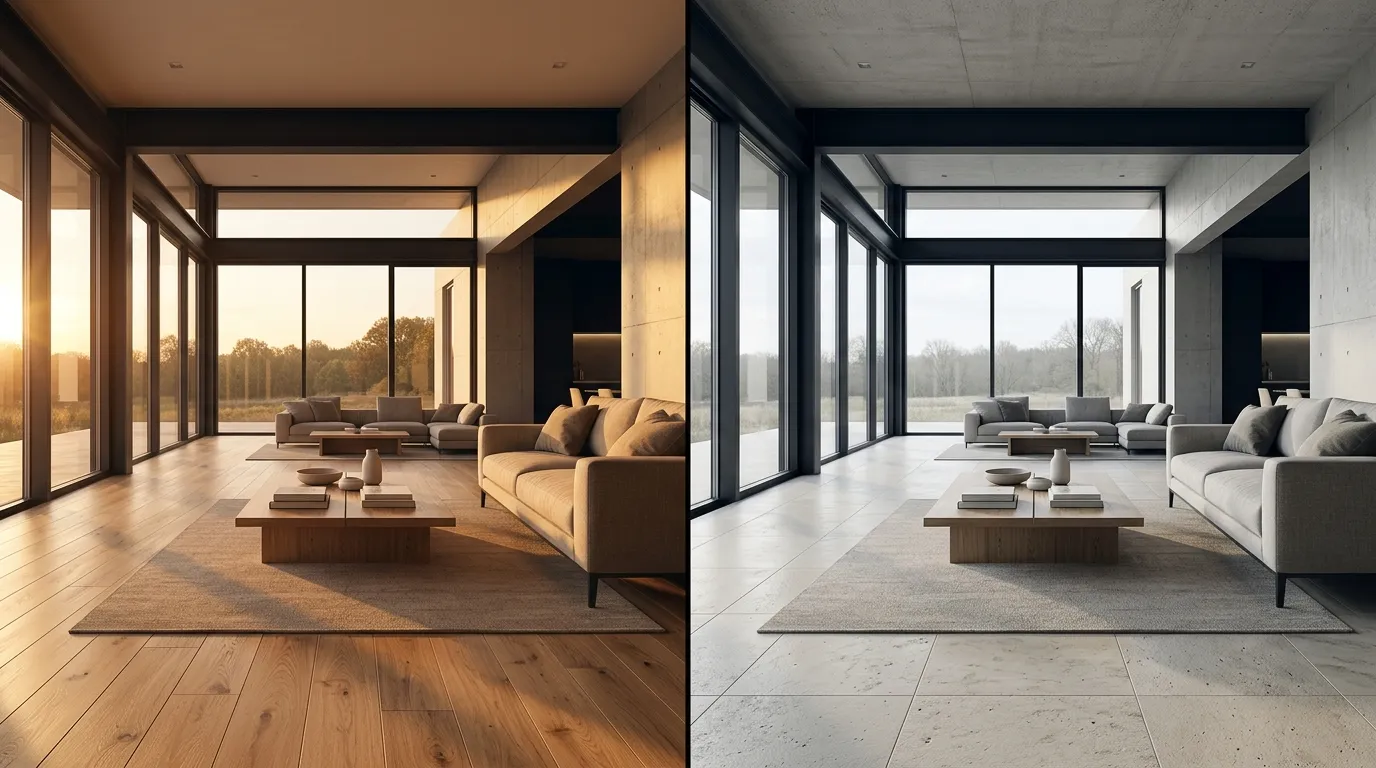
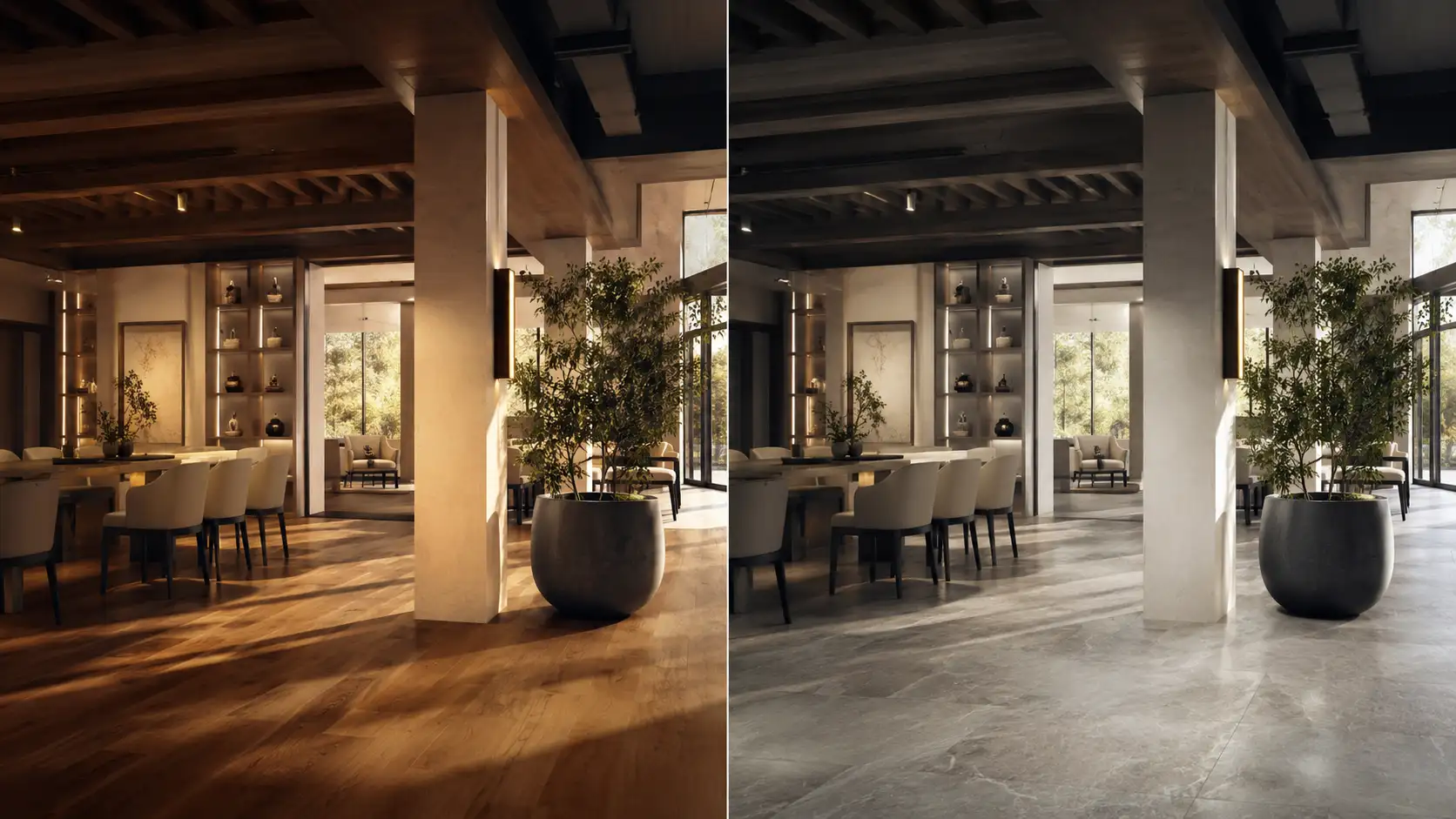
A rendering revision is any change requested against a delivered draft that does not alter the underlying design. Move the camera two metres left. Warm the evening light. Swap the terrace paving from concrete to travertine. Add a couple in the foreground so the plaza reads as occupied.
None of those touch the building. All of them touch the image.
That distinction matters more than any number in your quote, because the moment a request changes the model rather than the picture, you have left revision territory and entered re-work. Re-work is a different job with a different price, and any studio that pretends otherwise is either absorbing the cost quietly or about to send you an invoice you did not expect.
Most disputes in architectural visualization are not about quality. They are about which side of that line a request sat on.
How many revisions does the industry actually include?
Two to three rounds is the going rate, and it has been for years. Pricing guides across the sector land in the same place, and the cost of going past your allowance is remarkably consistent too.
Look at the third row before the others. When a single image costs a few hundred dollars and an extra round costs a hundred or more, revisions are not a rounding error on your budget. They are a meaningful percentage of it.
| What studios typically include | Typical figure | What happens after |
| Revision rounds in base price | 2 to 3 rounds | Billed hourly or per round |
| Cost per additional round | 100 to 400 USD | Charged per image, not per project |
| Per-image render price (2026) | 249 to 2,500 USD | Extra rounds can add 10 to 40 percent |
| Time added per round | 1 to 3 business days | Compounds against your deadline |
Figures compiled from published 2026 pricing guides by RealSpace3D, Visualizee, Rapid Renders and Freedes Studio. Named for attribution but deliberately not linked, since they are direct competitors. Treat these as market ranges, not quotes.
So the honest answer to “how many revisions should be included” is: at least two, and the number matters far less than the definition. For where those figures sit against the rest of a project budget, see our full breakdown of architectural rendering cost.
Why do revision rounds run out?
Because a round is a terrible unit of measurement.
A round can be one comment or it can be forty-one. It can arrive in a single tidy document or dribble in over four days as different stakeholders wake up and look at the file. Studios price rounds assuming the first version. Clients use rounds assuming the second. Both sides think they are being reasonable.
Three patterns burn through allowances faster than anything else:
- Feedback arriving unbatched. The principal comments Monday, the client comments Wednesday, the marketing lead comments Friday. That is three rounds consumed on what should have been one.
- Stakeholders who never saw the brief. Someone joins at draft two with opinions formed in absence of the agreed camera list, and reopens decisions that were settled weeks ago.
- Design still moving. The facade changes after modelling starts. This is not a revision at all, but it gets logged as one, and the allowance absorbs a cost it was never priced for.
Notice that only the third is genuinely about the design. The other two are process failures, and process failures are fixable for free. A complete 3D rendering brief removes most of them before production starts, and it also shortens your overall project timeline.
What counts as a revision and what counts as new scope?
This is the table worth screenshotting before your next kickoff call. The left column is what a competent studio should absorb inside your allowance. The right column is honest new work, and pretending otherwise helps nobody.
| Request | Revision, or new scope? | Why |
| Adjust lighting, time of day, sky | Yes, a revision | Re-render of an existing camera, no model change |
| Change material or finish on a modelled surface | Yes, a revision | Texture swap inside the agreed scope |
| Nudge camera height, angle or crop | Yes, a revision | Same view, refined. Not a new view |
| Adjust people, cars, planting, staging | Yes, a revision | Scene dressing, not geometry |
| Colour grade, contrast, post-production mood | Yes, a revision | Post work on a delivered frame |
| Add a brand new camera angle | No, new scope | A new image. Price it as one |
| Change the building design or massing | No, new scope | Model rebuild. Re-work, not revision |
| Add a unit type or floor layout | No, new scope | New geometry and new assets |
| Change deliverable format or resolution after sign-off | No, new scope | New output, new render time |
| Add a season, or a night version of a day shot | No, new scope | Effectively a second image from one model |
A studio that cannot tell you which side of this line your request falls on, before you sign, has not thought hard enough about its own process. It is one of the ten questions worth asking before you commit.
| See how a white-label production partner scopes revisions before work starts. Talk to Archvizly |
What does an extra round really cost you?
More than the invoice line, and the gap is where projects quietly lose money.
The numbers on scope creep are worse than most people assume. Analysis by Constrafor found that 75 percent of construction projects experience it, 85 percent of those exceed budget by an average of 27 percent, and 80 percent slip their schedule by an average of 33 percent.
The Project Management Institute reports the same pattern across project work generally. Research compiled by PlanRadar puts re-work between 4 and 10 percent of total project cost in most studies.
Visualization is a small line item on a development budget. It also sits directly on the critical path to a launch date, which is a very different thing.
That is the part people miss. A render running three days late does not cost you three days of rendering. It costs you a delayed sales gallery, a tender submitted at the wire, or a campaign that misses the window it was built for.
The image is cheap. The deadline is not.
Should you choose fixed rounds or flat-priced revisions?
Two models dominate the market. They fail in different directions, and which one suits you depends entirely on how settled your design is when production starts.
Read the row marked “hidden risk” carefully. It is the one nobody mentions in a sales call, and it is where each model actually breaks.
| Fixed rounds (2 to 3) | Flat-priced revisions in scope | |
| How it works | A set number of feedback cycles included | Unlimited changes inside the agreed brief |
| What it does well | Predictable cost for the studio. Simple to quote | Removes the argument. Feedback stays honest |
| What it cannot do | Cannot absorb messy or multi-stakeholder feedback | Cannot absorb genuine design changes. Those are quoted |
| Who it punishes | The client with many stakeholders | The studio with a vague brief |
| Cost behaviour | Predictable, then a cliff | Flat, with new scope quoted separately |
| Best fit | Settled design, single decision maker | Live design, agencies, multi-stakeholder review |
| Hidden risk | Rationed feedback. People stop asking | Requires a tight brief to work at all |
Rationed feedback is the quiet failure of the round-based model. When a client knows they have one round left, they stop raising small things. Those small things end up in the final file, in the sales gallery, on the tender board. The policy did not save money. It lowered the standard.
How should a revision policy be written?
A workable policy answers five questions in writing before a single image is modelled. If your studio agreement covers these, disputes mostly stop happening.
- What is the agreed camera list? Number of views, and roughly what each one shows. This is the single most useful line in any brief.
- What is included in a revision? Name the categories explicitly: lighting, materials, camera refinement, staging, post-production.
- What is quoted separately? New views, design changes, added unit types, format changes after sign-off.
- How is feedback submitted? One consolidated document per round, from one named person, within an agreed window.
- What happens when the design changes? Say it plainly. Design changes are re-work and get re-quoted. Everyone relaxes once this is written down.
This is not just tidiness. Constrafor’s data shows that disciplined contract management cuts cost overruns by around 40 percent and project delays by around 30 percent.
The American Institute of Architects makes the same argument about owner-architect agreements: the scope of services and deliverables has to be written down, or the dispute arrives later at a worse moment. Standard forms such as the AIA B-series owner-architect agreements exist precisely because handshake scope does not survive contact with a real project.
Five lines. Most rendering disputes die right there.
What should you ask a studio before signing?
Ask these five and listen for hesitation. The answers separate studios that have run hundreds of projects from studios still learning on yours.
| Ask this | A good answer sounds like | Treat as a warning sign |
| How do you define one revision round? | A written list of what is included, plus a consolidation rule | Vague, or defined only after you ask |
| What is chargeable, and what is absorbed? | A clear brief-versus-new-scope line | We handle it case by case |
| What happens if our design changes mid-project? | Re-quoted as new work, with a stated process | Silence, or an assurance it will be fine |
| How fast is one revision turned around? | A specific figure in business days | As soon as possible |
| Who actually does the revision work? | The same artist or a named production team | Cannot say, or subcontracted with no answer |
The last question matters more than most buyers realise. If revisions get handed to whichever freelancer is free that week, consistency across a set of images collapses, and consistency is the whole point of a commercial package of exterior rendering and interior rendering delivered as one set.
| Compare how in-house and outsourced teams handle revision load. Read the white-label guide |
What are the challenges and limitations?
Flat-priced revisions are not a free lunch, and any studio claiming otherwise is hiding something in the base price.
The model only works when the brief is genuinely tight. If the camera list is loose, “unlimited revisions inside scope” becomes unlimited argument about what scope was. A studio offering flat-priced revisions on a two-line brief is either about to lose money or about to reinterpret the agreement in its own favour.
There is also a case where fixed rounds are simply the better instrument. A single decision maker with a finished design and a fixed camera list does not need revision insurance. They will use one round, maybe two, and paying for flexibility they will never touch is just a worse price.
And no policy survives a client who keeps changing the building. That is not a revision problem, it is a project problem, and it needs a conversation rather than a clause.
Honest limits build more trust than generous promises.
How Archvizly handles rendering revisions
Archvizly works as a white-label production partner for architects and design firms, real estate developers, interior designers, construction firms, hospitality brands and property marketing agencies. Revisions inside the agreed brief are flat-priced, which means changes to lighting, materials, camera refinement, staging and post-production are covered without a round counter running in the background.
The line is the brief. Anything inside the signed scope is absorbed. A genuinely new request, a new camera angle, a changed building design, an added unit type, is quoted as new work before anything starts.
That structure exists for a specific reason. Property marketing agencies and overflow studios reselling production cannot price a job whose cost moves after the client has already been quoted. Flat-priced revisions inside a defined scope keep their margin predictable, which is the only way white-label work stays profitable for the partner.
Our founder puts it more simply: you keep the client and put your name on the work, and we handle the modelling, rendering and revisions behind the scenes.
It shows up in the work. On an overflow engagement for a mid-size visualization studio in Barcelona, predictable revision pricing was one of the terms that made the arrangement viable, because the studio was reselling our production to its own clients and could not carry a cost that moved after it had quoted.
| Talk through your camera list and revision terms before you commit. Book a scoping call |
Frequently asked questions
How many revisions should a rendering project include?
At least two rounds, and three is common. Published 2026 pricing guides across the sector put the industry standard at 2 to 3 rounds included in the base price, with additional rounds billed at roughly 100 to 400 USD each. The number matters less than the definition of what fits inside a round.
What counts as a rendering revision?
Any change to a delivered draft that does not alter the underlying design: lighting and time of day, material and finish swaps, camera refinement, staging elements like people and planting, and post-production colour work. If the request changes the 3D model itself, it is re-work rather than a revision.
Is a new camera angle a revision?
No. A new camera angle is a new image, because it requires fresh composition, lighting setup and render time from the same model. Nudging an existing camera is a revision. Adding a view that was not on the agreed camera list is new scope and should be quoted separately.
How much does an extra rendering revision cost?
Typically 100 to 400 USD per additional round per image, based on published 2026 studio pricing guides. On a project where images cost 249 to 2,500 USD each, two unplanned rounds can add 10 to 40 percent to the visualization budget.
Are unlimited revisions realistic?
Unlimited revisions inside a defined scope are realistic. Unlimited revisions with no scope definition are not, and any studio offering that is either pricing the risk into the base rate or planning to reinterpret the agreement later. The scope definition is what makes the promise deliverable.
What is the difference between a revision and re-work?
A revision changes the image. Re-work changes the model. Adjusting evening light on an existing render is a revision. Rebuilding a facade after the architect revises the design is re-work, and it carries modelling time that no revision allowance is priced to cover.
How long does one revision round take?
One to three business days is the typical range for a still image, depending on complexity and whether the change requires a full re-render. Animation revisions run considerably longer because the entire sequence has to render again.
Why do studios limit revision rounds at all?
Because render time and artist time are real costs, and unbatched feedback multiplies both. A client sending comments in three separate emails triggers three production cycles for what should have been one. Round limits are a blunt instrument aimed at that problem.
How do I avoid running out of revisions?
Consolidate feedback into one document per round from one named person, agree the camera list before modelling begins, and get every stakeholder to review the brief rather than the first draft. Most exhausted revision allowances are process failures, not design disagreements.
Should the revision policy be in the contract?
Yes. Five lines are enough: the agreed camera list, what counts as a revision, what is quoted separately, how feedback is submitted, and what happens when the design changes. Putting it in writing prevents almost every dispute that reaches invoice stage.
Do agencies need different revision terms than architects?
Usually, yes. An agency reselling production to an end client cannot absorb a cost that moves after they have already quoted. Flat-priced revisions inside a fixed scope protect their margin, whereas round-based pricing exposes them to it.
What if the client changes the design halfway through?
That is re-work, and it should be re-quoted. A good studio flags it the moment it appears rather than absorbing it silently and recovering the cost through slower delivery or a tighter revision stance later in the project.