

It’s 9pm on a Thursday and the competition board is due Monday. The design is resolved, but nobody on the team has slept, and the renders still aren’t started. That gap between “design done” and “visuals ready” is where most submissions get lost.
Outsource architectural rendering means hiring an external studio to build the model, render the views, and deliver final files to your spec, while your firm keeps every design decision. This is not offloading design. The studio runs production; you still choose the massing, the materials, and the camera angles. The word “outsource” here usually means the peaks, not the whole function: the competition crunch, the launch week, the quarter when three projects hit visualization at once. The value loop is plain: your deadline sets the schedule, not your single in-house seat. Capacity on demand.
Architecture has a workload problem that makes this timely. The RIBA Workplace and Wellbeing Report found that 90% of practice employees regularly work overtime, with the average employee logging 44 hours a week. Rendering is often the task that pushes those hours past the line.
What is outsourcing architectural rendering?
Outsourcing architectural rendering is the practice of contracting an external studio to produce a firm’s visualizations, from 3D model through to final images, animations, and virtual tours delivered to spec. The firm briefs the work and approves it. The studio does the production.
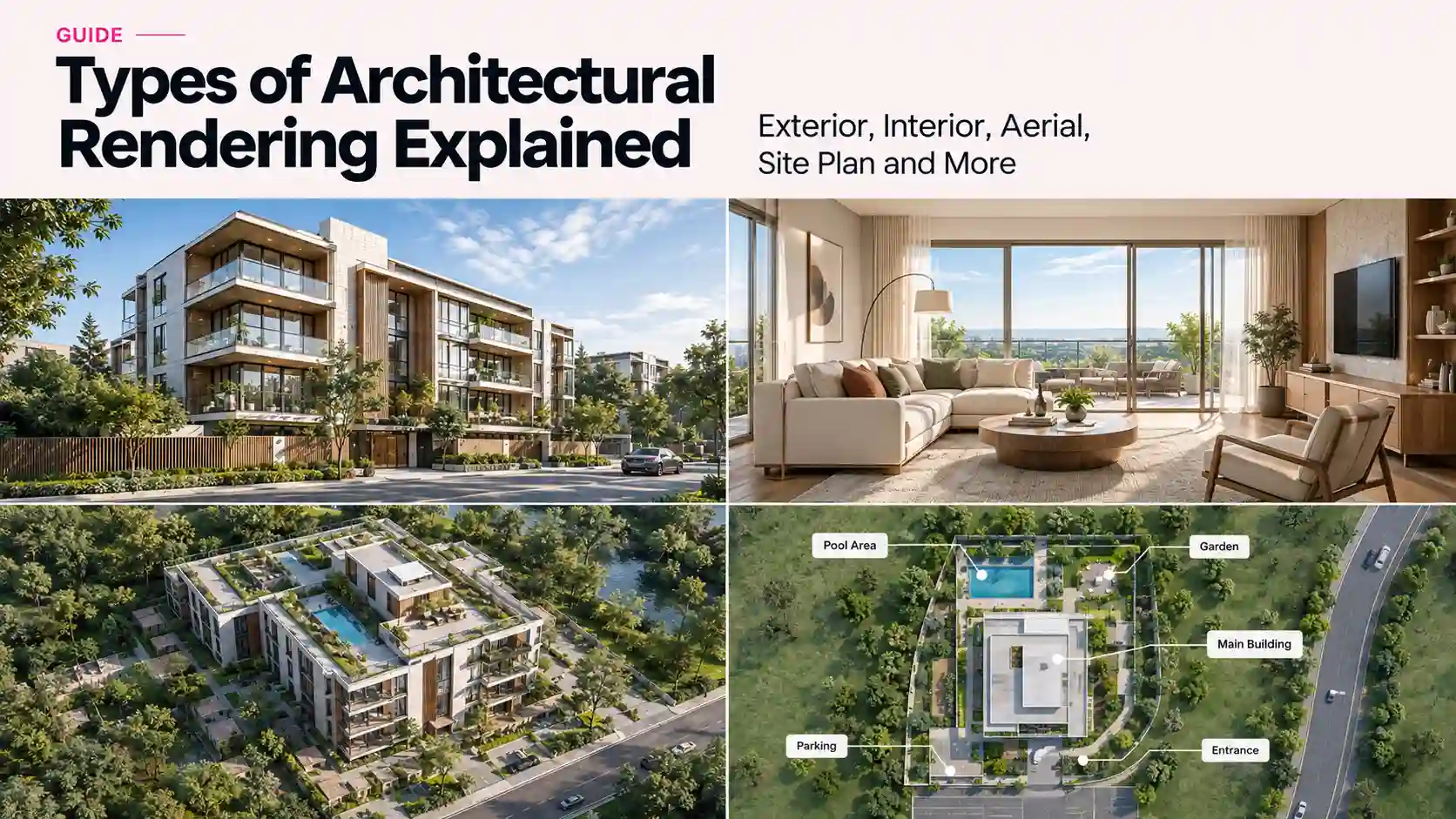
It sits next to a broader field. Architectural rendering, also called architectural visualization, is the craft of turning a proposed design into images or animations before anything is built. Outsourcing is simply who does that craft: an outside team instead of an internal one.
Two terms cause confusion, so lock them down.
White-label rendering means the studio’s name never appears. The client relationship, the branding, and the credit stay with you. Archvizly built its whole model on this. See how it ran an overflow rendering bench for a Barcelona visualization studio whose output had to be indistinguishable from work made in-house.
Production means the technical build: modeling, texturing, lighting, rendering, and post. It is not design. Design stays with the architect.
Draw that line clearly and the rest of the decision gets easier.
| Need render capacity that scales with your deadline instead of your headcount? See how a white-label bench works |
Why do architecture firms hit a rendering bottleneck?
An in-house visualization seat is fixed capacity meeting variable demand, and the mismatch is the whole problem. One visualizer can output a steady number of views per week. Project deadlines refuse to arrive at a steady rate.
Submissions cluster. Competitions, planning applications, launches, and client pitches all pull toward fixed dates. Rendering demand spikes on exactly those dates.
Revisions stack on top. A design change late in the week does not wait its turn; it lands on the same person already at capacity.
Then the maths gets unforgiving. When one seat is the constraint, the entire submission moves at the speed of that seat, no faster. Add a second competition in the same window and something slips.
That is why the global 3D rendering market was valued at $4.5 billion in 2025 and is projected to reach $19.8 billion by 2033, a 19.6% compound annual growth rate, with the architecture sector showing the highest demand for photorealistic visualization (Grand View Research). More renders per project, same number of hours in the week. The bottleneck is structural.
When should you outsource rendering, and when should you not?
Outsource when the workload is spiky or larger than your team can absorb, and keep it in-house when the work is small, constant, and tightly coupled to live design. That single rule prevents most bad calls.
Outsourcing earns its keep in four situations:
- A competition or tender that needs a full render set inside a fixed window.
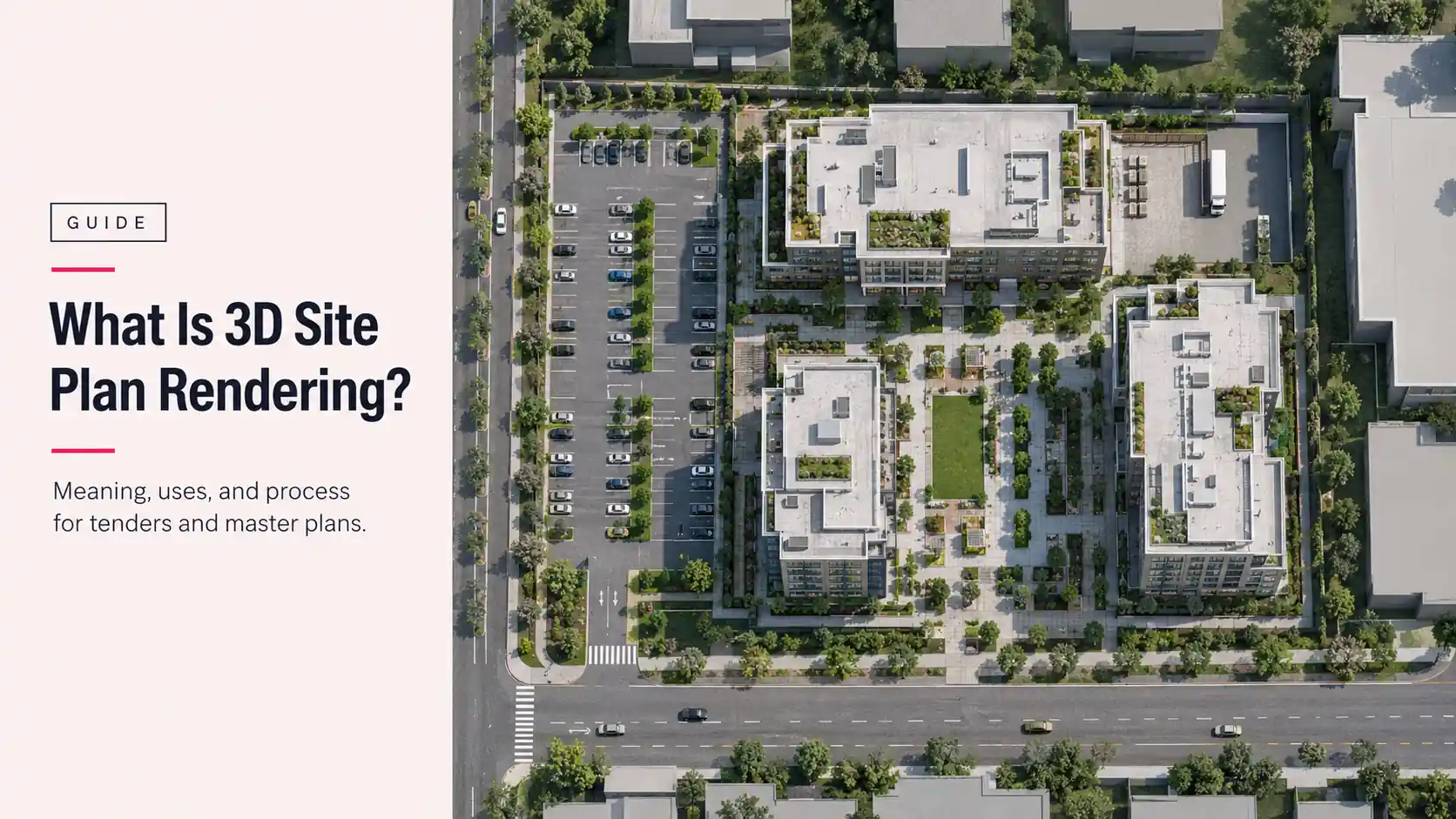
- Overflow when several projects reach visualization at once, like the tender site-plan and massing set a contractor needs alongside everything else in the pipeline.
- A capacity gap you don’t want to solve with a permanent hire.
- A style or output volume beyond your in-house range, such as a full interior presentation set for a luxury villa on a compressed timeline.
Keep it in-house when the design is still moving fast and the render is a working tool, not a deliverable. Early-stage massing studies that change hourly don’t belong with an external team; the coordination cost eats the time saved.
Here’s the uncomfortable truth most studios won’t tell you: outsourcing a design that isn’t locked will cost you more than doing it yourself. Garbage in, garbage rendered.
How does outsourced rendering work, step by step?
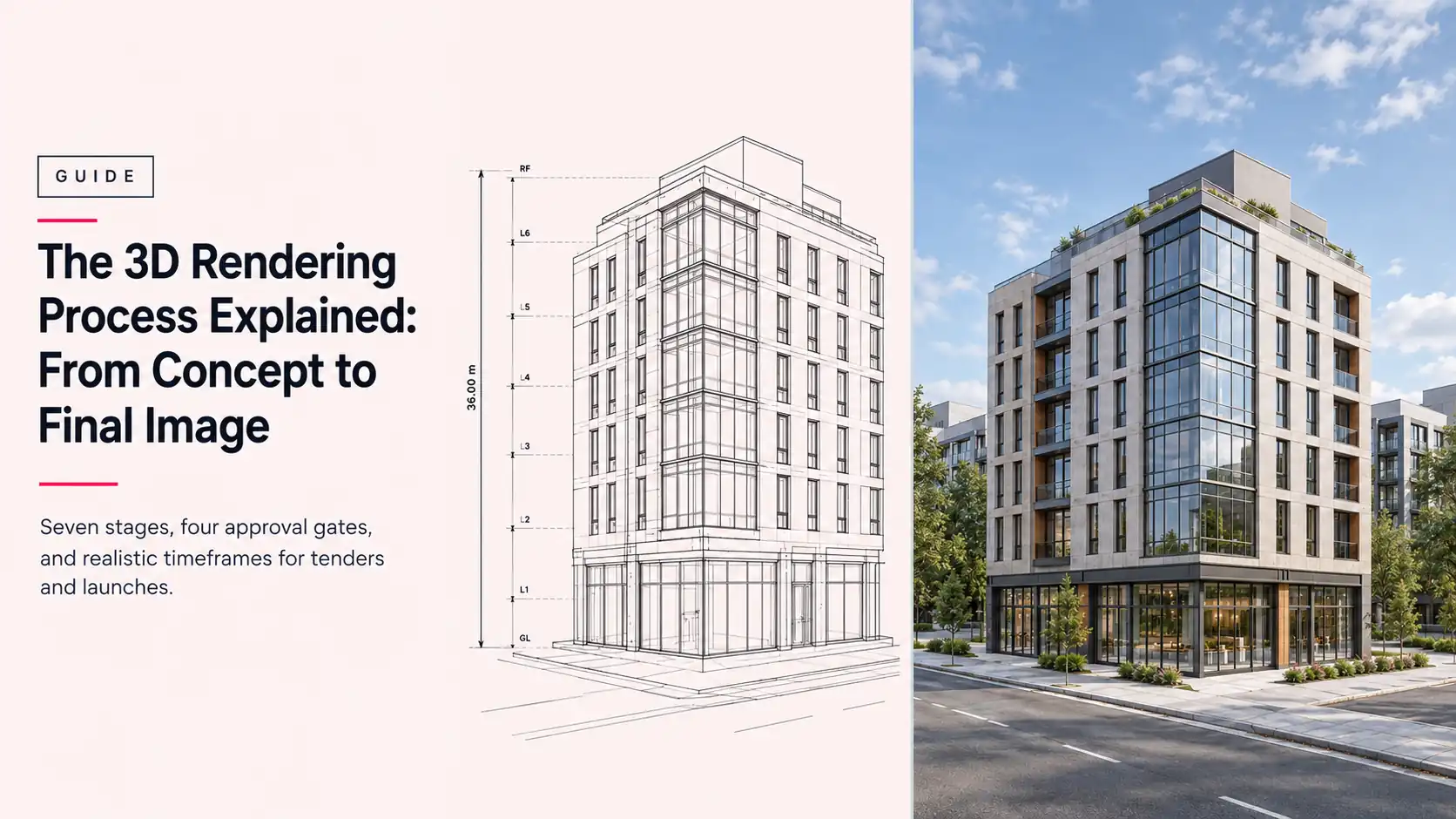
The process is a relay, and every handoff is a place to lose time or protect it. A clear brief up front is what keeps the baton moving.
A typical project runs in six steps.
- Brief. You send drawings or a model, references for materials and mood, the views you need, and the deadline.
- Model. The studio builds or cleans the 3D model from your files.
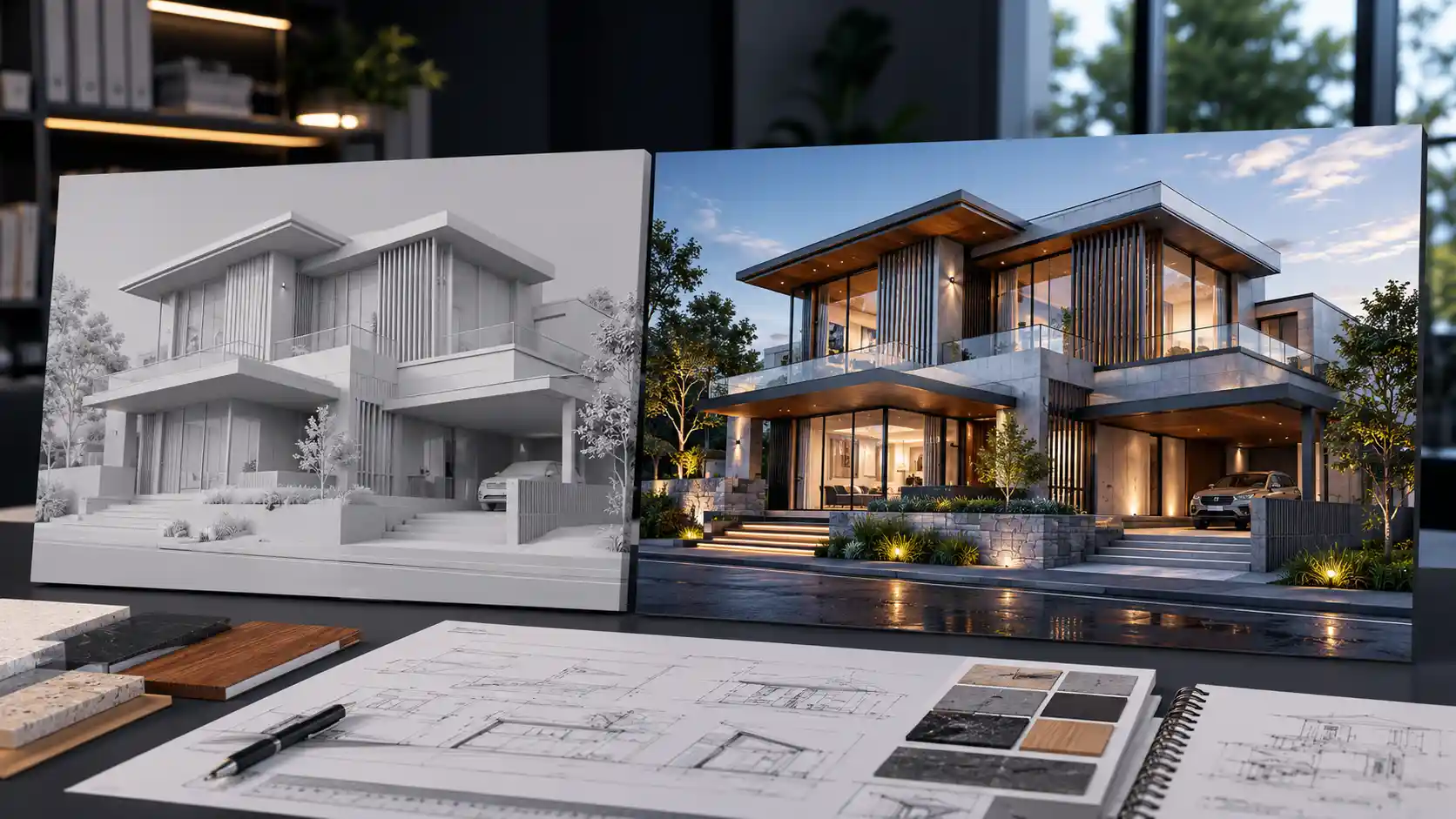
- Draft. A grey or clay render confirms camera angles and composition before any detail work.
- Materials and lighting. The studio applies finishes, sets the time of day, and lights the scene.
- Revision rounds. You mark up the draft; the studio revises within the agreed number of rounds.
- Delivery. Final files arrive in the formats you specified.
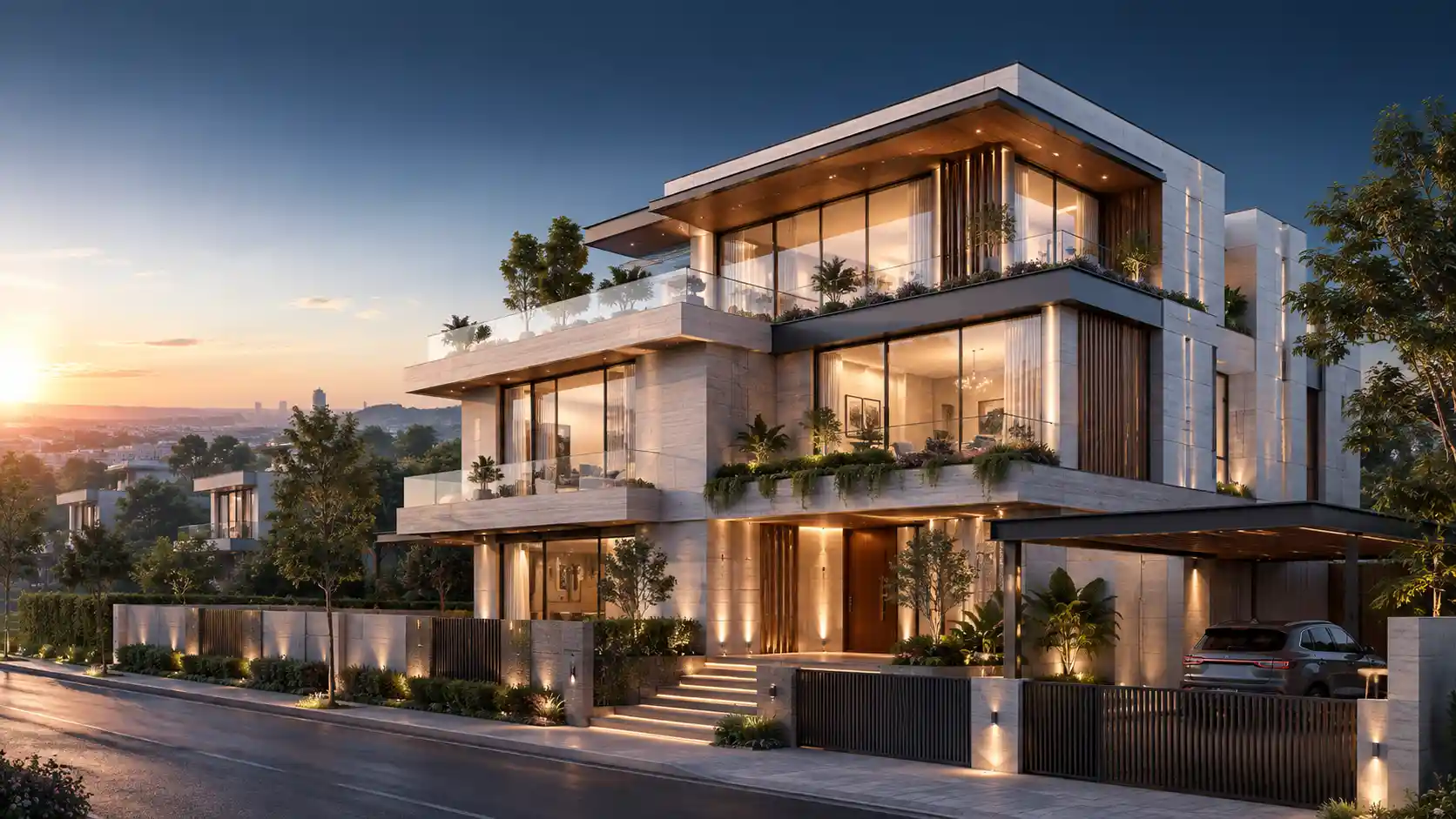
On timing, a single still view typically takes 48 to 72 hours of production once the model is built, including one revision round. End to end, counting intake, your own review and final delivery, the same image is usually 3 to 7 business days. Both figures are correct and they measure different things, which is the main reason published rendering timelines appear to contradict each other. The full breakdown of where the time actually goes separates the two properly. A full set is scheduled backwards from the deadline, which is why locking drawings early is the single most useful thing you control.
Miss the draft-approval step and you’ll pay for it twice.
What you send at step one determines almost everything downstream. Our 3D rendering brief checklist covers which files and formats to send, and includes a template you can copy.
In-house vs outsourced rendering: which should you choose?
Neither wins outright, so match the model to the shape of your workload. In-house buys control and speed on small changes; outsourcing buys elastic capacity for the peaks. The table below shows what each can and cannot do.
| Dimension | In-house rendering | Outsourced rendering |
| Capacity | Fixed. Handles steady flow, cannot absorb submission spikes | Elastic. Scales for competitions and launches, contracts when quiet |
| Speed on small tweaks | Fast. Same-room feedback, no handoff. Slows once loaded | Slower on tiny edits due to handoff, faster on full sets |
| Cost structure | Fixed salary whether busy or idle | Variable per project, no cost when there is no work |
| Style consistency | Full control day to day, limited by one person’s range | Matches your standards when briefed well, drifts on a thin brief |
| Deadline risk | One person is a single point of failure | Spreads load across a team, depends on the partner’s process |
The verdict is rarely all or nothing. Most firms keep a small in-house capability for live design and outsource the peaks. Best of both. If you have decided to outsource and the question is now who to hire, see how to choose an architectural rendering studio.
Studio vs freelancer: what changes when the deadline can’t move?
A freelancer is one person with finite hours. A studio is a team with cover. Under normal conditions that difference is invisible. Under deadline pressure it decides your night.
Freelancers suit one-off, low-volume work with a flexible date. Studios suit fixed deadlines and real volume, because holiday, illness and a second client emergency get absorbed rather than passed to you. Pick for the risk, not the rate.
The full three-way comparison, including hiring in-house, sits in how to choose an architectural rendering studio, alongside the ten questions worth asking before you commit a submission to anyone.
How do you outsource rendering without losing design control?
You keep control by staying the decision-maker at every gate while the studio executes between the gates. Control is lost through vague briefs, not through outsourcing itself. Four habits protect it.
- Lock the drawings before production starts. Late design changes are the top cause of blown budgets and missed dates.
- Give references for materials, mood, and camera angles, so the first pass lands close to your intent instead of the studio’s guess.
- Agree the number of revision rounds in writing, so feedback has a boundary and the schedule holds. What counts as a revision and what counts as new scope is worth settling before you start, and we cover the line in detail in how many revisions a rendering project should include.
- Share your file naming and conventions, so deliverables drop straight into your workflow without rework.
Do these four and the studio becomes an extension of your team rather than a black box. Briefs beat surprises.
How do you choose a rendering partner?
Choose on reliability against a fixed deadline rather than the lowest quote, because a cheap render that arrives late is worth nothing. The short version: ask who will actually produce the work, get the revision policy in writing before you get the quote, and ask for a first available start date rather than a project duration.
One test that no criteria table can hold is how a studio handles your first tricky question. A partner who asks about your drawings and your deadline before quoting is thinking about delivery. A partner who quotes instantly is thinking about the sale.
We wrote the full version separately, including the ten questions that expose a weak studio, the red flags that predict trouble, and our own answers to all ten questions applied to Archvizly: How to Choose an Architectural Rendering Studio.
What are the challenges and limitations?
Outsourcing rendering solves capacity, but it introduces real trade-offs, and pretending otherwise helps no one. Four are worth naming.
- Coordination overhead is real. Every handoff adds communication time, so tiny same-day edits are usually faster in-house.
- Style drift happens without references. A studio can match your standards, but only if you show them what those standards are; a thin brief produces generic work.
- Time zones cut both ways. An overseas team can render while you sleep, which is an advantage, or create a lag on urgent questions, which is a cost. Agree response windows up front.
- Quality varies across providers. The market is wide, from solo freelancers to structured studios, and the range of skill is genuine. A trial project on a low-stakes deadline is the cheapest way to test a partner before you trust them with a competition.
None of these are reasons to avoid outsourcing. They’re reasons to brief well and start with a test.
What is the future of outsourced architectural rendering?
The direction is more rendering, produced faster, with AI in the pipeline rather than replacing it. Demand is climbing (Grand View Research projects the market more than quadrupling to $19.8 billion by 2033), and firms can’t hire their way to that capacity fast enough.
Real-time engines are shortening draft cycles, so approval on camera angles now happens in hours, not days.
AI tools are speeding up early passes and post-production, though final photorealistic quality and technical accuracy still need a human artist for anything going in front of a planning board or a buyer.
The net effect for architecture firms is simple. Rendering becomes more of a flexible, on-demand service and less of a permanent cost center. The peaks get outsourced; the design stays home.
| Facing a fixed submission date with a full render set to produce? Start a project with a white-label studio |
Frequently Asked Questions
Should architecture firms outsource rendering?
Architecture firms should outsource rendering when workload is spiky or larger than in-house capacity, such as competitions, tenders, or several projects reaching visualization at once. It’s less useful for constant small tweaks during early, iterative design. Most firms keep a small in-house capability and outsource the peaks.
Does outsourcing rendering mean losing control of the design?
No. You stay the design decision-maker and the studio executes production to your spec. Locking drawings, supplying references, and agreeing revision rounds up front keep control with you while the studio handles the technical build.
How fast can an outsourced studio deliver renders?
Once the 3D model is built, a single still view typically takes 48 to 72 hours of production including one revision round. End to end, counting your own review, most stills land in 3 to 7 business days and animation runs 3 to 8 weeks: full timeline breakdown by project type.
How much does it cost to outsource architectural rendering?
Between roughly 250 and 5,000 US dollars per still image in 2026, with most professional work landing between 400 and 1,500. Cost depends on view count, model complexity and turnaround speed, so ask for a per-view quote against your brief rather than a blanket rate: full price tables by service type.
What files do you receive from a rendering studio?
You receive still images as high-resolution JPEG and PNG, animation as MP4, layered files as EXR when images need further post-production, and 3D models as FBX or .blend when other vendors need the geometry. Agree the format list in writing before the project starts.
What is white-label rendering?
White-label rendering is production work delivered under your name, with the studio staying invisible and the client relationship staying yours. It lets agencies and studios scale output without revealing an outside partner. Confidentiality is contractual, usually with an NDA.
Is it better to hire a freelancer or a rendering studio?
A freelancer suits one-off, low-volume work with a flexible date and the lowest per-image cost. A studio suits fixed deadlines and full render sets because a team covers illness, holidays and overflow: full comparison including hiring in-house.
What do you need to provide to start an outsourced rendering project?
At minimum a 3D model or CAD geometry, plus 2D drawings, a material schedule, reference images, your camera list and the deadline. Native files from your own software beat converted exports every time: the complete brief checklist and a template you can copy.
Can outsourced renderings match our in-house style?
Yes, an outsourced studio can match your house style when you supply references, past work, and clear material specifications. Style drift happens only when the brief is thin. A short test project confirms the match before you commit a major submission.
How many revision rounds are normal?
Two to three rounds is the industry standard inclusion, with extra rounds typically charged at 100 to 400 dollars each. The number matters far less than the written definition of what fits inside a round: what counts as a revision versus new scope.
Is outsourcing rendering secure and confidential?
Outsourcing rendering is secure when the partner offers a signed NDA and a white-label workflow, so your project and client relationship stay confidential. Ask how files are stored and who has access. Reputable studios treat confidentiality as standard, not an upgrade.
Does outsourcing rendering work for competitions and tenders?
Outsourcing works well for competitions and tenders because the deadline is fixed and the render volume is high, exactly the conditions a studio is built for. Lock the drawings early, brief thoroughly, and schedule backwards from the submission date. A team absorbs the spike that a single in-house seat cannot.