

Ask ten studios what a render costs and you will get quotes between 250 and 5,000 dollars for what sounds like the same image. Both ends of that range are legitimate. Neither studio is trying to mislead you.
They are quoting different products.
Architectural Visualization Services cost in 2026 runs from roughly 250 to 5,000 US dollars per still image, with most professional work landing between 400 and 1,500 dollars, and animation priced separately at 2,500 to 20,000 dollars per finished minute. The spread is not arbitrary. It tracks four things: image complexity, whether a usable 3D model already exists, where the studio operates, and how much revision latitude the price includes.
That last one catches people out. A 400 dollar image with two revision rounds and a 900 dollar image with unlimited revisions inside scope can land at the same final invoice, and the cheaper quote can end up costing more.
Price per image is not price per project.
How much does architectural rendering cost by service type?
These are 2026 market ranges in US dollars, compiled from fourteen published studio pricing guides. Standard covers competent professional work. Premium covers high complexity, high resolution, or launch-critical marketing imagery.
Find your service in the left column before comparing any quote you have received. Comparing an interior quote against an exterior benchmark is the most common way buyers convince themselves they are being overcharged.
| Service | Standard range | Premium range | Priced per |
|---|---|---|---|
| Interior still | 300 to 1,200 | 1,200 to 2,500 | Image |
| Exterior still, residential | 400 to 1,500 | 1,500 to 3,000 | Image |
| Exterior still, commercial | 800 to 2,500 | 2,500 to 5,000+ | Image |
| Aerial or bird’s-eye view | 800 to 2,000 | 2,000 to 4,000 | Image |
| 3D floor plan | 150 to 600 | 600 to 1,500 | Plan |
| Site plan or masterplan | 1,000 to 3,000 | 3,000 to 8,000 | Plan |
| 360 panorama | 400 to 1,200 | 1,200 to 2,500 | Panorama |
| Virtual staging, photo-based | 16 to 75 | 75 to 200 | Photo |
| Virtual staging, CGI quality | 500 to 1,200 | 1,200 to 1,800 | Room |
| Architectural animation | 2,500 to 8,000 | 8,000 to 20,000+ | Finished minute |
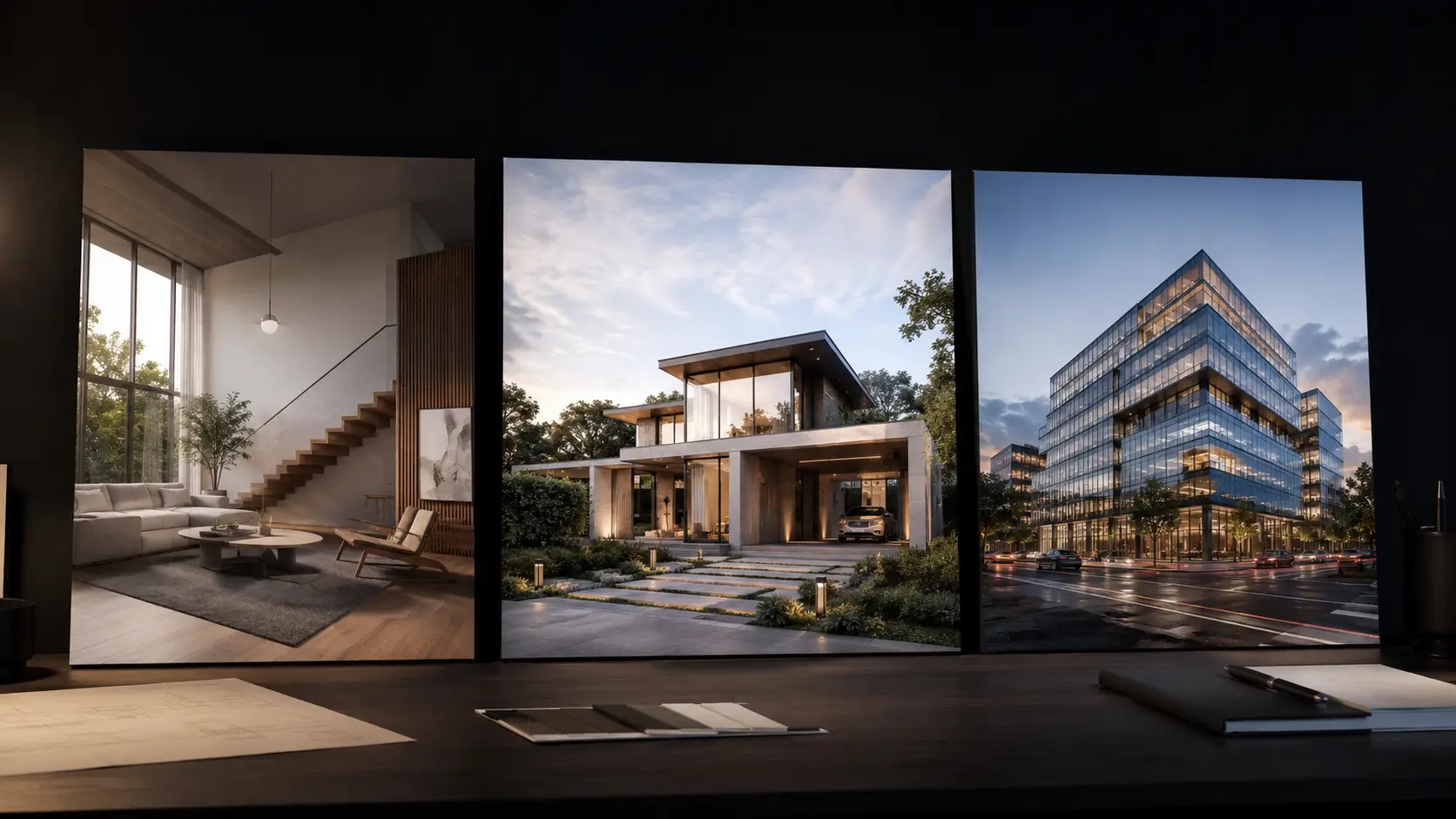
Ranges compiled from published 2026 pricing guides by ArchiCGI, PixReady, Rapid Renders, Cylind, Maverick Frame, No Triangle Studio, Los Angeles Rendering, Render3DQuick, Freedes Studio, Limina Studios, MyArchitectAI, CAD Crowd, Provisual and Virtual Staging. Named for attribution but not linked, since they are direct competitors. Treat these as market norms rather than a quote.
Note the two virtual staging rows. They are genuinely different products sharing one name. Photo-based staging drops furniture into an existing photograph for tens of dollars. CGI-quality staging rebuilds the room in 3D and costs twenty times more. Studios quoting 24 dollars and studios quoting 1,200 dollars are both telling the truth.
Why do published prices vary so much?
Five reasons, and once you can name them the quotes stop looking random.
- Different definitions of the deliverable. One studio’s price includes the 3D model build. Another assumes you supply it. That single difference moves a quote by 300 to 1,500 dollars.
- Different revision allowances. Two to three rounds is standard, with extra rounds at 100 to 400 dollars each. A quote with one round included is a lower number describing less.
- Different resolution and licensing. Web resolution and print or billboard resolution are not the same product, and commercial usage rights sometimes sit outside the base price.
- Different labour markets. A studio paying US salaries cannot price like a studio paying South Asian or Eastern European salaries. This is arithmetic, not quality.
- Different quality tiers presented identically. Template scenes with swapped geometry and bespoke lighting and composition both get called an architectural render.
When you compare quotes, normalise for the first two before you look at the number. Most apparent price differences disappear.
What actually drives architectural rendering cost?
Six factors, roughly in order of how much they move the number.
The third row is the one that saves buyers real money and gets overlooked most often. Renders get cheaper per image as you order more of them, because the expensive part happens once.
| Factor | Effect on price | Why |
|---|---|---|
| Whether a 3D model exists | Adds 300 to 1,500 | Modelling from PDFs is a separate job before rendering starts |
| Scene complexity | Can double the base price | Facade detail, glazing behaviour, planting, surrounding context |
| Number of views | Reduces cost per image | Model and materials are built once, then reused across cameras |
| Resolution and intended use | Adds 10 to 30 percent | Print and outdoor need more render time and more scrutiny |
| Revision latitude | Adds 100 to 400 per round | Each round is production time plus a re-render |
| Turnaround speed | Adds 25 to 50 percent | Rush pricing funds parallel staffing and priority render capacity |
A single exterior might cost 900 dollars. The same building from six angles rarely costs 5,400, because the model, the materials and the lighting were built for the first image and the remaining five are largely camera work and render time. Expect meaningful volume pricing on packages, and ask for it if it is not offered.
Render settings themselves matter less to price than people assume for still images. Chaos, the company behind V-Ray, documents the quality versus render time trade-off in detail, and any competent studio has already tuned it. Artist hours drive cost. Machine hours mostly drive animation.
Send your files and views for a scoped quote rather than a range. Talk to Archvizly
Why does the studio’s location change architectural rendering cost?
Because the largest line item in a render is a salary, and salaries are not global.
The US Bureau of Labor Statistics puts median pay for special effects artists and animators at 99,800 dollars a year. A studio employing artists at that level, in that market, with US overheads, has a cost floor that a studio operating in South Asia or Eastern Europe simply does not have. The image on screen can be identical. The cost of producing it is not.
This is worth saying plainly, because the industry usually talks around it. Offshore production is cheaper because labour is cheaper, not because the work is worse. The variable that predicts quality is the studio’s process and the seniority of its artists, not its postcode.
What you are buying with a higher price in a high-cost market is usually proximity: same timezone, same language, easier meetings, sometimes local accountability. Those are real benefits and worth paying for on some projects. They are not the same thing as better renders.
Judge the portfolio, not the passport.
What are the three pricing models?
Most studios use one of three. Which suits you depends on how often you need work, not on which is cheapest per image.
Read the bottom row before the top. Each model has a way of costing you money, and picking well means choosing the risk that fits how your work actually arrives.
| Per image | Package or project | Monthly retainer | |
|---|---|---|---|
| How it works | Fixed price per final image | One quoted price for a defined set | Fixed monthly fee for reserved capacity |
| Best for | One-off renders, testing a studio | Launch campaigns, tender packages | Agencies and studios with steady overflow |
| Cost per image | Highest | Lower, volume discount applies | Lowest at consistent volume |
| Predictability | High per image, low per project | High | Very high. Same number every month |
| What it cannot do | Absorb scope growth cheaply | Flex once the package is agreed | Justify itself at low or irregular volume |
| Main risk | Cost creeps as views are added | Under-scoping the package at the start | Paying for capacity you did not use |
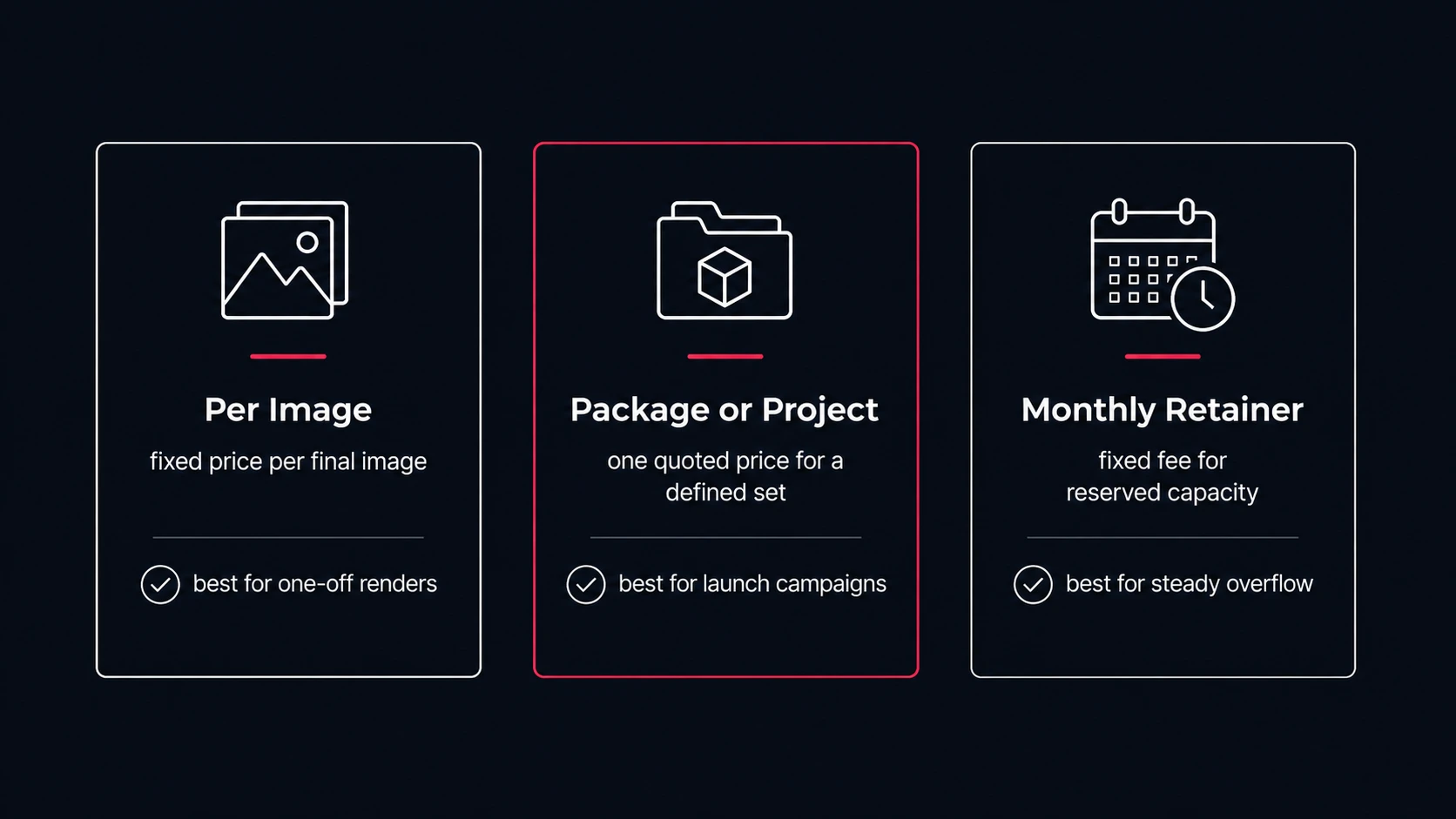
Retainers are the least discussed and the most useful for agencies. If you resell production to your own clients, a fixed monthly cost turns visualization from a variable expense into a known one, which is the difference between quoting confidently and quoting nervously.
What is included, and what costs extra?
The gap between these two columns is where quotes stop matching invoices. Ask about every row in the right column before signing.
| Item | Usually included | Usually extra |
|---|---|---|
| Draft render for review | Yes | No |
| 2 to 3 revision rounds | Yes, at most studios | Further rounds, 100 to 400 each |
| Web resolution files | Yes | No |
| Print or billboard resolution | Sometimes | Often 10 to 30 percent more |
| Building the 3D model | Only if stated | Yes, if you supply drawings only, 300 to 1,500 |
| Additional camera angle | No | Yes, priced as a new image |
| Night or seasonal variant of a view | No | Yes, typically 40 to 70 percent of full price |
| Rush delivery | No | Yes, 25 to 50 percent premium |
| Commercial usage rights | Usually | Confirm for outdoor and paid media |
| Source 3D model files | No | Sometimes available for a release fee |
Two rows deserve extra attention. Commercial usage rights matter because renders routinely contain purchased furniture, planting and texture libraries governed by royalty-free licence terms, and those terms follow the image onto your billboard. And the additional camera angle row is the single most common source of unexpected cost, because buyers reasonably think of a new view as a revision. It is not. It is a new image.
How do you pay less without getting less?
Six levers, and none of them involve asking a studio to cut its rate.
- Order views together rather than one at a time. Volume pricing is real and the model build only happens once.
- Supply a clean 3D model. This is the single largest line item you can remove, worth 300 to 1,500 dollars.
- Write a complete brief. Vagueness gets absorbed as extra revision rounds, at 100 to 400 dollars each.
- Batch your feedback into one document per round. Three separate emails can consume three rounds.
- Book earlier and skip the rush premium, which runs 25 to 50 percent.
- Fix your camera list before production starts. Adding views later is priced as new images, not revisions.
Levers two and three are the big ones, and they are covered in detail in our 3D rendering brief checklist, which includes a template you can copy. Lever four is really about understanding what counts as a revision, which we cover in how many revisions a rendering project should include.
The cheapest render is a well-briefed one.
What are the challenges and limitations?
Every architectural rendering cost figure in this article is a market range, not a quote. Ranges are useful for sanity-checking a proposal and useless for budgeting a specific project, because the four biggest cost drivers are all project-specific.
Price also correlates with quality in this market, but not linearly and not reliably at the top. The gap between a 250 dollar image and a 900 dollar image is usually visible to anyone. The gap between 900 and 2,500 is more often about complexity, resolution and revision latitude than raw craft, and paying more does not automatically buy a better picture.
There is a floor worth respecting. Below roughly 250 dollars for a professional architectural still, something has been removed: artist seniority, revision rounds, originality of the scene, or asset licensing. Sometimes that trade is fine for an early concept. It is rarely fine for the image that fronts a launch campaign.
And AI tools are genuinely changing the bottom of this market, particularly in photo-based virtual staging where prices have collapsed toward tens of dollars. That pressure has not reached commercial architectural visualization, where technical accuracy and client-specific design still require an artist. Assume it will move eventually.
Budget for the project, not the picture.
How Archvizly prices work
Archvizly works as a white-label production partner for architects and design firms, real estate developers, interior designers, construction firms, hospitality brands and property marketing agencies. We quote per project rather than publishing a rate card, because the four factors that actually set the price all depend on your files and your view list.
We use all three models. Per image for one-off work and first projects, package pricing for launch campaigns and tender sets, and monthly retainers for agencies and studios with steady overflow. The retainer is the one most agencies end up on, because a fixed monthly cost is what lets them quote their own clients without carrying the risk.
On price positioning, we are direct about it. Our production costs less than a comparable US or Western European studio because our cost base is lower, not because the work is thinner. Same software, same standards, same revision discipline.
Revisions inside the agreed brief are flat-priced, which is the part that changes the real number rather than the quoted one. You can read the reasoning in our guide to rendering revisions and what counts as new scope, and if you are still shortlisting studios, our ten questions for evaluating a rendering studio includes our own answers to all ten.
Send your drawings, view count and deadline for a fixed quote. Book a scoping call
Frequently asked questions
How much does architectural rendering cost?
Between roughly 250 and 5,000 US dollars per still image in 2026, with most professional work landing between 400 and 1,500 dollars. Interiors typically run 300 to 1,200, residential exteriors 400 to 1,500, and commercial exteriors 800 to 2,500. Architectural animation is priced separately at 2,500 to 20,000 dollars per finished minute.
How much does a 3D exterior rendering cost?
Residential exteriors typically cost 400 to 1,500 dollars per image, rising to 1,500 to 3,000 for premium or highly detailed work. Commercial and mixed-use exteriors run 800 to 2,500 as standard and can exceed 5,000 for complex facades with extensive surrounding context.
How much does an interior rendering cost?
Interior stills typically cost 300 to 1,200 dollars per image, with premium work at 1,200 to 2,500. Interiors are usually slightly cheaper than exteriors because there is no site context or landscaping to build, though heavily furnished spaces with detailed materials can reverse that.
How much does architectural animation cost?
Between 2,500 and 20,000 dollars per finished minute, depending on complexity and resolution. A 60 second walkthrough at 30 frames per second is 1,800 individual frames, each of which has to render, which is why animation is priced on a completely different scale from stills.
Why is one studio 300 dollars and another 3,000 for the same render?
They are usually quoting different deliverables. Check whether the price includes building the 3D model, how many revision rounds are included, what resolution and usage rights you get, and where the studio’s artists are paid. Normalising for those four removes most apparent price differences.
Does ordering more renders reduce the price per image?
Yes, significantly. The 3D model, materials and lighting are built once and reused across every camera, so a six-view package costs far less than six times a single image. Volume pricing is standard on packages, and worth asking for if it is not offered.
How much does virtual staging cost?
It depends which product you mean. Photo-based virtual staging, which adds furniture to an existing photograph, costs 16 to 75 dollars per image. CGI-quality staging, which rebuilds the room in 3D, costs 500 to 1,800 dollars per room. Both are marketed as virtual staging.
How much do extra revisions cost?
Typically 100 to 400 dollars per additional round per image, once the included allowance is used. Two to three rounds is the industry standard inclusion. Some studios instead offer flat-priced revisions inside the agreed brief, which removes the per-round charge entirely.
Is offshore rendering lower quality?
Not inherently. The US Bureau of Labor Statistics puts median pay for special effects artists and animators at 99,800 dollars a year, so a US studio has a cost floor an offshore studio does not. That difference is labour economics rather than craft. Quality tracks the studio’s process and artist seniority, not its location.
What is a fair price for a single architectural render?
For professional commercial work, expect 400 to 1,500 dollars per still. Below roughly 250 dollars something has usually been removed, whether artist seniority, revision rounds, scene originality or asset licensing. That trade can be acceptable for early concept work and is rarely acceptable for launch imagery.
Should I pay per image, per package, or on a retainer?
Per image suits one-off work and testing a new studio. Package pricing suits launch campaigns and tender sets where the scope is known. Monthly retainers suit agencies and studios with steady overflow, because a fixed cost lets you quote your own clients without carrying the variability.
What costs extra that I might not expect?
Additional camera angles are priced as new images rather than revisions, which surprises most buyers. Also watch for night or seasonal variants of an existing view at 40 to 70 percent of full price, print resolution upgrades, rush delivery at 25 to 50 percent, and building the 3D model if you only supply drawings.