

A Principal Architect emails a rendering partner at 11pm with a submission due in four days. The design is solid. The narrative is solid. What’s still missing is the set of images that will actually get a jury or a client to stop flipping pages and look.
Architecture competition renderings are the photorealistic 3D visuals used in a proposal, RFP response, or juried design submission to show how a project will actually look and feel before it’s built. They combine an exterior or interior hero shot, supporting angles, and presentation-board layouts to give evaluators a concrete, emotional read on a design that drawings and diagrams can’t provide on their own. Not a marketing render made for a sales gallery after the design is settled, but a proposal-stage render made under a deadline, before the commission is even won. That’s the boundary line that changes everything about how the rendering work gets planned.
The modifier “competition” or “pitch” matters here. It means the renders have to be accurate to a design that might still be shifting, produced fast enough to hit a submission window that doesn’t move, and consistent in style across every board in the set, because a jury comparing five firms side by side will notice if one firm’s renders look like they came from three different studios. The flywheel is simple: renders that read as credible and consistent win more trust from the jury, more trust wins more commissions, and more commissions fund a stronger portfolio for the next pitch. Renderings aren’t decoration on the proposal. They’re part of the argument.
What actually makes architecture competition renderings win a jury or client vote?
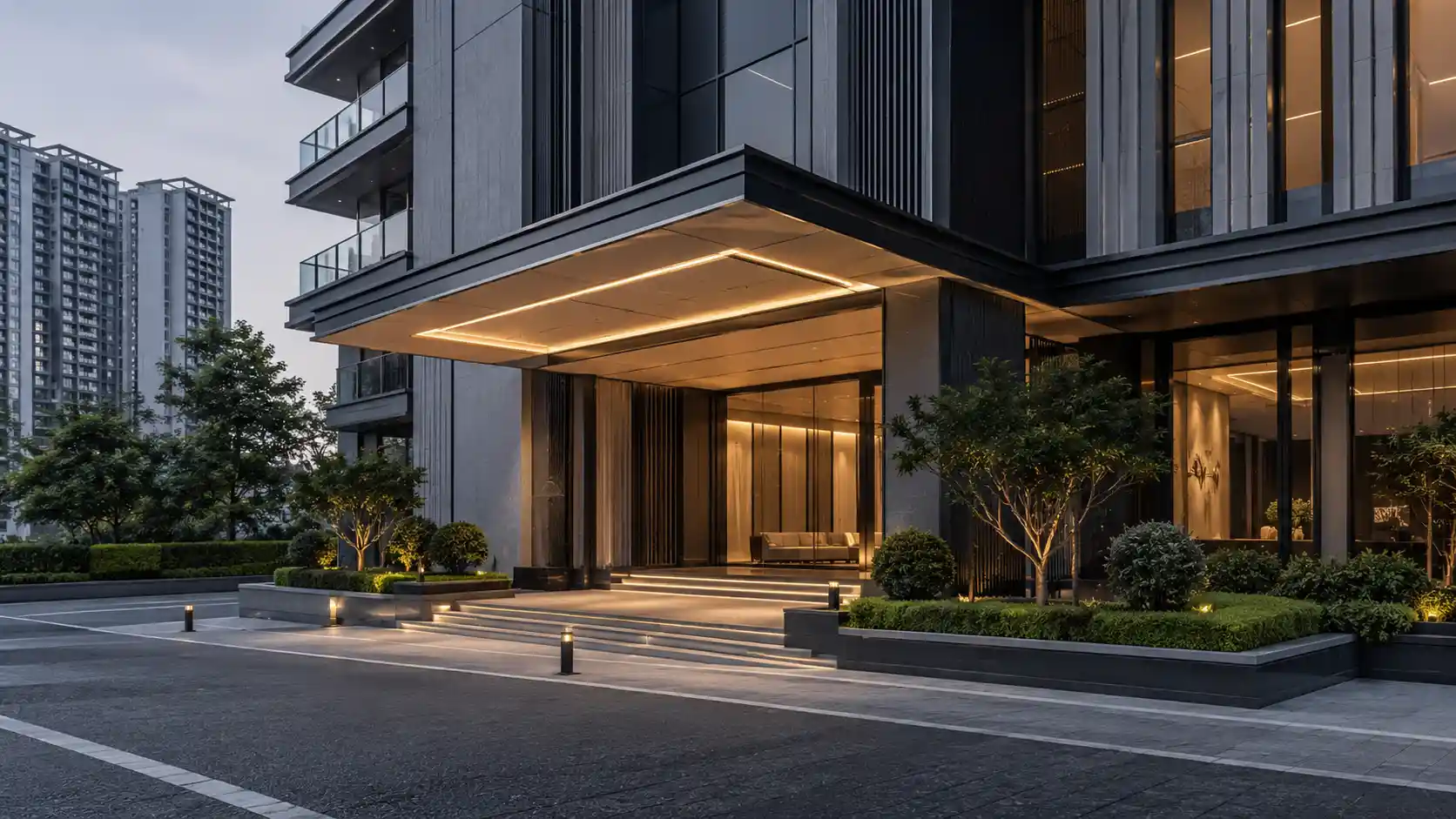
Evaluators, whether it’s a three-person jury or a developer’s internal committee, are reading dozens of proposals in a compressed window. Most of what they remember afterward isn’t the floor plan. It’s the image that made the project feel real.
Three things separate renders that move a vote from renders that just fill a page. First, technical accuracy: materials, massing, and site context that hold up under a second look, not just a first glance. Second, narrative sequencing: a hero shot that establishes the big idea, followed by supporting angles that answer the questions a jury will actually ask (how does it meet the street, how does the entry sequence work, what does it look like at the scale a pedestrian actually experiences). Third, consistency: every board in the submission using the same lighting logic, the same level of material detail, and the same color grade, so the set reads as one confident presentation instead of a patchwork.
Firms that treat renderings as an afterthought, something to generate quickly once the drawings are locked, usually end up with the third problem even when the first two are fine. A render set built without a shared brief and a shared production pipeline drifts in tone from image to image, and a drifting tone reads as a rushed proposal even when the design underneath it is strong.
Haven’t AI-generated renders already commoditized architecture pitch renderings?
This is the real objection, and it’s worth answering directly instead of pretending it isn’t out there. AI image generators can now produce a plausible-looking building render in seconds, and that has genuinely lowered the floor for what counts as “a rendering” in a proposal package. If the bar is just “does it look like a building,” AI tools cleared that bar a while ago.
But a competition or RFP submission isn’t judged against that bar. It’s judged against technical accuracy to the actual design, consistency across a full set of boards, and reliability against a fixed deadline. That’s exactly where AI-generated concept images run out of runway.
| Dimension | Generic AI-generated concept image | Production-grade 3D rendering |
| Design accuracy | Approximates a mood or style. Cannot be traced back to the actual model, massing, or site file. A juror who cross-checks against the drawings will catch the gap. | Built directly from the architect’s 3D model and site data, so every render matches the drawings it’s presented alongside. |
| Consistency across a set | Each generation is a fresh roll: lighting, material tone, and framing shift from image to image. Cannot guarantee a matched hero shot and supporting angles. | One pipeline, one lighting and material setup, applied across every board, so the hero shot and supporting angles read as one presentation. |
| Revisions under deadline | Re-prompting produces a new, unrelated image rather than a controlled edit. Cannot reliably adjust one material or one camera angle without regenerating the whole shot. | Scene-based edits: swap a material, move a camera, adjust a sky, inside a defined revision-round structure tied to the submission date. |
| What it’s good for | Fast internal mood exploration and early design conversations, before a submission is on the table. | Client-facing and jury-facing proposal boards, RFP responses, and any presentation where accuracy and consistency will be checked. |
AI tools haven’t commoditized architecture pitch renderings. They’ve commoditized the low-effort version of them, and made the accurate, consistent, deadline-proof version stand out more, not less, because the gap between the two is now easier for a jury to spot.
How should your rendering strategy change by pitch scenario?
“Architecture proposal” isn’t one thing. A client RFP response, a juried design competition, and an investor pitch each reward a different kind of render set, and using the same approach for all three is a common reason a strong design underperforms in the room.
| Scenario | What the evaluator is checking for | What the render set should prioritize |
| Client RFP response | Can this firm execute on my brief specifically, not a generic version of the project type. | Site-specific accuracy: real context, real neighboring buildings, real material palette tied to the brief. |
| Juried design competition | Does the big idea read instantly, across a room of competing boards seen for seconds each. | One unmistakable hero shot plus a tightly sequenced board layout, prioritizing clarity over quantity of views. |
| Investor pitch | Is this something that will be desirable and sellable once built. The financial case, not the design case. | Lifestyle and amenity framing: people, activity, and finished-product polish that reads as market-ready. |
A single render set built for “architecture proposal” in the abstract usually lands closer to the RFP column by default, which is exactly why it can underperform in a juried competition or an investor room. Know which room you’re walking into before the brief goes to the rendering studio.
Which render types actually move the needle in a proposal set?
Not every project needs the same mix, but a proposal set that’s missing one of these usually feels thin to an evaluator:
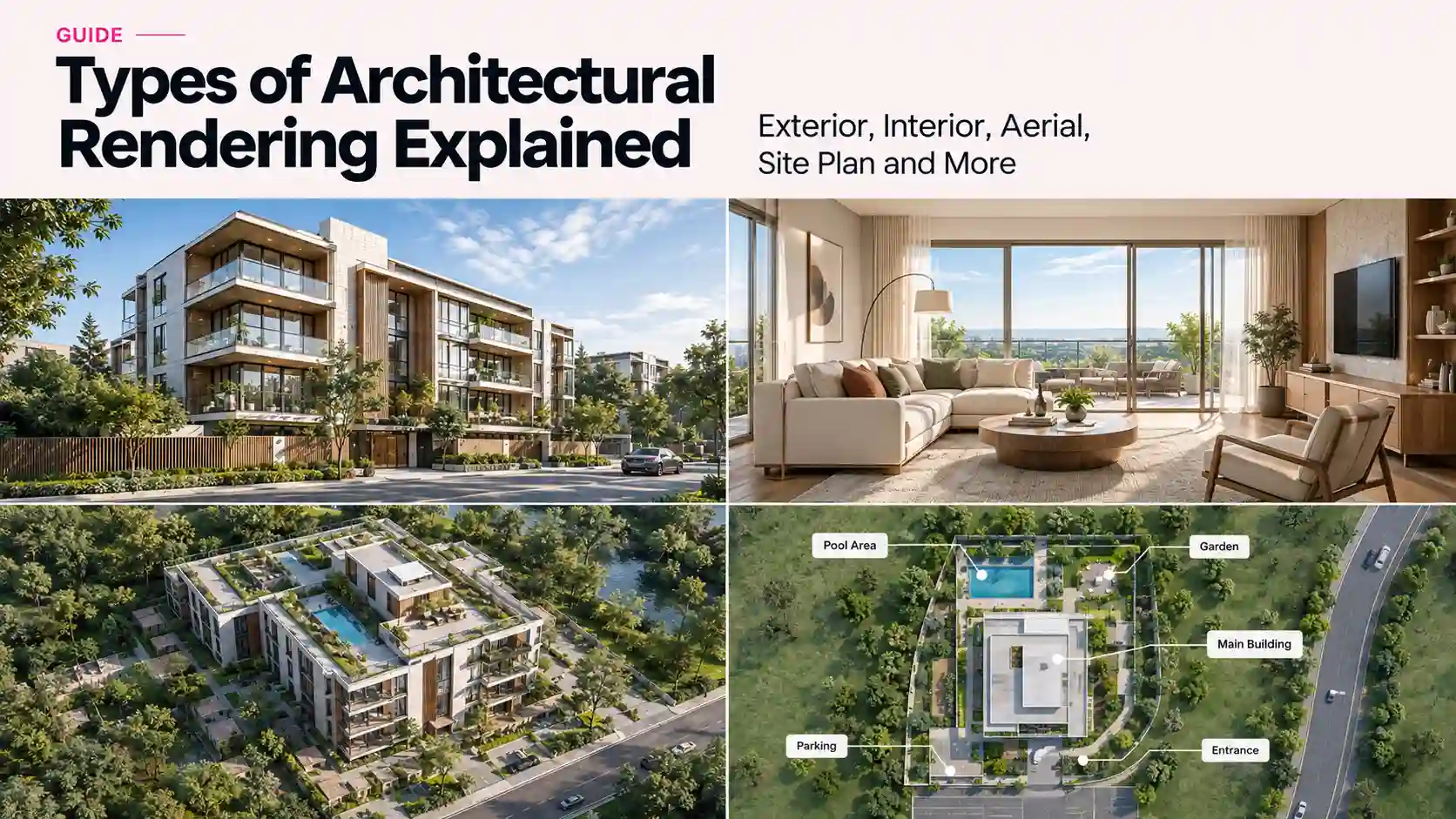
- The hero shot. One exterior or interior image that carries the whole proposal on its own, the image evaluators remember after they’ve closed the deck.
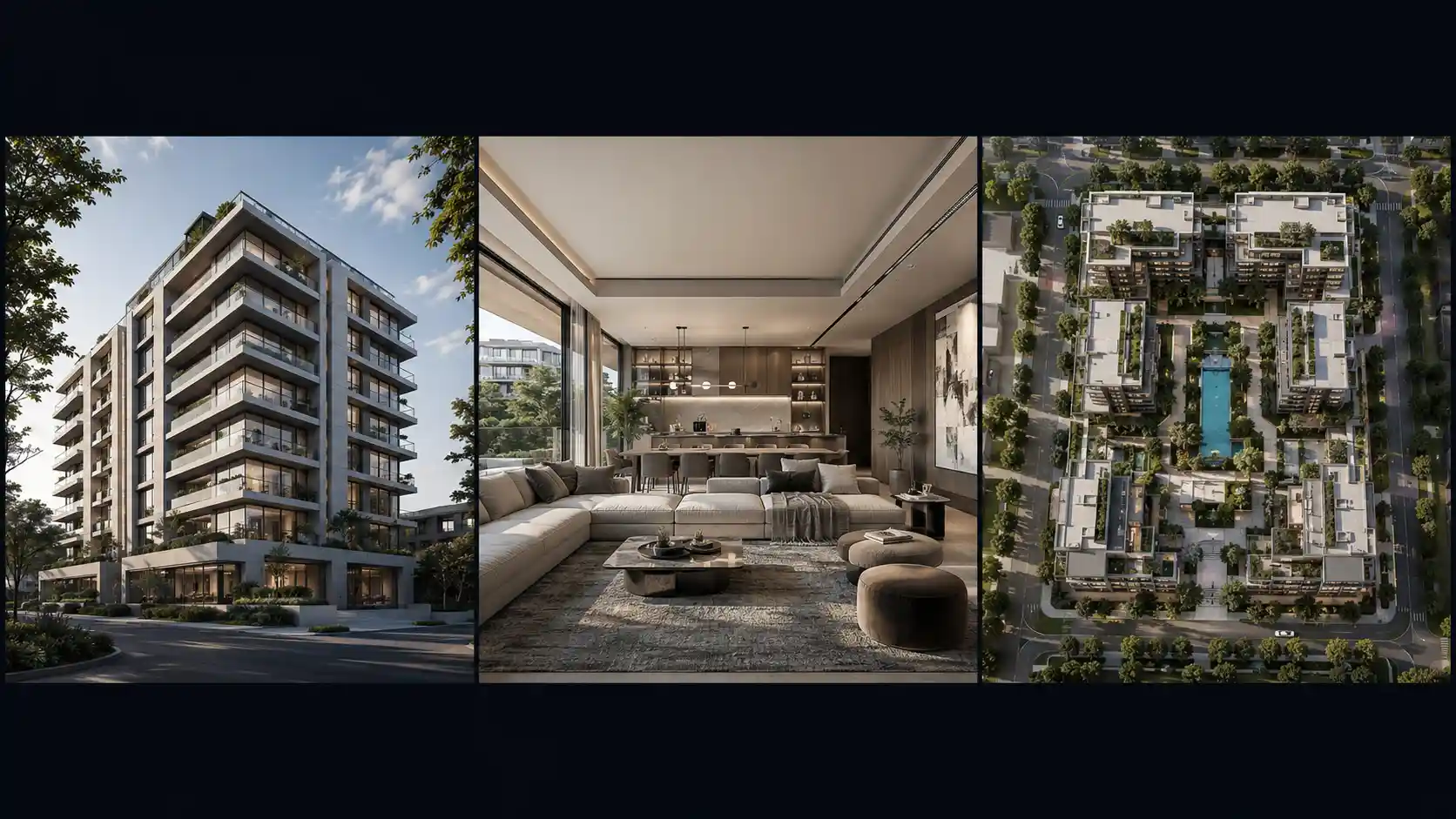
- An eye-level street or entry view. This is what tells a jury the project actually understands how people will experience it, not just how it reads from a drone.
- An aerial or context view. Necessary for masterplan and multi-building submissions, where site relationships matter as much as the building itself.
- Interior views tied to the brief’s stated priorities. A lobby, a key amenity space, or a signature interior moment, whichever the client’s brief actually singles out.
Scale the count to the format, not the other way around. A tight juried competition board often performs better with three precise, well-sequenced views than with eight generic ones competing for attention.
How do you keep deadline reliability and revision rounds under control?
Submission deadlines don’t move for a design that’s still evolving, and that’s the single biggest production risk in a pitch-critical render schedule. A design change two days before submission needs a rendering partner that can absorb a scene-based edit: swap a material, adjust a massing detail, re-time a shadow study, without restarting the shot from scratch.
Build the revision structure into the brief up front, not after the first round comes back. A workable pattern for pitch-critical work: define exactly how many revision rounds are included per image, agree turnaround per round before the brief is sent, and flag which views are locked versus still-in-motion so the studio can prioritize accordingly. Firms that skip this step tend to find out about it during the worst possible week: the one right before the deadline.
This is also where render capacity that scales matters more than render capacity that’s merely available. A firm juggling three simultaneous submissions needs a production partner that can take on a second or third project in parallel without every queue backing up onto the same deadline. Archvizly’s own architectural visualization services are built around exactly that kind of parallel capacity.
What belongs on a vendor-selection checklist for pitch-critical renders?
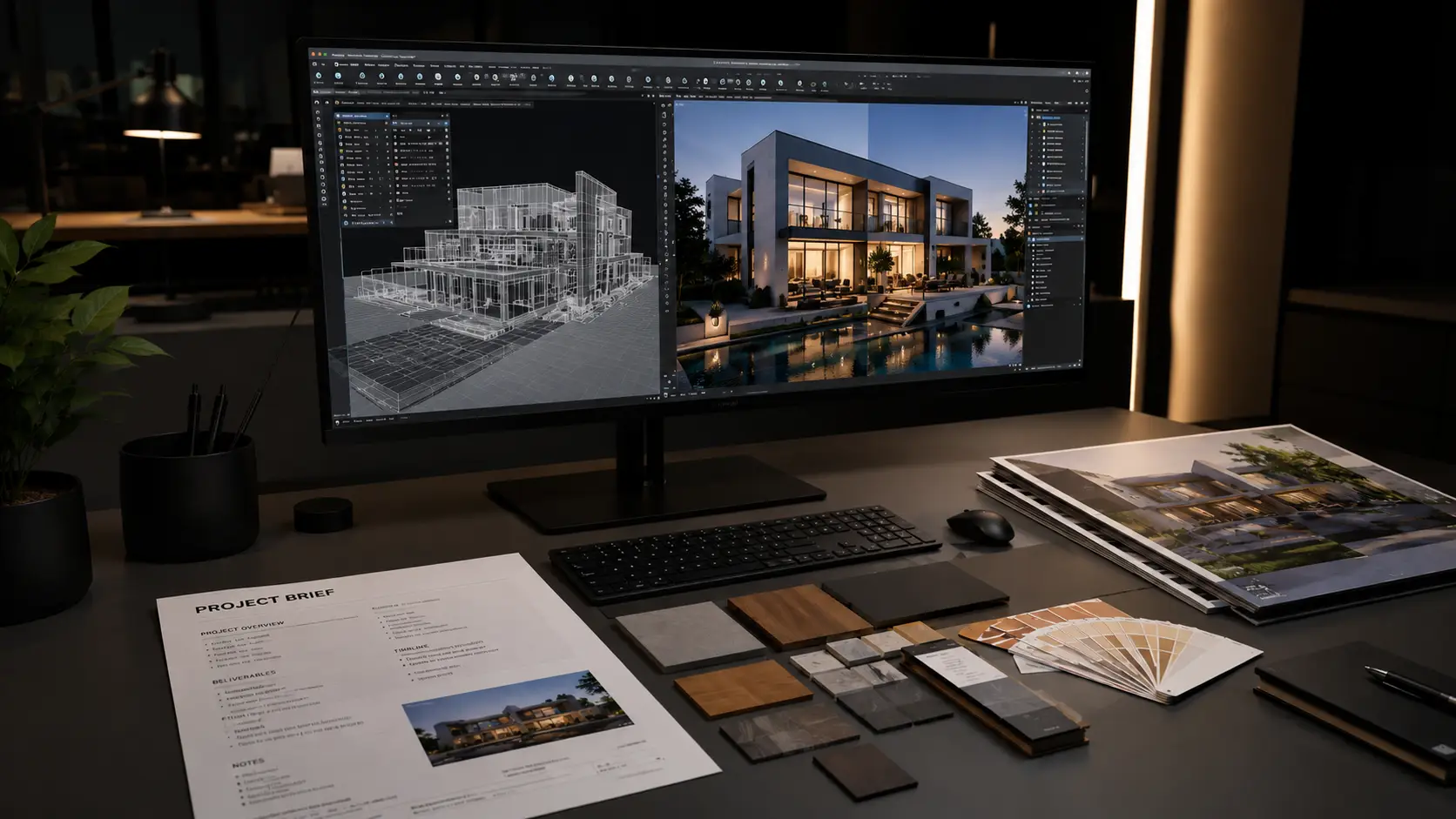
Choosing a rendering partner under deadline pressure is a different decision than choosing one for a marketing campaign with a flexible timeline. Before committing budget, confirm:
- Can they work directly from your 3D model and site files, rather than starting from reference images alone?
- What’s their standard turnaround per view, and does that timeline actually fit your submission date with buffer for revisions?
- How many revision rounds are included, and what happens if the design shifts mid-production?
- Can they hold one consistent lighting and material style across a full board set produced by more than one artist?
- What file formats do they deliver? JPEG and PNG for boards, EXR for post-production flexibility, MP4 for any walkthrough component.
- Do they have spare production capacity if your firm has more than one submission due the same month?
Two Archvizly resources go deeper on exactly this evaluation: the Vendor Vetting Checklist for Architectural Visualization walks through the full set of questions to ask before handing off a project, and the 3D Rendering Brief Checklist covers exactly what to send a studio so the first draft comes back close to final, which matters even more when there’s no time for a wasted round.
What mistakes sink otherwise-strong proposals?
A strong design can still lose on presentation. The recurring pattern:
Briefing the rendering studio too late, so the render set gets rushed instead of sequenced. Sending a brief with no reference for lighting mood or material priority, which forces the studio to guess and burns a revision round on corrections that could have been avoided. Mixing render styles across boards because two different freelancers or tools were used to hit the deadline. And treating renders as the last line item instead of part of the proposal strategy, decided in the final week instead of planned alongside the written response.
None of these are design problems. They’re production-planning problems, and they’re the ones a clear brief and a reliable partner solve before they ever reach the jury. The guide to vetting a visualization partner covers how to spot these risks before signing off on a vendor.
FAQ
What is the difference between architecture pitch renderings and standard marketing renders?
Pitch renderings are produced before a commission is won, under a fixed submission deadline, and judged for accuracy against a design that may still be evolving. Marketing renders come after, once the design is locked, and are optimized for a sales gallery or launch campaign rather than a jury.
Do AI-generated renderings hurt or help an architecture proposal?
Used for early internal mood exploration, they can help speed up design conversations. Used as the final submission images, they typically hurt. A jury cross-checking accuracy and consistency across a board set will notice the gaps that come from an unrelated, un-modeled image.
How many renderings does a competition submission actually need?
Enough to establish one clear hero shot plus the specific supporting angles the brief calls for, often three to six images for a tightly sequenced board, more for a multi-building masterplan submission.
What’s a reasonable turnaround for renderings tied to a submission deadline?
It depends on view complexity and revision count, but a production partner should be able to state a specific turnaround per view before work starts, not after. That number is what your submission calendar gets built around.
Should exterior or interior renders come first in a pitch package?
Whichever one the brief’s stated priority is. For most competition and RFP formats, the exterior hero shot leads because it’s the image evaluators register first, with interior views supporting the specific spaces the brief calls out.
How many revision rounds should be built into a pitch-critical rendering schedule?
Define the number before the brief goes out, not after the first draft comes back, and confirm what happens if the design itself shifts mid-production, since that’s a different situation than a stylistic revision.
What file formats should a rendering partner deliver for a proposal?
JPEG or PNG for presentation boards, EXR for any post-production color or lighting flexibility, and MP4 if a walkthrough or animated sequence is part of the submission.
How do you brief a rendering studio for a time-sensitive competition entry?
Send the 3D model or site files directly, reference images for lighting and material mood, the specific views the brief requires, and the hard submission date up front. See the 3D Rendering Brief Checklist for the full list.
What’s the difference between a hero shot and a presentation board?
The hero shot is a single standout image. A presentation board is the full page layout: hero shot, supporting views, and often plans or diagrams, arranged as one cohesive sheet for a jury or client to review.
Can the same render set be reused across an RFP and a later marketing campaign?
Often yes for the core hero shot, though a marketing campaign usually needs additional lifestyle and amenity framing that a competition-focused set doesn’t prioritize.
How do you evaluate a rendering vendor before a pitch deadline?
Check their turnaround per view, revision structure, ability to work from your model directly, and available capacity. The Vendor Vetting Checklist covers this in full.
What should go/no-go qualification look like before committing rendering budget to a pitch?
Confirm the submission date, the required view count, and vendor capacity all line up before the brief is sent. Qualifying the production plan is as important as qualifying the opportunity itself.
A proposal deadline isn’t the moment to find out your rendering partner can’t scale. Start a project with a team built for pitch-critical timelines: model-accurate renders, one consistent style across the full board set, and revision rounds that hold even when the design is still moving.