

Search “how long does 3D rendering take” and you get four different answers. Three to seven days. One to two weeks. Two to four weeks. Someone on Reddit says two days. They are all telling the truth, and none of them are counting the same thing.
That is the whole problem.
How long 3D rendering takes depends on three separate clocks running at once: studio production time, machine render time, and your own review time. Most published timelines quote only the first, which is why a project sold as five days routinely lands on day nine.
So, how long does 3D rendering take? A single still image typically takes three to seven business days end to end. An architectural animation takes three to eight weeks. But those figures move enormously depending on how complete your brief is and how fast you turn feedback around, and one of those two variables is entirely yours.
Your deadline is mostly in your hands.
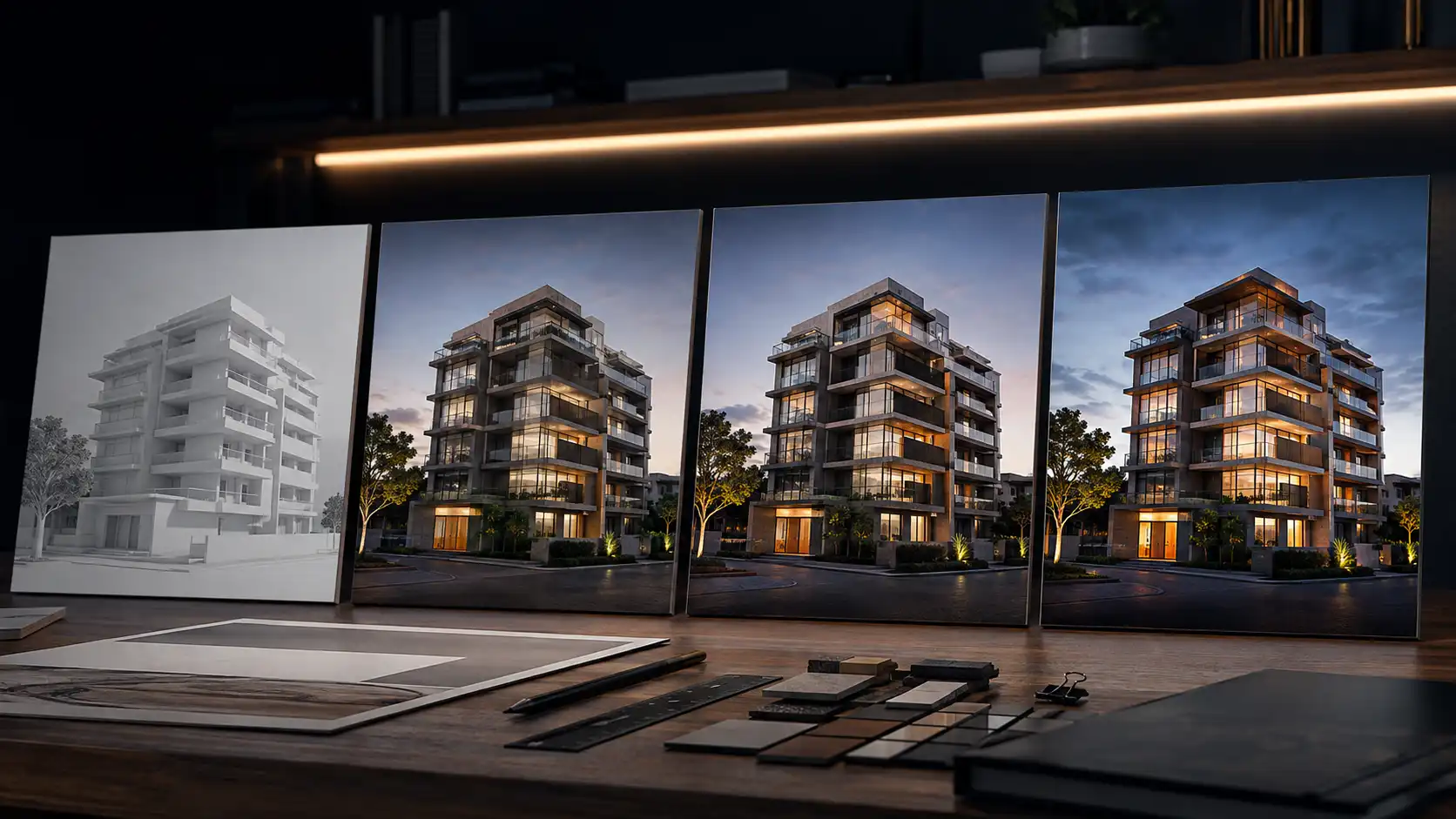
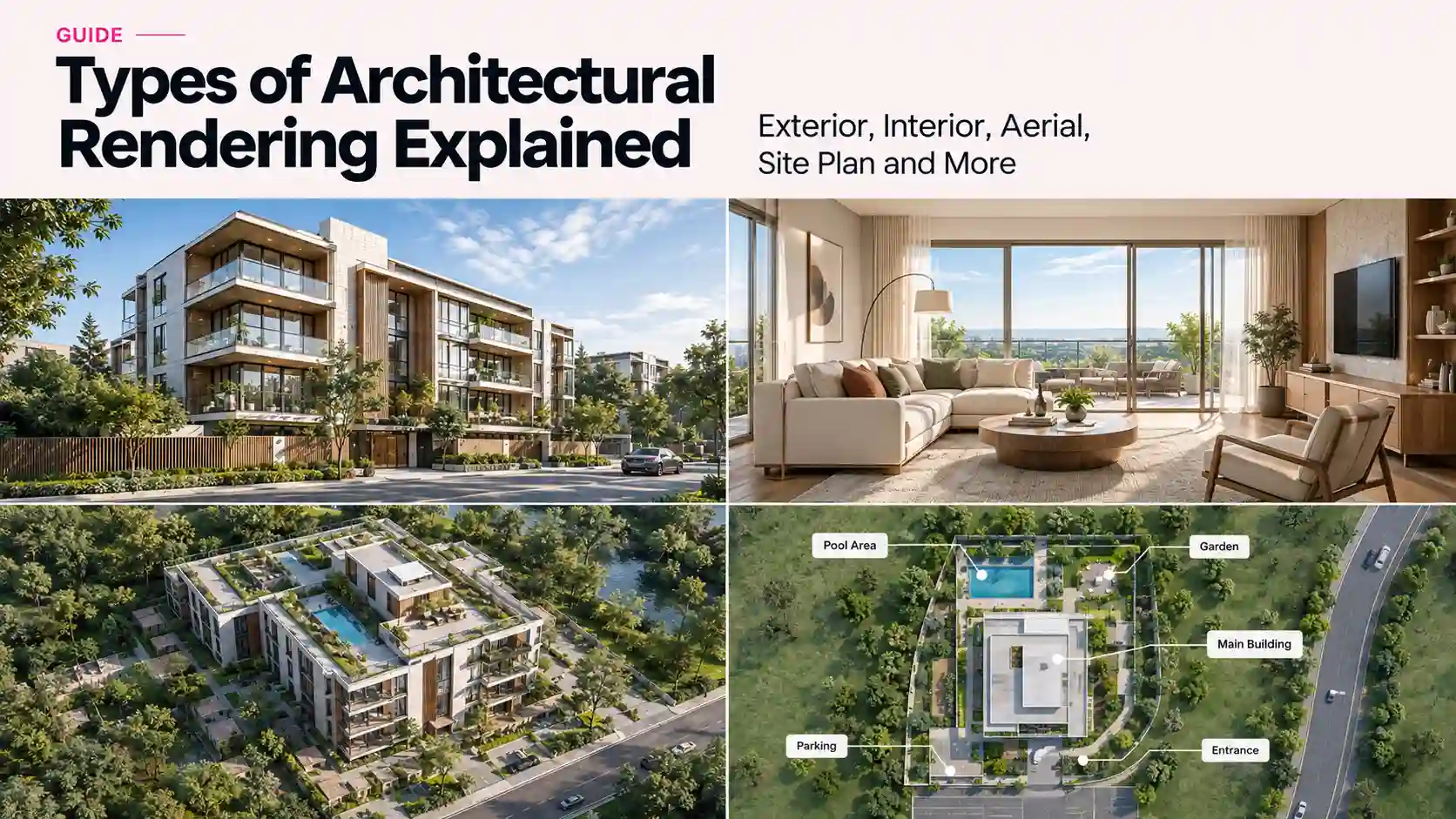
How long does 3D rendering take, by project type?
These are end-to-end working-day ranges including one round of revisions, which is how a client experiences the project rather than how a studio logs it.
Read the third column with suspicion. Rush delivery is real, but it is bought with parallel staffing and premium render capacity, and it removes almost all of your revision room.
| Project type | Typical timeline | Rushed | What drives the range |
| Single interior room | 2 to 3 days | 24 hours | Furniture count and material complexity |
| Interior set, 3 to 5 views | 4 to 7 days | 2 to 3 days | Consistency across views, not view count |
| Single residential exterior | 3 to 5 days | 1 to 2 days | Landscaping and site context detail |
| House, full package of 5 to 8 views | 5 to 10 days | 3 to 5 days | Interior and exterior in one style |
| Commercial or mixed-use building | 1 to 3 weeks | 5 to 7 days | Facade complexity and surrounding context |
| High-rise or tower | 2 to 3 weeks | 7 to 10 days | Massing, glazing behaviour, aerial context |
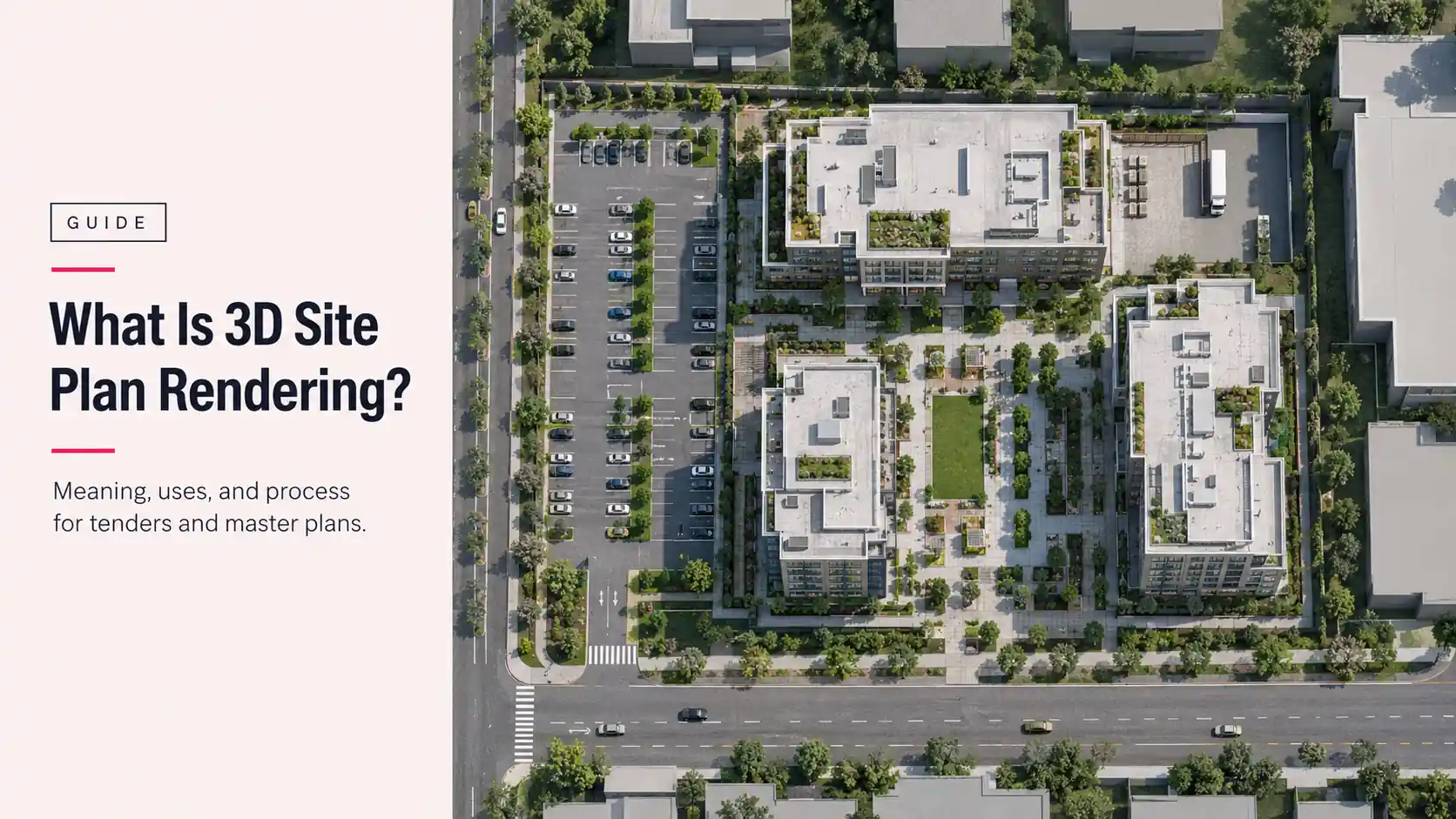
| Masterplan or site plan | 2 to 4 weeks | 10 to 14 days | Area covered and level of detail required |
| 360 panorama or virtual tour | 1 to 2 weeks | 5 to 7 days | Full-sphere detail, nothing can be cropped out |
| Animation, 30 to 60 seconds | 3 to 8 weeks | 2 to 3 weeks | Frame count and render farm capacity |
Ranges compiled from published 2026 timeline guides by ArchiCGI, Rendimension, JS Engineering and Los Angeles Rendering. Named for attribution but not linked, since they are direct competitors. Treat these as market norms rather than a quote.
Where does the time actually go?
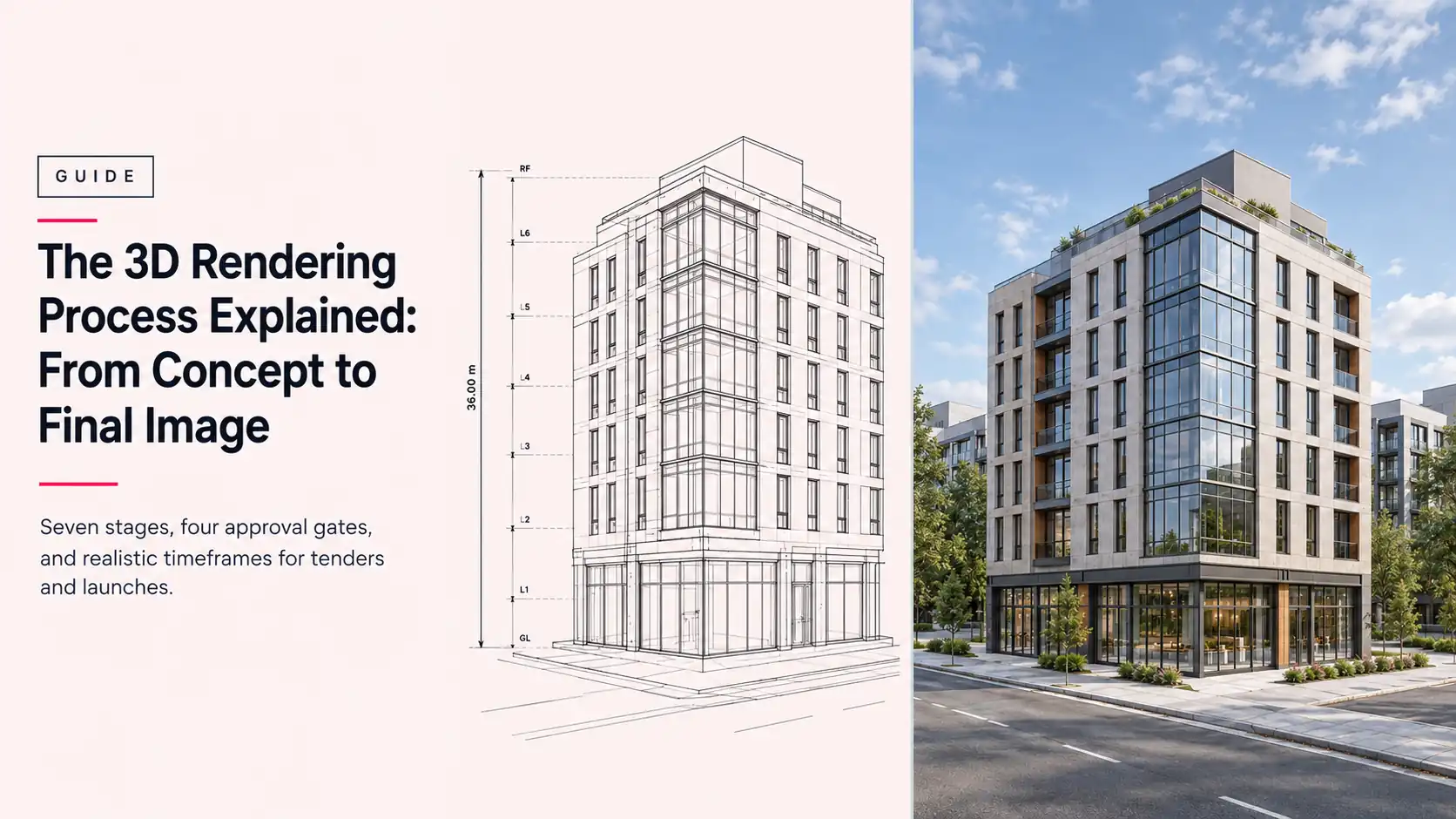
Almost nobody breaks this down, which is precisely why the estimates confuse people. Here is a nominal five-day single exterior still, phase by phase, with the responsible party named.
| Phase | Typical duration | Who holds it | What happens if it slips |
| Brief intake and file check | 2 to 4 hours | Studio | Wrong units or missing textures found here cost hours, not days |
| Model import and cleanup | 0.5 to 2 days | Studio | An unpurged or badly exported file can double this |
| Camera, lighting, material setup | 1 day | Studio | Vague material specs push this into guesswork |
| Draft render and internal QA | 0.5 day | Studio | Mostly machine time. Runs overnight |
| YOUR REVIEW | 1 to 3 days | You | The single largest uncounted block in most projects |
| Revision round | 1 to 2 days | Studio | Unbatched feedback multiplies this |
| Final high-resolution render | 0.5 to 1 day | Studio | Machine time. Scales with resolution, not effort |
| Post-production and delivery | 0.5 day | Studio | Colour, sky, people, final format checks |
Add the studio-side phases and you get roughly four to five working days. Add a client review that takes three days instead of one and the same project is now a working week and a half.
The studio did not get slower. The clock just included you.
This is why briefing quality shows up as speed. A complete 3D rendering brief collapses the intake, cleanup and setup phases, and it removes most of the reason for a second revision round. The fastest projects are almost never the ones with the biggest budget. They are the ones with the clearest brief.
Why do published timelines contradict each other?
Four reasons, and once you know them the contradictions stop being confusing.
- Some count business days, some count calendar days. A five business day project spanning a weekend is a seven day wait. Studios quote the first, clients experience the second.
- Some include client review, some do not. This is the biggest single discrepancy. A studio quoting production time only is not lying, but it is describing a different measurement.
- Some assume a finished model is supplied. If the studio has to build the model from drawings, add days. Sometimes many days.
- Some quote first draft, some quote final files. First draft can arrive in two days on a project whose final approved files land on day nine.
When you receive a quote, ask which of those four the number describes. Any competent studio will answer immediately.
How long does architectural animation take?
Animation follows different physics, because the constraint is arithmetic rather than artistry.
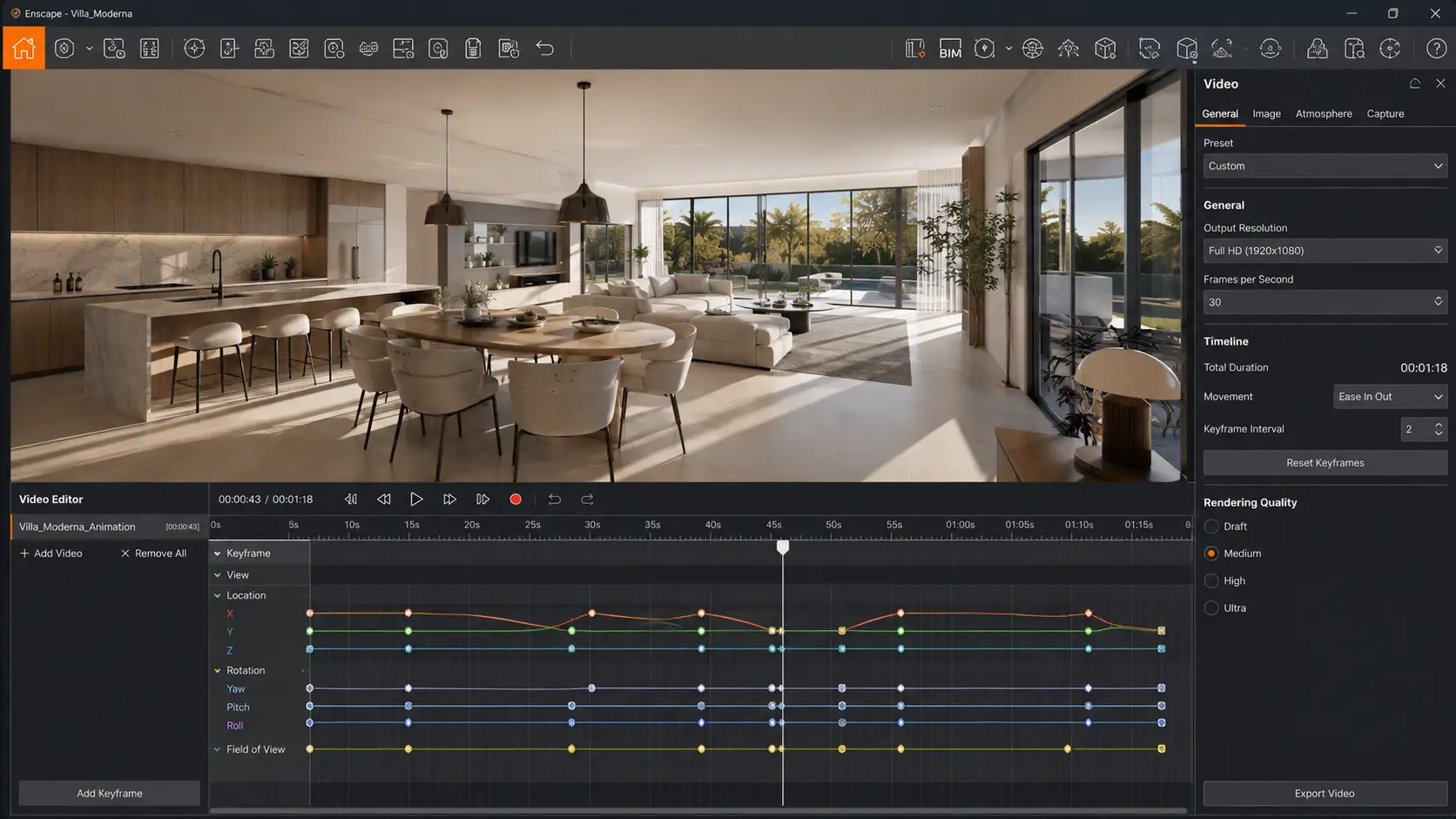
A 60 second walkthrough at 30 frames per second is 1,800 individual images. Each one has to render. At a modest 30 minutes per frame, that is 900 hours of pure machine time, which is about 37 and a half days of continuous rendering on a single workstation.
That is why render farms exist.
Distributing those frames across a render farm cuts the wall-clock time to hours or days rather than weeks. Ranch Computing puts a 10 second HD animation at 300 frames and 2 to 30 hours on a local machine, which scales predictably upward with length and resolution. The render itself is rarely the bottleneck on a professional project. Camera choreography, asset build and review cycles are.
Note that production time does not scale linearly with length. A 60 second film is not twice the work of a 30 second one, because the camera choreography and asset build largely happen once.
| Animation length | Frames at 30fps | Realistic production time | Rushed |
| 10 seconds | 300 | 2 to 3 weeks | 7 to 10 days |
| 30 seconds | 900 | 3 to 5 weeks | 2 weeks |
| 60 seconds | 1,800 | 4 to 8 weeks | 2 to 3 weeks |
| 90 seconds or more | 2,700+ | 6 to 12 weeks | Rarely advisable |
The honest planning rule for animation: decide your final cut length before production starts. Changing it mid-project is not an edit, it is a re-render.
What actually controls your timeline?
Six factors, split by who controls them. The split matters more than the list.
Four of the six sit on your side of the table. That is not a complaint. It means most of the schedule is genuinely yours to control.
| Factor | Effect on timeline | Who controls it |
| Brief completeness | Can swing a project by 2 to 4 days | You |
| Speed of your feedback | Adds 1 to 3 days per round | You |
| Whether feedback is batched | Unbatched can triple review cycles | You |
| Quality of the source model | 0.5 to 2 days of cleanup | You |
| Scene complexity and view count | Scales roughly linearly | Shared |
| Render capacity and staffing | Determines rush capability | Studio |
Render settings matter less than most people assume for still images. Chaos, the company behind V-Ray, documents the quality versus render time trade-off in detail, and the practical takeaway is that a competent studio has already tuned this. Sampling and noise thresholds change hours. Briefing and feedback change days.
Can you get renders faster?
Yes, usually, and it costs money in one of three currencies.
You pay in cash, through rush pricing that typically runs 25 to 50 percent above standard and funds parallel staffing plus priority render capacity. You pay in revision room, because a compressed schedule leaves space for one round rather than two or three. Or you pay in scope, by cutting view count, dropping a season variant, or accepting a simpler treatment of landscaping and context.
Most rush projects pay in all three without realising it. The cash component typically runs 25 to 50 percent above standard, which is one of the cost drivers we cover in detail once our full architectural rendering cost breakdown is live.
What genuinely cannot be compressed is the model build on a project with no supplied geometry. If a studio has to model a building from PDF elevations, that time is real and no amount of budget removes it. Everything downstream can be parallelised. That cannot.
Speed is bought, not summoned.
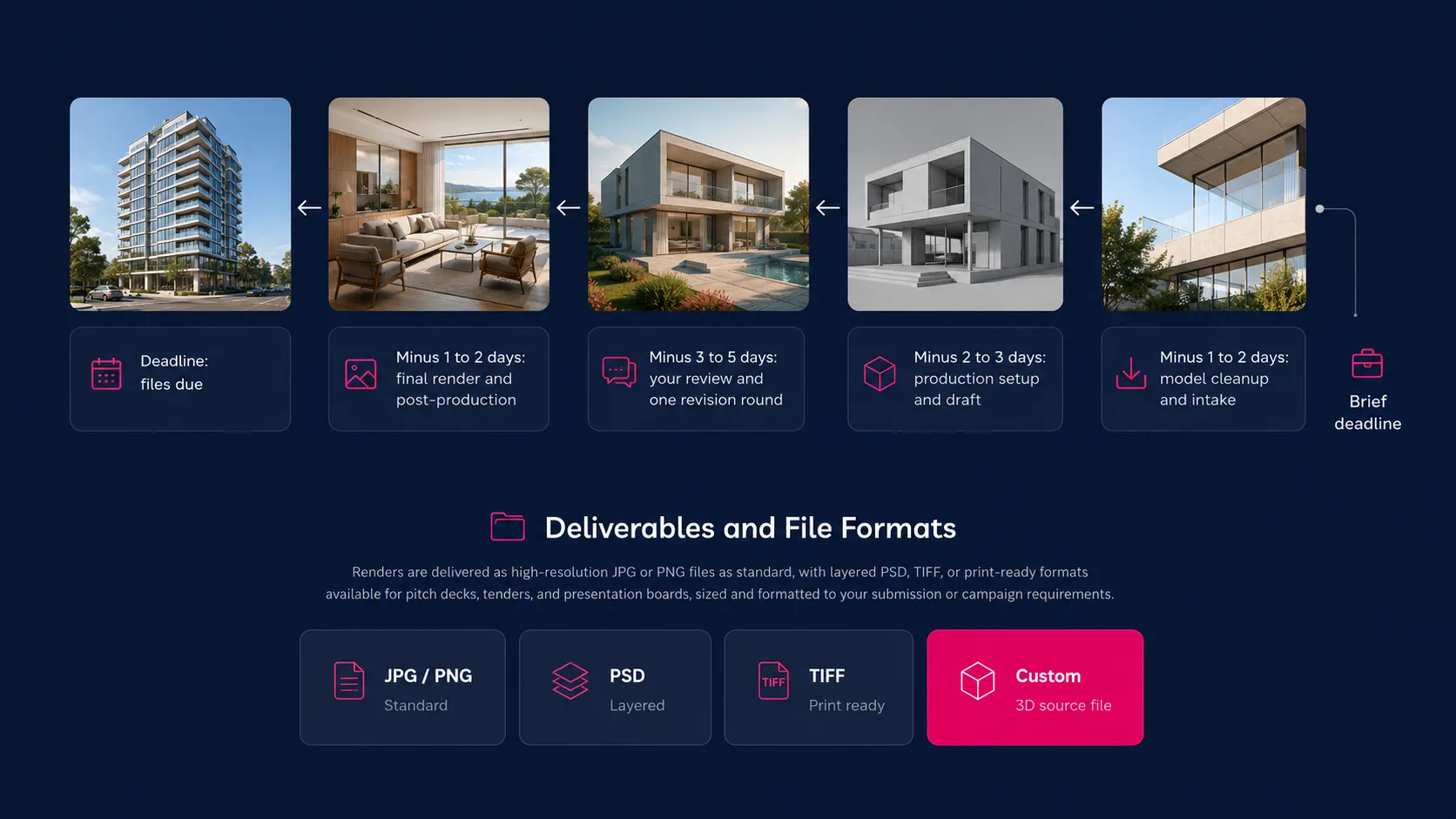
How do you plan backwards from a hard deadline?
Tenders and launch dates do not move. Work back from them rather than forward from today.
- Fix the date the finished files must be in your hands. Not the submission date. The date you need them, which should sit at least two days earlier.
- Subtract post-production and final render: 1 to 2 days.
- Subtract your own review and one revision round: 3 to 5 days. Be honest about how fast your stakeholders actually respond.
- Subtract production setup and draft: 2 to 3 days for a still, considerably more for animation.
- Subtract model cleanup and intake: 1 to 2 days, or more if the studio is modelling from drawings.
- The date you land on is your brief deadline. Send everything by then, complete, in one go.
For a single exterior still against a hard date, that usually means the brief needs to leave your desk 8 to 10 working days beforehand. For an animation, 6 to 10 weeks.
The American Institute of Architects makes the same point about owner-architect agreements: the schedule for providing services belongs in writing alongside the scope. A visualization timeline is the same instrument at smaller scale.
| Working to a tender or launch date? Send the date first and we will work backwards with you. Book a scoping call |
What are the challenges and limitations?
Every timeline in this article assumes the design has stopped moving. If the facade is still being resolved, no schedule survives, because a design change is a re-model rather than a revision and it resets the clock rather than nudging it.
Rush work also carries a quality ceiling nobody advertises. Compressed schedules mean fewer iterations on lighting and composition, which are exactly the things that separate a render that sells units from a render that merely documents a building. A 24 hour turnaround is technically possible on a simple interior. It will not be the best image that model could have produced.
And timelines quoted anywhere, including here, assume the studio has capacity when you call. A studio at full load in launch season has a different first-available date than the same studio in a quiet month, and that has nothing to do with how long the work takes.
Ask for a start date, not just a duration. It is one of the ten questions that separate a reliable studio from a risky one.
How Archvizly handles timelines
Archvizly works as a white-label production partner for architects and design firms, real estate developers, interior designers, construction firms, hospitality brands and property marketing agencies. We quote a start date and a delivery date, not a duration, because a duration without a start date tells you nothing useful about whether you will make your tender.
File review happens before quoting. If the model arrives in the wrong units, sitting kilometres from the origin, or missing its texture folder, you hear about it on day one while it still costs hours rather than days.
Revisions inside the agreed brief are flat-priced, which removes the incentive to ration feedback near a deadline. You can read how that works in our guide to rendering revisions and what counts as new scope. For overflow and launch work, that combination is what makes a date hold: a clear brief, a fixed scope, and no argument about revisions in the final week.
Frequently asked questions
How long does 3D rendering take?
A single still architectural rendering typically takes 3 to 7 business days end to end, including one revision round. Interior rooms can land in 2 to 3 days, commercial buildings run 1 to 3 weeks, and animations take 3 to 8 weeks. The range depends heavily on brief completeness and how quickly you return feedback.
Why do rendering studios quote such different timelines?
Because they measure different things. Some quote business days and some calendar days. Some include your review time and some count only studio production. Some assume you supply a finished 3D model while others include modelling from drawings. Ask which of those a quote describes.
How long does a single interior render take?
Two to three business days for a straightforward room, and 24 hours is achievable at rush pricing. Furniture count and material complexity drive the range more than room size does. A detailed kitchen takes longer than a large empty living space.
How long does an architectural animation take?
Three to eight weeks for a 30 to 60 second walkthrough. A 60 second film at 30 frames per second is 1,800 individual frames, each of which has to render. Production time does not scale linearly with length, because camera choreography and asset build largely happen once.
Why does animation take so much longer than stills?
Arithmetic. At 30 minutes per frame, a 1,800 frame animation is 900 hours of machine time, roughly 37 days of continuous rendering on one workstation. Render farms distribute those frames to cut wall-clock time, but the asset build and camera work still take weeks.
Can I get a rendering in 24 hours?
For a simple interior with a supplied model, usually yes at rush pricing. Expect to pay 25 to 50 percent above standard, and expect one revision round rather than two or three. Complex exteriors and anything requiring modelling from scratch cannot compress that far.
What slows a rendering project down the most?
Client review time and incomplete briefs, in that order. Review is the single largest uncounted block in most schedules, often adding 1 to 3 days per round. An incomplete brief adds 2 to 4 days by pushing guesswork into the setup phase.
Does the studio’s computer speed affect my deadline?
Less than people assume for still images. Final render is typically half a day to a day of machine time that runs overnight. Setup, revision and review dominate the schedule. Hardware matters far more for animation, where frame count makes render time the binding constraint.
How far in advance should I brief a studio before a tender?
Eight to ten working days for a single exterior still, and 6 to 10 weeks for an animation. Work backwards from the date you need files in hand, not the submission date, and leave at least two days of buffer before submission.
Does a better brief actually make it faster?
Yes, measurably. A complete brief collapses the intake, cleanup and setup phases and removes most of the reason for a second revision round. It commonly saves 2 to 4 days on a still image project, which is often the difference between making a deadline and missing it.
What happens to the timeline if the design changes mid-project?
It resets rather than slips. A design change means re-modelling, which sends the project back to an early phase, so it should be re-quoted as new work rather than absorbed as a revision. Flag design instability before production starts.
Can multiple views be produced in parallel?
Yes, and this is why a package of 5 views does not take 5 times as long as one. The model, materials and lighting are built once and reused across cameras. A 5 to 8 view house package typically runs 5 to 10 days rather than the 15 to 35 that sequential production would imply.