
A studio I worked with lost a hospital tender three years ago because their in-house 3D artist got sick for four days, right before submission. Nobody had a backup plan. The firm that won had weaker architecture, but their renders showed up on time.
An architectural rendering company is a production studio that converts CAD files, drawings, or physical references into photorealistic still images, animations, and virtual tours, and delivers them on a schedule a design team can actually plan around, to help architects, developers, and marketing teams win approvals, tenders, and buyers without staffing a permanent visualization department.
That’s different from a freelancer picking up gigs between projects, or a single in-house hire doing one job at a time. A rendering company runs the work like a production line, with a project manager, quality control, and enough bench depth that one person’s flu doesn’t blow your deadline.
The “architectural” part matters specifically because building geometry, material accuracy, and site context carry legal and sales weight that product or game rendering doesn’t. A wrong window mullion or an inflated tower height can sink a planning approval, not just look sloppy.
(Product studios and game studios also call themselves “3D rendering companies.” This guide is about the architecture and real estate side specifically.)
The real value isn’t any single render. It’s repeatability: the same studio producing your next fifty renders at the same quality, on the same week-over-week cadence, without you rebuilding a team from scratch every time.
Consistency is the product.
What is an architectural rendering company?
An architectural rendering company takes a design that only exists as lines, layers, and specifications, and turns it into something a client, a planning board, or a buyer can actually picture themselves standing inside.
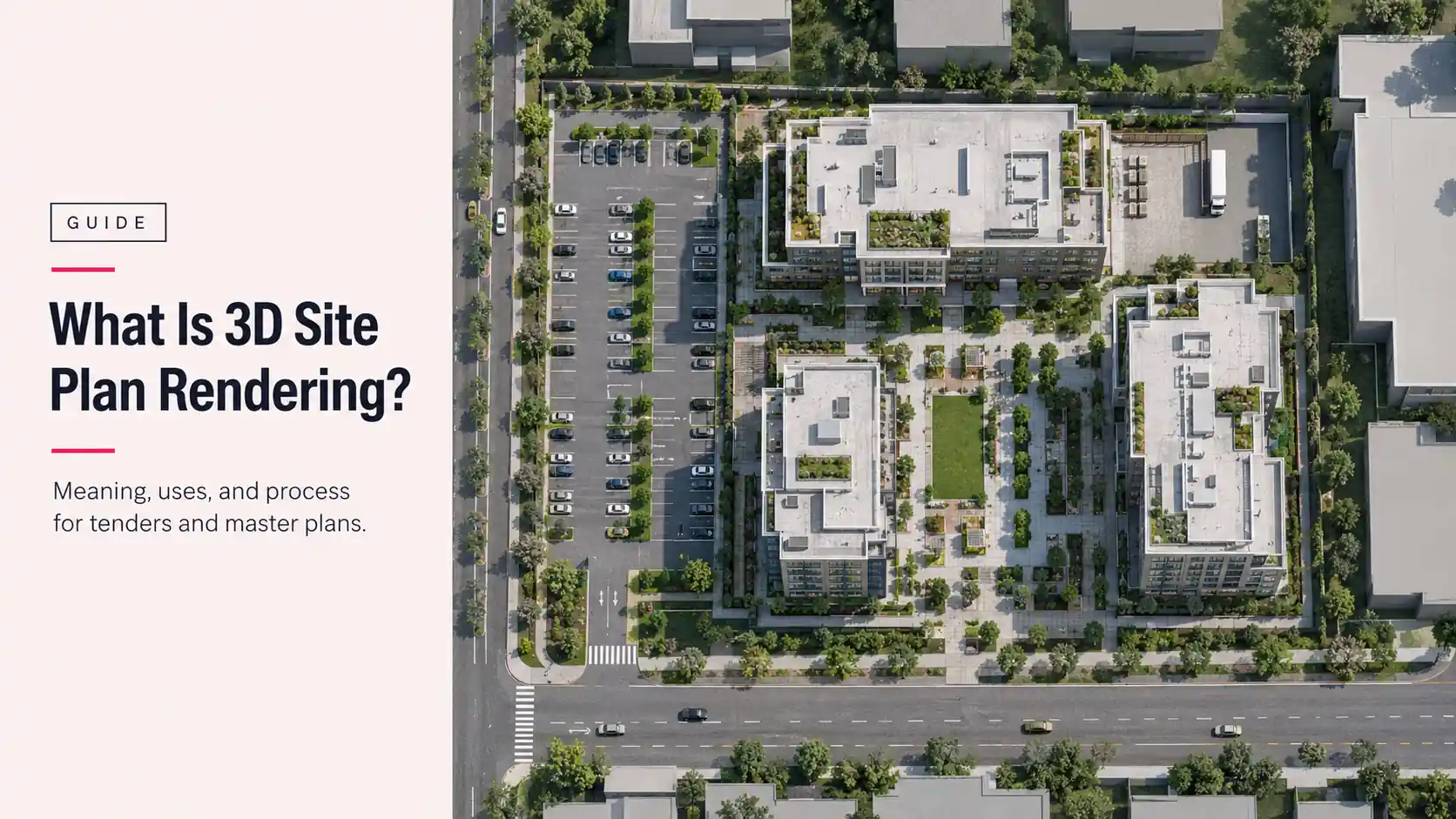
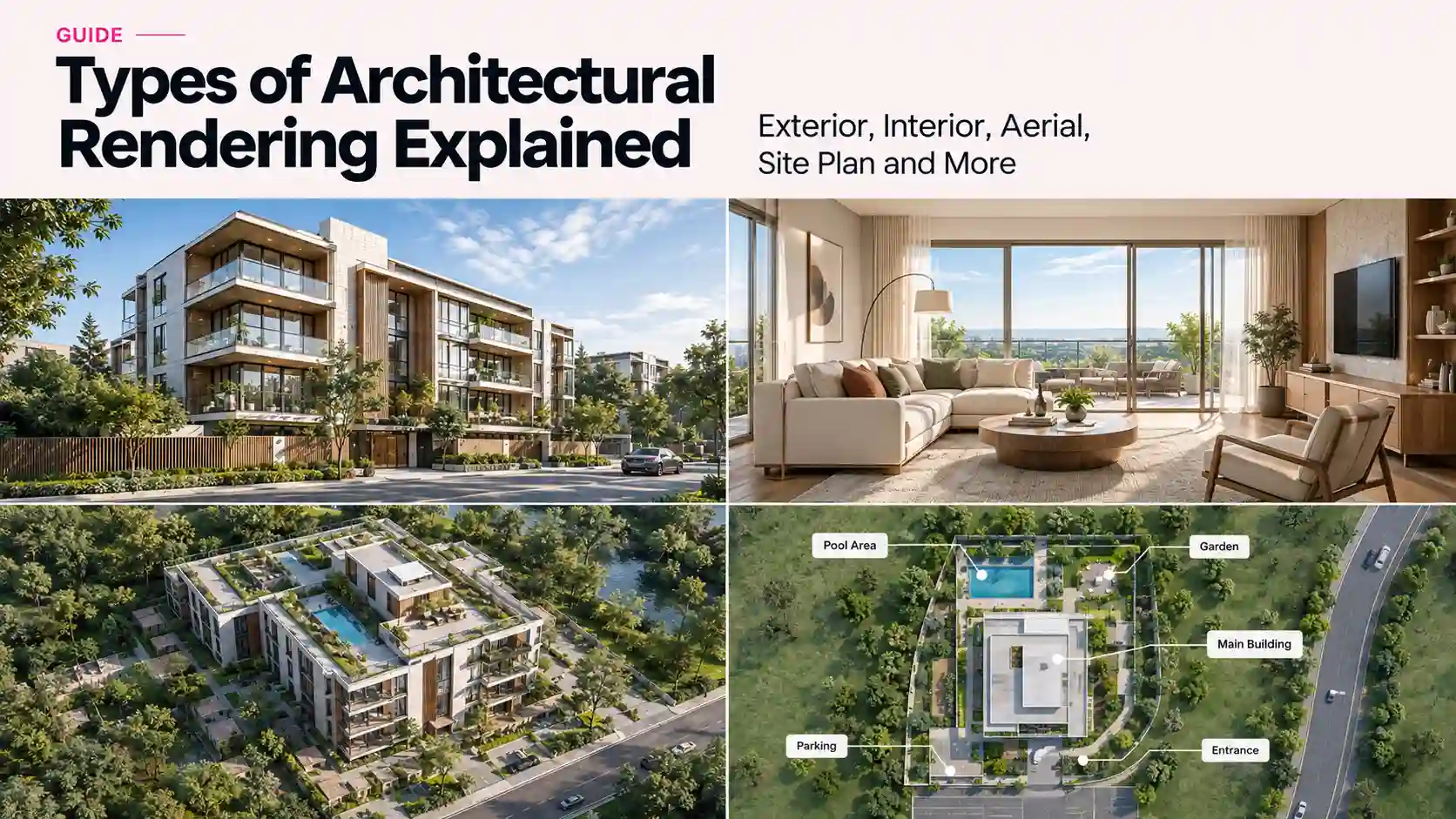
Most studios split into two tracks. One is stills: single photorealistic images of a building’s exterior, an interior room, a site plan, or an aerial view, priced and delivered per image. The other is motion: architectural animations, walkthroughs, and 360-degree virtual tours, which take longer and cost more because every frame has to hold up, not just one angle.
Some studios only do one track. The larger, more established ones do both, plus virtual staging and photomontage for real estate marketing on top.
Scope first, then vendor.
Why do architects and developers outsource rendering instead of hiring in-house?
Three reasons come up in almost every conversation about this: deadlines, cost, and consistency.
Tender and competition deadlines don’t move. A design team that wins a bid needs renders ready for submission day, not whenever the internal queue clears. Outsourcing gives a firm access to a production team that flexes around a launch date instead of a fixed headcount.
Then there’s the math on hiring. A mid-level 3D visualizer in the US carries a median salary around $95,000 a year, before software licenses, hardware, and management overhead. Unless a firm is producing renders constantly, that’s a lot of fixed cost sitting idle between projects.
Outsourcing to a studio outside the US, particularly in Eastern Europe or South Asia, can bring comparable quality for close to half the price, mostly because of labor cost differences rather than lower standards.
None of that makes outsourcing automatically correct. A firm producing renders every single week might genuinely be better off hiring. But for most architecture practices, developers, and agencies, the workload is lumpy: heavy before a submission, quiet after.
Lumpy workload favors a partner over a hire.
How much does architectural rendering cost in 2026?
Pricing varies more than most people expect, mostly because “a rendering” can mean a $250 still or a $10,000 photorealistic hero shot of a tower. The table below breaks out what drives that range by project type.
| Rendering type | Typical price (per image) | Typical turnaround |
| 3D interior rendering, residential | $250 – $2,000 | 3–7 days |
| 3D interior rendering, commercial | $450 – $2,500 | 5–10 days |
| 3D exterior rendering, residential | $400 – $2,800 | 3–7 days |
| 3D exterior rendering, commercial | $800 – $10,000+ | 1–2 weeks |
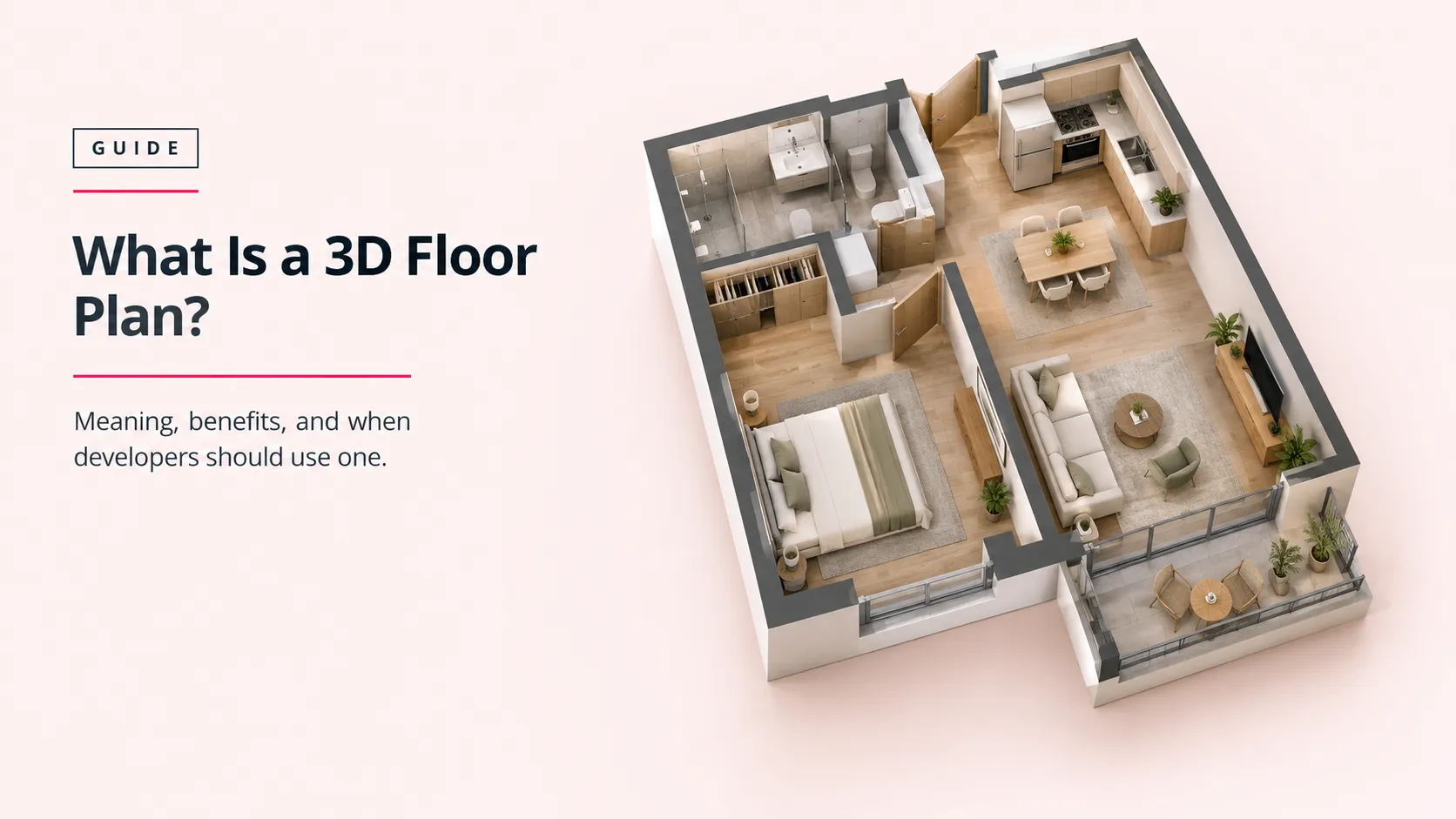
| 3D floor plan rendering | $250 – $1,500 | 3–7 days |
| Architectural animation | $4,000 – $12,000 per minute | 2–3 weeks |
| 360° virtual tour | $800 – $2,000 | 5–10 days |
Figures above are drawn from MyArchitectAI’s 2026 rendering cost breakdown, which surveyed pricing across more than 30 rendering providers.
The gap between the low and high end of each row usually comes down to three things: how much post-production polish the job needs, how many revision rounds are included, and whether the studio is quoting US rates or an offshore rate.
None of those are red flags on their own. A $600 exterior render for an early concept study is a completely reasonable choice. A $600 exterior render for a hero marketing image on a luxury tower is not. That’s a mismatch between budget and use case, not a bargain.
In-house vs. outsourcing vs. AI rendering software
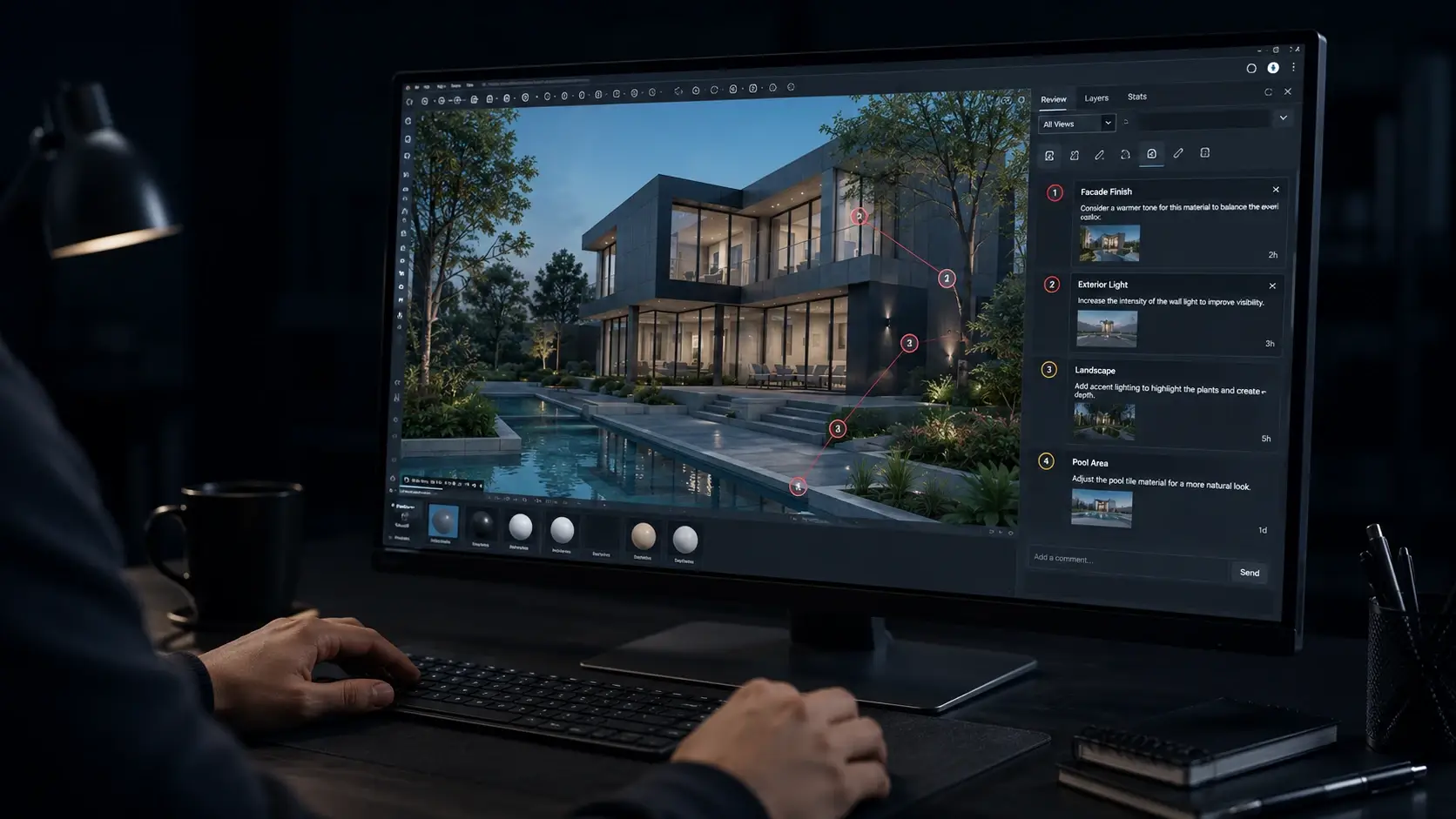
It helps to see outsourcing next to the two alternatives, hiring in-house or using AI rendering software, because each one solves a different problem, not the same problem cheaper.
| Option | What it can do | What it can’t do | Typical cost |
| In-house hire | Same-day turnaround; full control over priorities; deep familiarity with your projects | Flex down when work is quiet, you pay the salary regardless of volume | ~$95,000/year median salary |
| Outsourced rendering company | Scales up or down with your pipeline; brings a full production team (PM, artists, QC) for one relationship | Match same-day turnaround on complex scenes; plan 3 days to 2 weeks | $250 – $10,000+ per image |
| AI rendering software | Near-instant turnaround; low monthly cost; good for early concept iteration | Reliably match hand-finished photorealism for hero marketing images or complex custom geometry | $20 – $50/month |
How does the outsourcing process actually work?
The sequence is fairly consistent across studios, even though the details differ.
- You send a brief: CAD files, reference images, material specs, and a deadline.
- The studio quotes price and turnaround based on scope and current workload.
- Both sides sign an NDA before any files change hands, since it’s usually an unreleased project.
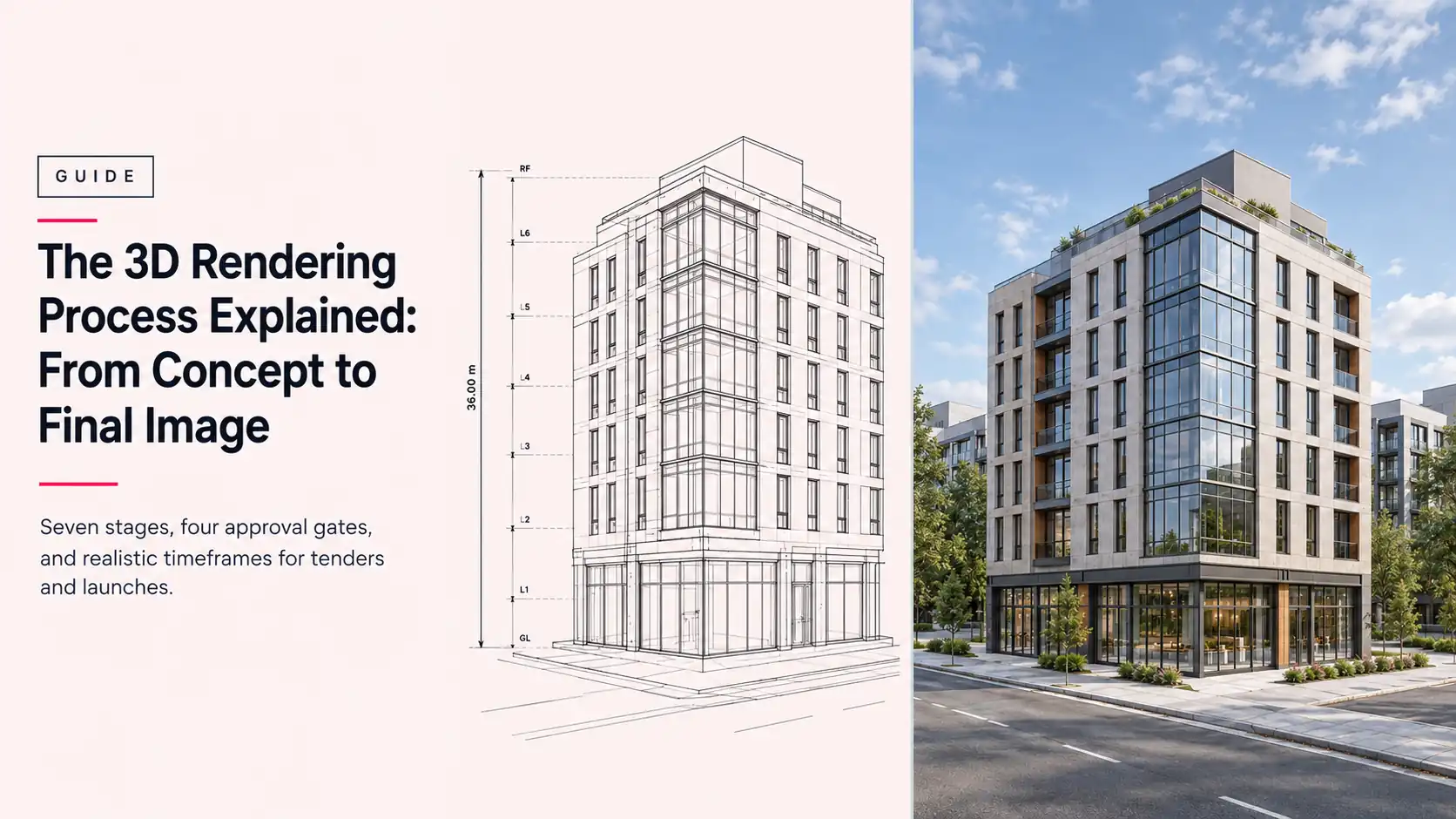
- Production starts: modeling, texturing, lighting, then render passes.
- You review a draft and request revisions. Most studios include a set number free, then charge for anything beyond that.
- The studio runs its own quality control before handoff, checking the draft against your brief.
- You receive final files in the formats you specified, and the relationship either ends or continues on the next project.
Seven steps, one relationship, if it works.
What are the different types of architectural rendering companies?
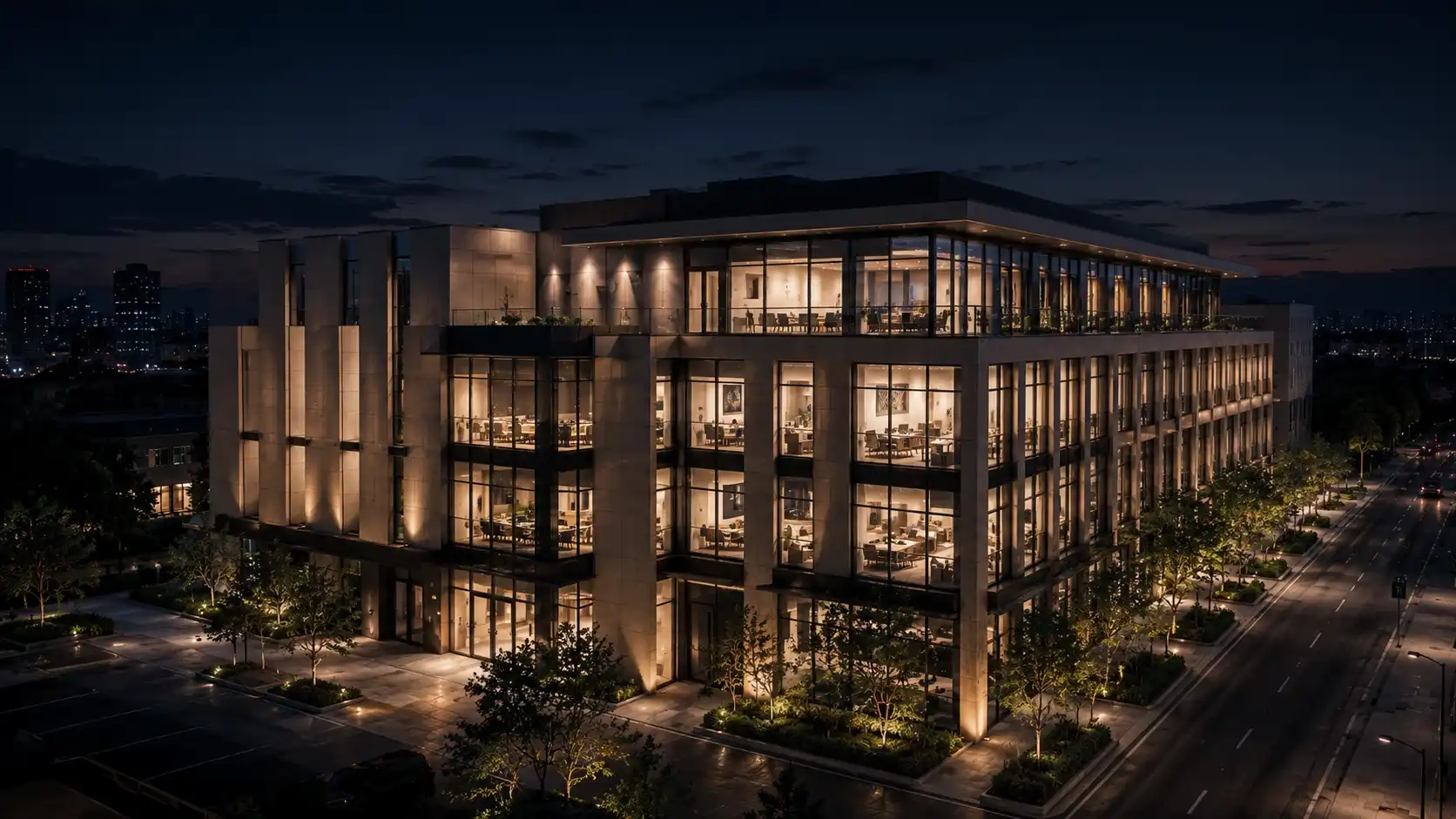
Every architectural rendering company in this space falls into roughly four categories, and knowing which one you’re evaluating changes what questions actually matter.
| Type | Can offer | Cannot offer | Best fit |
| Solo freelancer | Lower price, direct communication with the person doing the work | Backup coverage if they’re sick or overbooked, large-volume capacity | Small one-off projects, tight budgets |
| Offshore volume studio | High output, low per-image cost, fast turnaround on standard requests | Deep collaboration on complex, custom, or unusual projects | Repetitive real estate listings, high-volume catalogs |
| Boutique creative studio | Strong art direction, distinctive style, close collaboration | Guaranteed capacity or bench depth at scale | Flagship hero images, competition entries |
| Enterprise white-label partner | Confidential production behind your brand, dedicated PM, scalable capacity, consistent process across many projects | The rock-bottom price point of a pure volume shop | Ongoing partnerships, agencies and developers with recurring need |
How is a white-label rendering partner different from a typical vendor?
White-label means the studio’s name never appears on the work. Your client, your investor, or your sales team sees your brand on every render, every deck, every listing. The production team stays invisible on purpose.
That matters most for property marketing agencies and architecture firms managing their own client relationships. Nobody wants a prospective buyer to find the rendering studio’s own portfolio and realize three competing developments used the same team.
A white-label partner also tends to assign a dedicated project manager and hold to your file-naming conventions and brand guidelines, rather than making you adapt to theirs. That’s a small operational detail that saves real time across a dozen projects a year.
The work looks like it came from your team, because officially, it did.
See what a white-label architectural visualization partnership looks like end to end in our complete guide for creative teams and developers.
What should you check before hiring an architectural rendering company?
Most bad experiences with an architectural rendering company trace back to the same handful of gaps in the vetting process. This checklist covers the ones that actually predict trouble.
| What to check | Why it matters | Red flag |
| Portfolio in your specific project type | A studio strong in interiors may be weak on aerials or towers | Portfolio shows one style only, no range |
| Sample turnaround against your actual brief | Quoted turnaround and real turnaround aren’t always the same | Vague answer, no committed date |
| Revision policy in writing | Free revisions vs. paid ones changes your real project cost | “Unlimited revisions” with no scope defined |
| NDA and IP terms | You need to own the final files outright | Studio keeps rights or reuses your renders in its own portfolio without asking |
| Communication channel and time zone overlap | A large time gap can turn a quick fix into a two-day delay | No named point of contact, only a generic inbox |
| References from similar clients | Past performance on your project type predicts future performance | No references offered, or references you can’t verify |
What are the challenges and limitations of outsourcing architectural rendering?
Outsourcing isn’t friction-free, and any guide that pretends otherwise is selling something.
Time zone gaps are real. A studio twelve hours away can turn a five-minute fix into an overnight wait, which matters when a tender is due in six hours and someone spots a wrong material on the facade.
Revision creep happens on both sides. Clients ask for “just one more small change” past what was scoped, and studios sometimes push back harder than the relationship can absorb, especially near a deadline. Get the revision count and the definition of a small change in writing before it becomes a fight.
Quality can be inconsistent between studios, and sometimes within the same studio between artists. A portfolio shows the best work, not the average job. Asking for a small paid test project before committing to a large one is a reasonable way to see the average, not just the highlight reel.
Confidentiality risk is genuine for unreleased developments. An NDA helps, but it’s only as good as a studio’s actual internal practices, which is worth asking about directly: how client files are stored, and who has access.
The fix for most of this is a written brief and a written agreement, not more trust.
How do you choose the right rendering partner for your project?
Match the architectural rendering company type to the job, not the other way around. A one-off floor plan for a small renovation doesn’t need an enterprise white-label partner. A developer launching several towers a year across multiple markets probably shouldn’t be managing five different freelancers.
Start with volume and cadence. If renders are a recurring, ongoing need tied to a pipeline of projects, a long-term partner with dedicated capacity beats re-sourcing a new freelancer every time. If it’s genuinely a single project, the calculus changes.
Then weight the evaluation checklist above by what actually breaks your projects, which is usually turnaround reliability and communication, not the sticker price on the quote.
Ready to see how a dedicated production partner would handle your next project? Start a conversation with Archvizly.
What is the future of architectural rendering outsourcing?
Real-time engines like V-Ray, Enscape, and Twinmotion have cut iteration time from hours to seconds, changing what studios can turn around same-day versus what still needs a full render pass.
AI-assisted tools are speeding up early concept work, but for client-facing, sales-grade imagery, hand-finished production is still the standard most firms hold to in 2026.
The studios adapting fastest are combining both: AI and real-time tools for early rounds, full production pipelines for the final hero images that actually go in front of a buyer or a planning board.
Frequently Asked Questions
What does an architectural rendering company actually do?
It turns CAD files, architectural drawings, or physical references into photorealistic still images, animations, or virtual tours, so a client, planning board, or buyer can see the finished project before it’s built.
How much does architectural rendering cost in 2026?
Residential interior stills typically run $250–$2,000, exterior stills $400–$2,800, and commercial exteriors up to $10,000 or more per image. Animation runs $4,000–$12,000 per minute, based on 2026 pricing data from over 30 rendering providers.
How long does architectural rendering take?
Most still images take 3–10 days depending on complexity and revisions. Animations and virtual tours typically take 1–3 weeks because every frame has to hold up, not just a single angle.
Is it cheaper to hire an in-house 3D visualizer or outsource?
It depends on volume. An in-house hire carries a median salary around $95,000 a year regardless of workload, while outsourcing scales with actual project volume. Firms with steady, high-volume rendering needs may save by hiring; firms with lumpy, deadline-driven demand usually save by outsourcing.
What is white-label architectural rendering?
White-label rendering means the studio produces the work but its name never appears on it. Your brand goes on every image, deck, and listing, while the production team stays confidential behind the scenes.
What should be in an NDA with a rendering company?
At minimum, it should cover confidentiality of unreleased project details, who owns the final files and source scenes, and how long the studio retains your materials after the project closes.
How many revisions are normally included?
Most studios include a set number of free revisions per image, commonly one to three rounds, with anything beyond that billed separately. Get the exact number and the definition of a “minor” versus “major” revision in writing before the project starts.
What file formats should a rendering company deliver?
For stills, expect high-resolution JPEG or TIFF/PNG files; for source scenes, formats vary by software (3ds Max, Blender, Cinema 4D). Confirm upfront whether you need raw project files or only the finished renders, since that changes the price and the ownership terms.
Can a rendering company work across time zones?
Yes, and many studios use that as an advantage, running production overnight relative to the client’s working hours. The tradeoff is slower turnaround on last-minute fixes, since a quick change can mean waiting until the next business day on the studio’s side.
What’s the difference between a freelancer and a rendering studio?
A freelancer is one person with one set of availability and one skill level. A studio has a project manager, multiple artists, and a quality control step, so the work continues even if one artist is unavailable or overbooked.
How do you check a rendering company’s quality before committing?
Review a portfolio in your specific project type (interiors, towers, aerials), ask for client references you can actually contact, and consider a small paid test project before committing to a large one.
Do rendering companies handle architectural animation and virtual tours too?
Larger, established studios typically offer both stills and motion work, including walkthroughs and 360-degree virtual tours, though pricing and turnaround for animation run considerably higher than for still images.