
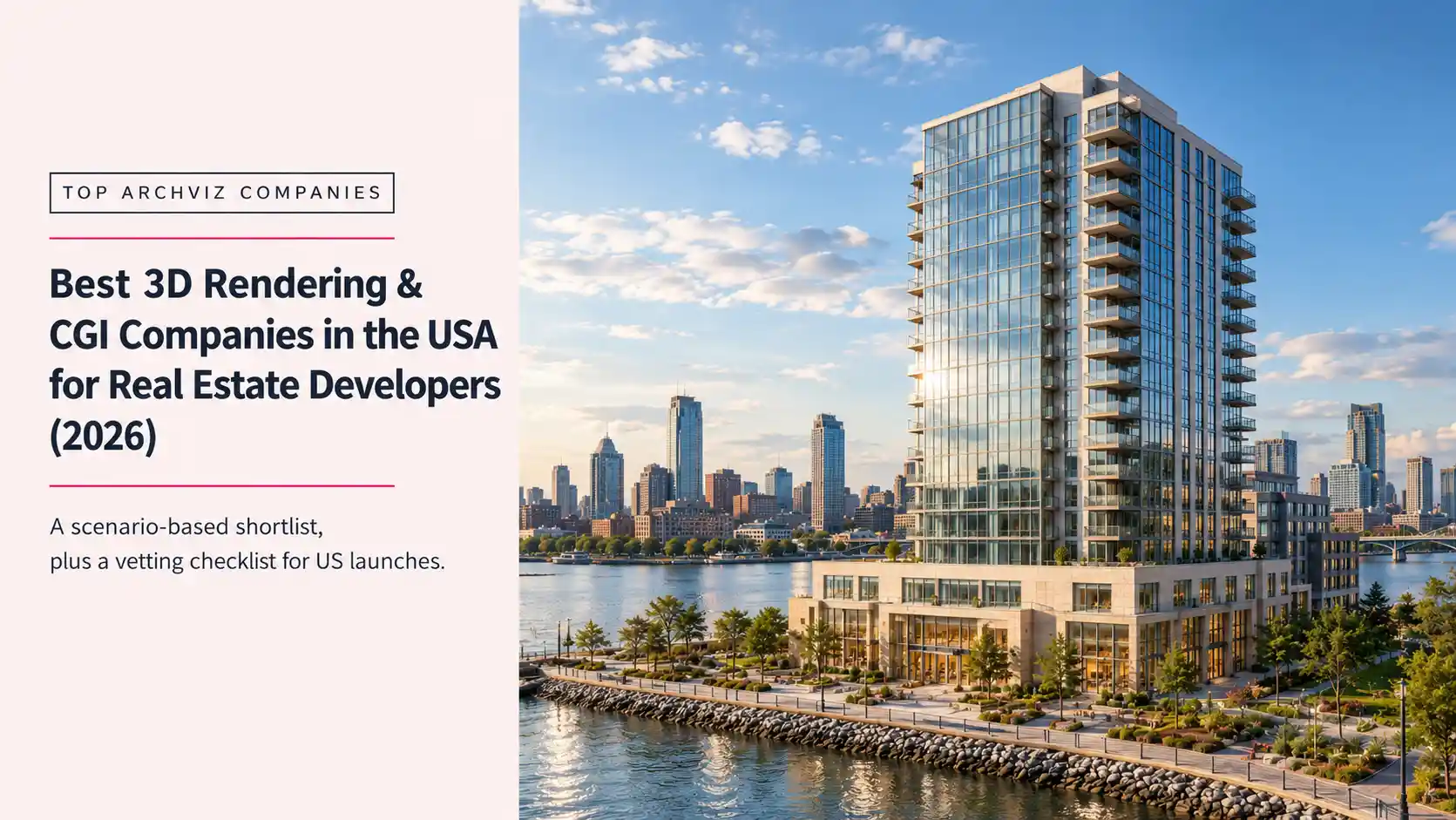
The best 3D rendering companies in the USA for real estate developers are the ones whose process fits the stage your project is in, not just the ones with the most dramatic portfolio. A studio that is perfect for a flagship branded-residence film can be the wrong choice for a 300-unit multifamily lease-up that needs forty accurate interiors in six weeks.
This guide compares eight of the best 3D rendering companies for real estate developers working in the US market, Archvizly included, then goes further than the usual top-10 list. You will find a shortlist table, how we chose each studio, honest profiles with watch-outs, a stage-by-stage matching framework, a US vs offshore vs white-label comparison, real price ranges and a full launch-package budget, a timeline counted back from your sales launch, and the vetting questions most lists skip. If you already know you need production-ready real estate rendering services for a launch, the stage framework is the fastest place to start.
The Shortlist at a Glance
Use this table to narrow the field before reading the full profiles. “Best development stage” is our read of where each studio’s public positioning and service mix fits most naturally, not a ranking of quality.
| Studio | Base | Best development stage | Core deliverables | Working model | Public pricing |
| Archvizly | Remote, serving US teams | Pre-sale, lease-up and multi-phase programs | Stills, animation, aerials, 3D floor plans, 360 tours | White-label production partner | Yes, price page |
| DBOX | New York, Miami and London | Flagship luxury and branded-residence launches | Brand campaigns, CGI, film, sales environments | Full-service creative agency | No, quote only |
| Neoscape | Boston, New York and Chicago | Large mixed-use and master-planned projects | Branding, renderings, film, digital twins, websites | Full-service creative agency | No, quote only |
| VISUALHOUSE | New York and Los Angeles | High-end condo and landmark launches | Branding, CGI, film, print and digital collateral | Full-service creative agency | No, quote only |
| Steelblue | San Francisco | West Coast residential and mixed-use | Renderings, films, virtual tours, interactive | Creative visualization studio | No, quote only |
| Kilograph | Los Angeles and Barcelona | Master plans and civic-scale storytelling | Strategy, branding, film, visualization, leasing apps | Full-service creative agency | No, quote only |
| BINYAN | New York, founded in Sydney | Film-led campaigns for iconic projects | CGI stills, live-action film, digital experiences | Integrated content agency | No, quote only |
| The Boundary | US presence, founded in the UK | Immersive sales suites and virtual showrooms | CGI, marketing films, virtual tours, digital twins | Visualization studio with a sales platform | No, quote only |
How We Chose These Studios
Most pages ranking for this topic are written by rendering studios, and most of them list themselves first. This one does too, so here is exactly how the list was built.
- US relevance: each studio either has a US office or publicly shows US real estate work, verified on its own website in October 2026.
- Developer focus: real estate development had to be a stated core market, not a side category next to product rendering.
- Recurring industry recognition: the independent studios below appear repeatedly across multiple current US rankings, not just one.
- Breadth of deliverables: each can cover at least stills, animation and one interactive or immersive format.
We deliberately left out software vendors, freelancer marketplaces and studios whose real estate work is a small slice of a product-rendering business. Those can be useful, but they answer a different question than which of the best architectural rendering companies in the USA can carry a development launch.
Disclosure: Archvizly publishes this guide and is listed first. The other seven follow in no ranked order, and none paid for placement. We did not commission test projects from them, so treat the profiles as a shortlist to vet, not a verdict.
The Best 3D Rendering Companies in the USA, One by One
1. Archvizly
Best for: developers, property marketing agencies and architects who need dependable production capacity across a launch or several phases.
Archvizly works as a white-label production partner rather than a branding agency. Projects start from your drawings and references shared through cloud storage, a clay render is approved before any materials go on, and finals arrive production-ready. A single still typically takes 3 to 5 business days depending on complexity, and two revision rounds are included at each milestone under a zero-cost revision policy for feedback-based changes. Deliverables cover exterior and interior stills, aerials, animation, 3D floor plans and 360 tours, so one team can carry a sales gallery, a brochure and a listing site.
Pricing: Published price ranges on a public price page, so you can budget before the first call.
Pros:
- Transparent pricing, with standard price lists published online.
- A single still typically takes 3 to 5 business days, with two revision rounds included at each milestone.
- Confidential white-label delivery, so images ship under your brand or your agency’s brand.
- A clay render approval step before materials, which catches plan errors early.
- Covers stills, aerials, animation, 3D floor plans and 360 tours from one team.
Cons:
- Does not run brand strategy, naming or website builds, so pair it with your marketing agency.
- Works remotely, so in-person site walks and on-site meetings are not part of the standard process.
2. DBOX
Best for: flagship luxury towers and branded residences where the campaign itself is part of the product.
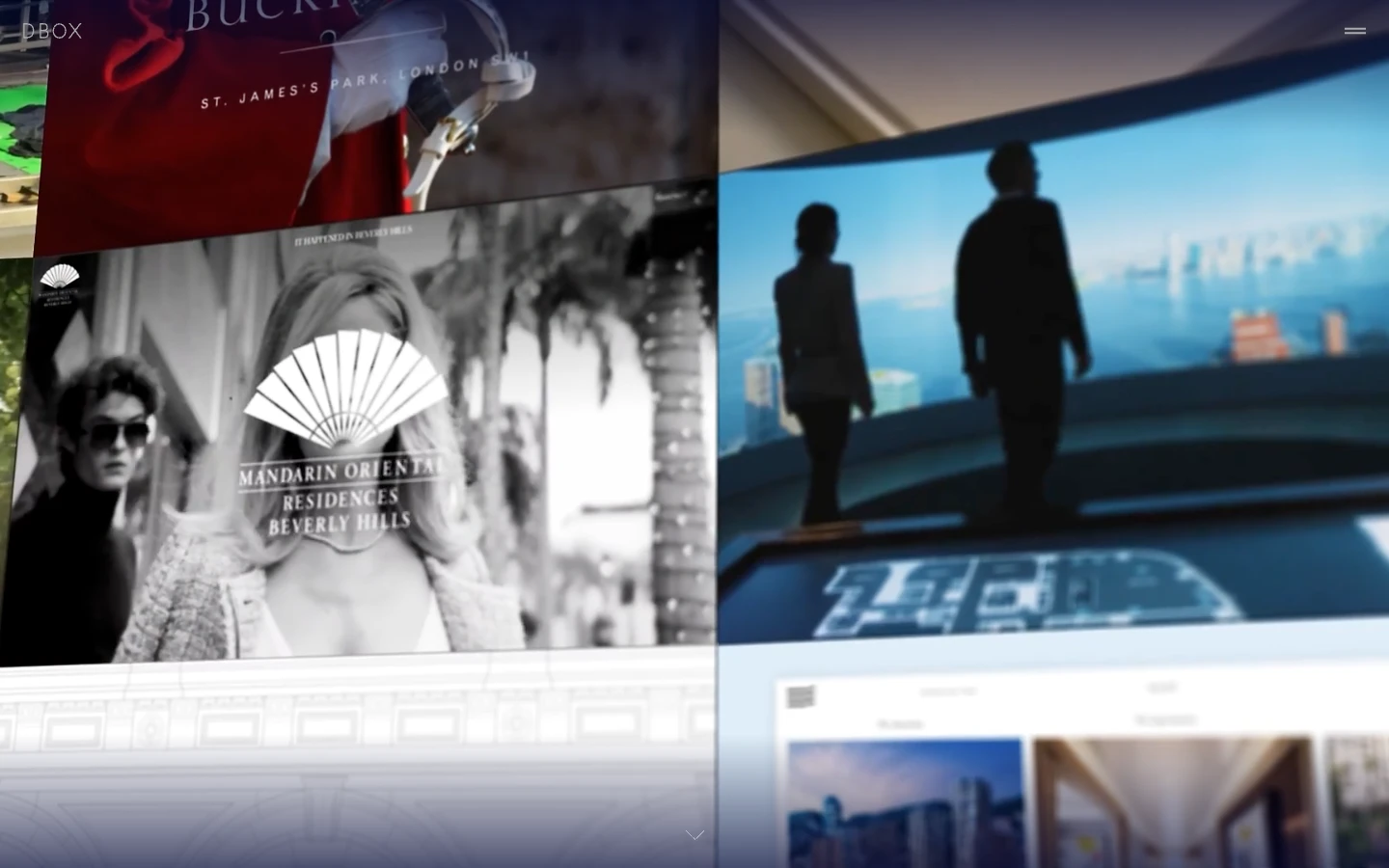
DBOX describes itself as a creative communications agency that builds brands and immersive marketing campaigns for property development, architecture and the arts. Its published work includes 432 Park, Riviera Tower and 80 Clarkson, alongside hospitality brands such as Mandarin Oriental and St. Regis. Expect strategy, campaign identity and sales environments alongside the CGI and film.
Pricing: No public price list. Projects are quoted through the contact page.
Pros:
- Brand strategy, campaign identity, CGI and film from one agency.
- A deep landmark track record, including 432 Park, Riviera Tower and 80 Clarkson.
- Hospitality brand experience with names such as Mandarin Oriental and St. Regis.
- Offices in New York, Miami and London suit projects marketed to international buyers.
Cons:
- No published pricing, so budgeting starts only after a scoping conversation.
- The campaign-led model is more than a mid-market lease-up usually needs.
- Agency-scale engagements need early booking, so confirm availability against your launch date.
3. Neoscape
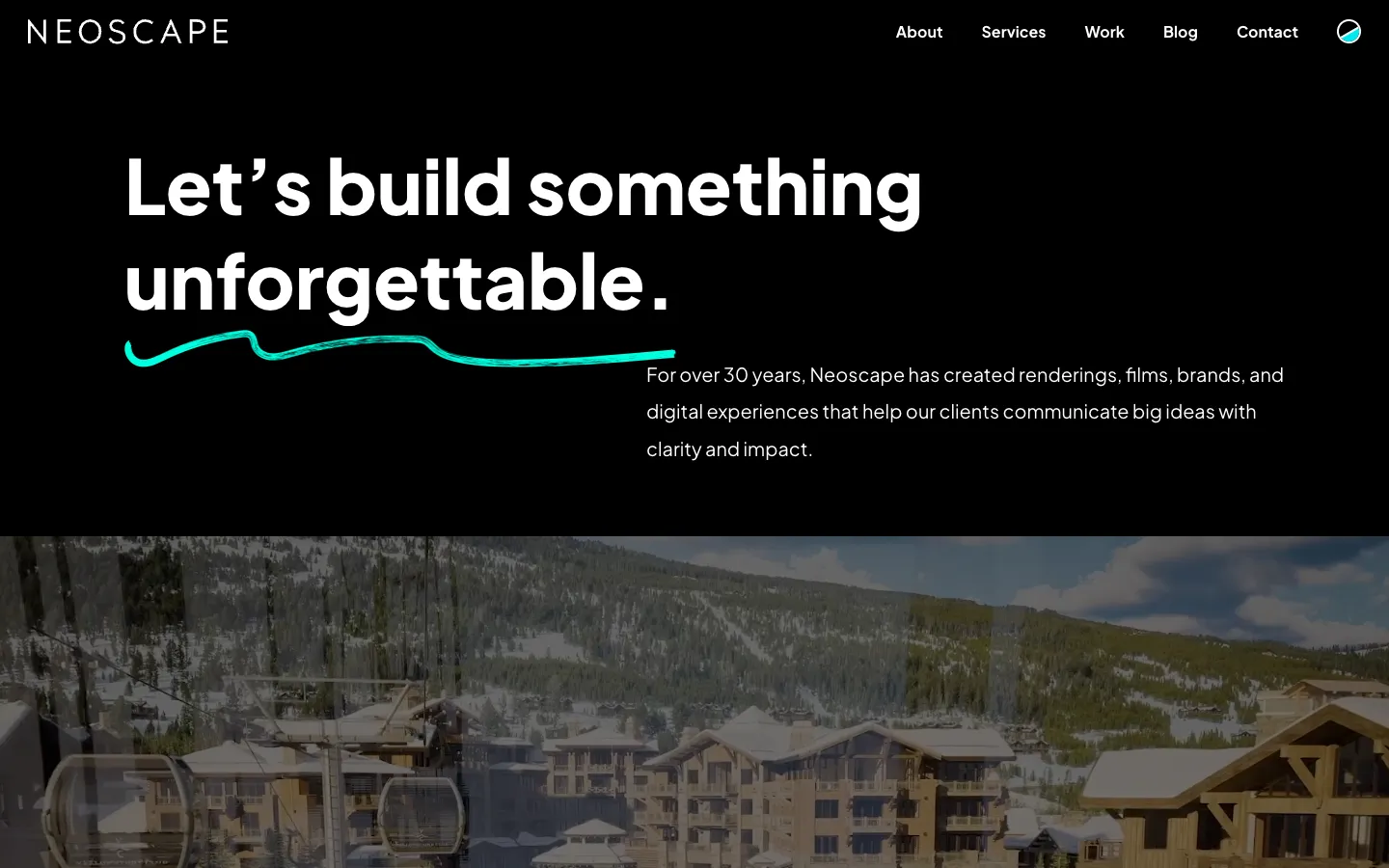
Best for: large mixed-use, office and master-planned projects that need visualization tied to a full marketing program.
Neoscape has offices in Boston, New York and Chicago and says it has worked for more than 30 years across residential, mixed-use, office, hospitality and life science. Its services span strategy and branding, renderings, film, animation, digital twins, VR, websites and marketing suites, with published work including 15 Laight and Aviator House.
Pricing: No public price list. Projects are quoted through the contact page.
Pros:
- More than 30 years in visualization, with offices in Boston, New York and Chicago.
- One of the widest service mixes: branding, renderings, film, digital twins, VR, websites and marketing suites.
- Experience across residential, mixed-use, office, hospitality and life science.
- Strong fit when visuals, website and sales center need to launch together.
Cons:
- No published pricing.
- With so many services, stills-only projects may not get the agency’s full attention, so confirm who leads production.
- A full agency process can be heavier than a developer needs for a fast lease-up.
4. VISUALHOUSE
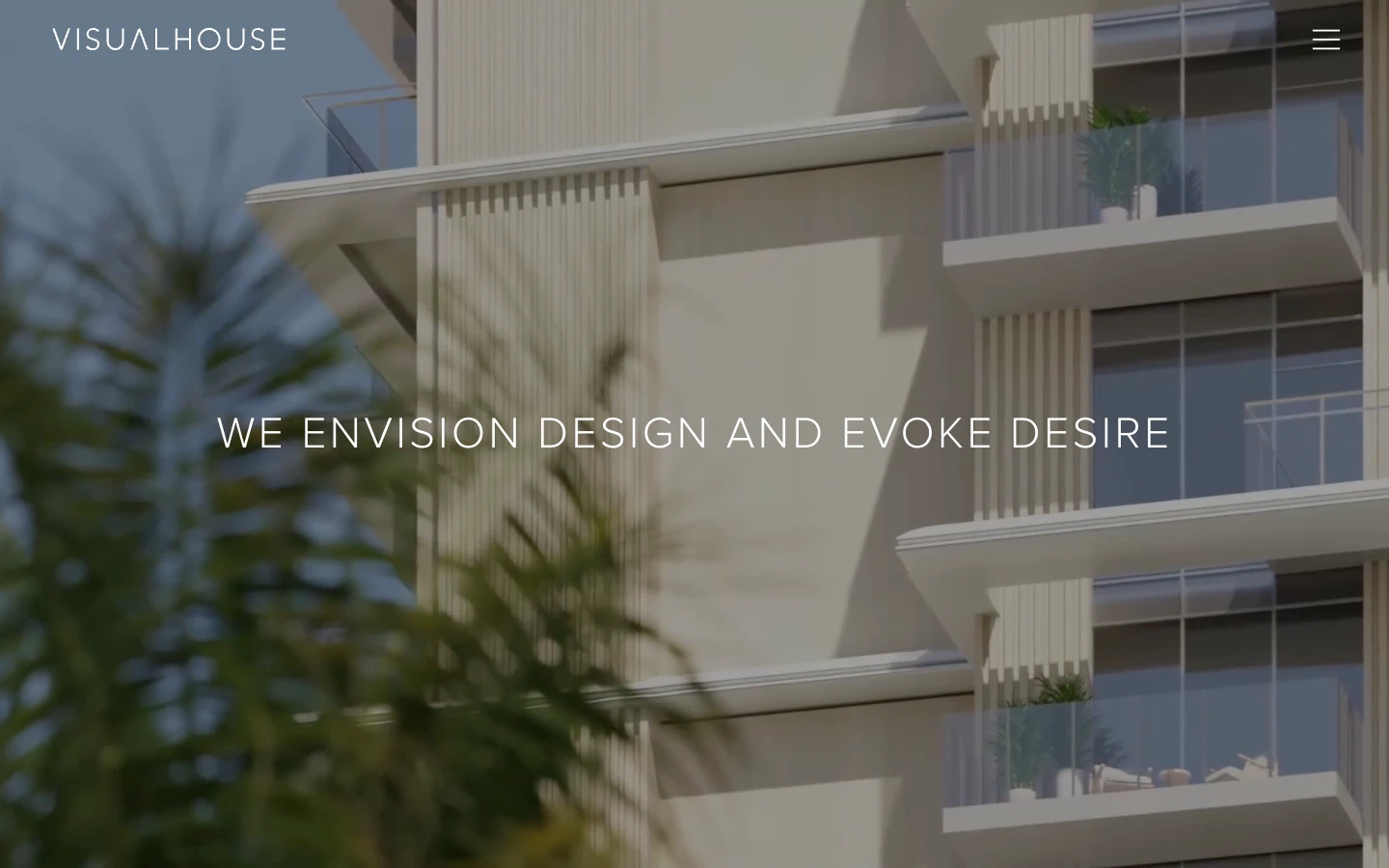
Best for: high-end condominium and landmark launches that need renders, film and collateral to share one look.
VISUALHOUSE is headquartered in New York with a West Hollywood office in Los Angeles and positions itself as a full-service creative agency that builds real estate brands for leading developers. Its public channels also list Miami, London, Dubai and Hong Kong, which suits developers marketing to international buyers.
Pricing: No public price list. Projects are quoted through the contact page.
Pros:
- Headquartered in New York with a West Hollywood office in Los Angeles.
- A full-service creative agency built around real estate brands.
- Public channels also list Miami, London, Dubai and Hong Kong, useful for global buyer campaigns.
- Renders, film and collateral share one look across print and digital.
Cons:
- No published pricing, and visualization is often bundled into a larger package.
- Positioned for high-end launches, so mid-market budgets may not be a natural fit.
- Scope boundaries between brand and production need to be agreed early.
5. Steelblue
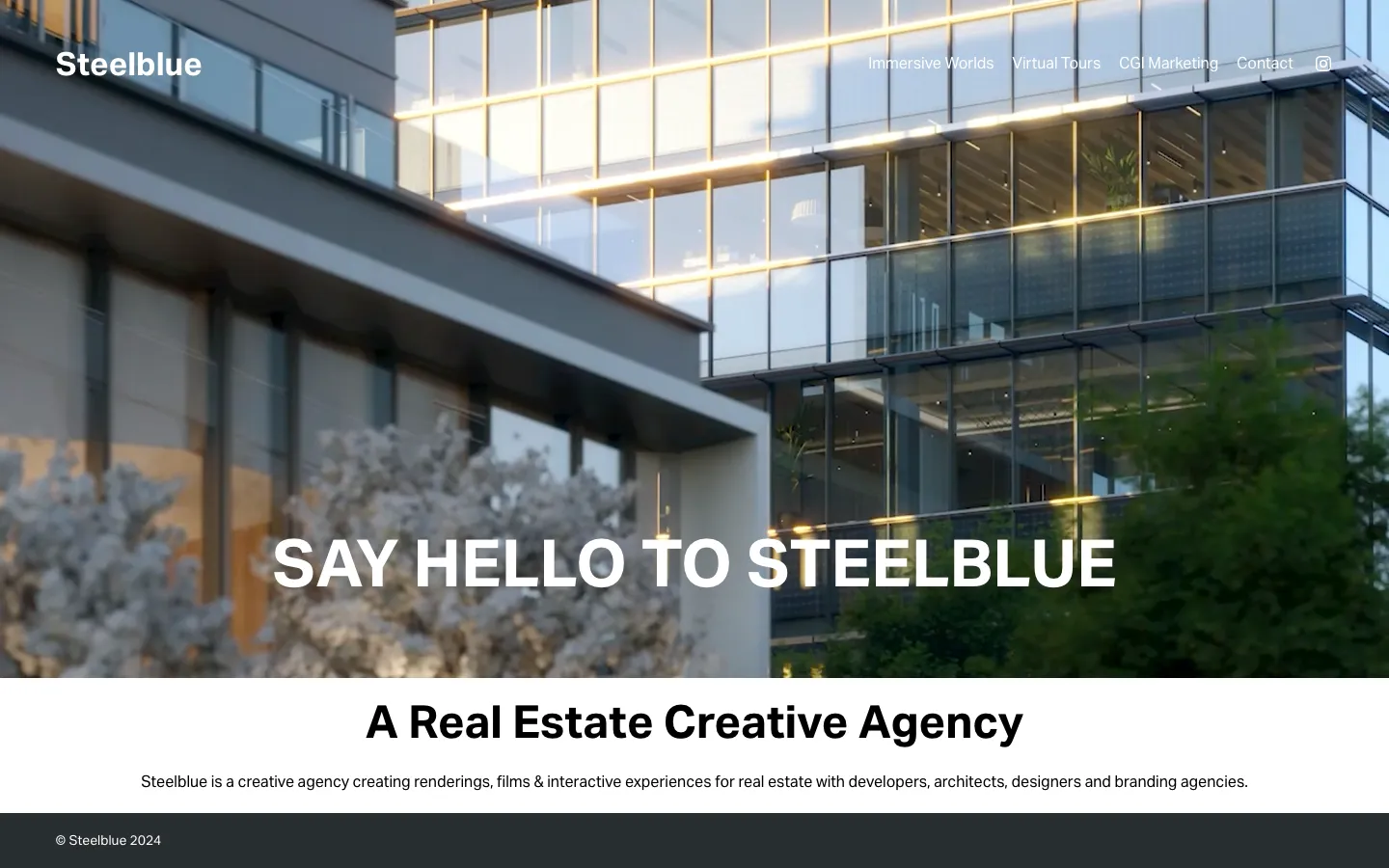
Best for: West Coast residential and mixed-use projects that want renderings, films and interactive tools from one studio.
Based in San Francisco, Steelblue describes itself as a creative agency creating renderings, films and interactive experiences for real estate, working with developers, architects, designers and branding agencies. Virtual tours and immersive environments sit alongside its CGI marketing work.
Pricing: No public price list. Projects are quoted through the contact page.
Pros:
- San Francisco base with West Coast market context.
- Renderings, films and interactive experiences such as virtual tours under one roof.
- Used to working alongside developers, architects, designers and branding agencies.
- A focused visualization studio rather than a broad brand agency.
Cons:
- No published pricing.
- No in-house brand strategy, so you will still need a branding partner.
- East Coast projects are handled remotely, so ask how site context is captured.
6. Kilograph
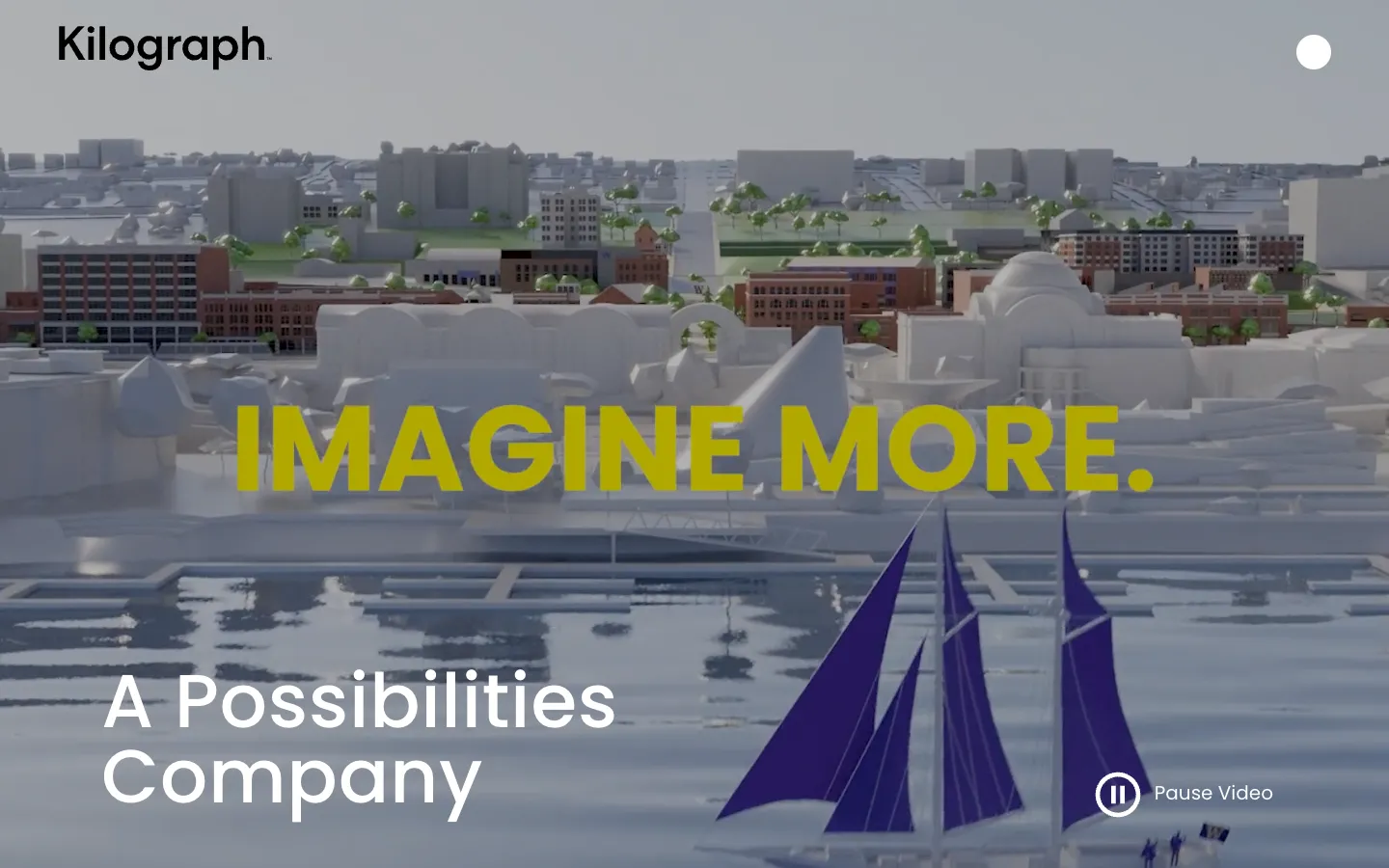
Best for: master plans, campuses and civic-scale developments that need a narrative as much as an image.
Kilograph works from Los Angeles and Barcelona and combines narrative strategy, branding, websites, interactive experiences, film and visualization, including custom leasing apps. Its portfolio includes One Cherry Creek, Mr. C Residences Downtown and Freedom Plaza.
Pricing: No public price list. Projects are quoted through the contact page.
Pros:
- Offices in Los Angeles and Barcelona.
- Combines narrative strategy, branding, film, visualization and custom leasing apps.
- Strong on master plans, campuses and civic projects such as One Cherry Creek and Freedom Plaza.
- Good fit when a project needs a story for stakeholders, not just images.
Cons:
- No published pricing.
- Story-led scope can be more than a stream of unit interiors requires.
- Confirm how high-volume still production is staffed across phases.
7. BINYAN Studios
Best for: campaigns where live-action film and CGI need to blend seamlessly.
BINYAN was founded in Sydney in 2008 and now operates from New York among other cities. BINYAN calls itself an integrated content agency, with services spanning CGI stills, live-action film and digital experiences for landmark projects.
Pricing: No public price list. Projects are quoted through the contact page.
Pros:
- Founded in Sydney in 2008, with offices in New York, London, Dubai, Sydney and Melbourne.
- Blends CGI stills, live-action film and digital experiences.
- Experience on landmark projects where film carries the campaign.
Cons:
- No published pricing.
- Film-led schedules run longer than stills-only work.
- The website shares little detail on services and process, so expect to learn most of it on a call.
8. The Boundary
Best for: sales suites, virtual showrooms and immersive buyer experiences.
The Boundary was founded in 2014 by Peter Guthrie and Henry Goss. Beyond CGIs, animations and marketing films, it offers virtual tours, virtual showrooms, digital twins and its own sales platform. US work shown on its site includes The Residence at 1428 Brickell, Five Park Miami Beach and 611 West 56th Street.
Pricing: No public price list. Projects are quoted through the contact page.
Pros:
- Founded in 2014 by Peter Guthrie and Henry Goss, with a dedicated US site.
- CGIs, marketing films, virtual tours, virtual showrooms and digital twins.
- Its own Realspace sales platform for immersive buyer experiences.
- US work includes The Residence at 1428 Brickell, Five Park Miami Beach and 611 West 56th Street.
Cons:
- No published pricing.
- Immersive platforms add licensing and hosting decisions, so ask who owns the files after sell-out.
- Founded in the UK, so confirm where your project’s production team sits.
Match the Studio to Your Development Stage
Most lists of top 3D rendering companies stop at portfolio quality. For a developer, the better question is what the visuals have to achieve next. US banks and credit unions typically want 50 to 70 percent of condo units under contract before funding construction, according to a lender’s guide to condo construction loans, which puts your marketing visuals on the financing critical path.
| Development stage | What the visuals must do | What to prioritize | Usually the best fit |
| Pre-sale or pre-leasing launch | Sell or lease units off-plan | Unit-accurate interiors, fast first drafts, volume capacity | White-label production partner or regional studio |
| Capital raise | Win investor and lender confidence | Massing, unit mix and site context accurate to plans | Production partner working from CAD/BIM |
| Entitlement and community meetings | Show impact honestly | Accurate context, aerials, verified views | Studio with site plan and aerial experience |
| Multi-phase master plan | Stay consistent for years | Locked style guide, reusable models, steady capacity | Production partner with long-term capacity |
| Hospitality or branded pre-opening | Express the operator brand | Interior mood, amenities, film | Full-service creative agency |
Pre-sale or pre-leasing launch
This is the highest-stakes stage: renders carry the sales gallery, the landing page and the broker deck before anything is built. Prioritize fast first drafts, experience with your unit type, and enough capacity for interior variations across floor plans rather than one hero exterior.
Capital raise
Investors and lenders read renders differently from buyers. They check massing, unit mix and site context against your entitlements, so dimensional accuracy from CAD or BIM files matters more than cinematic art direction. A small set of precise views, an aerial showing the site in its neighborhood and a typical floor plate usually does more for a capital raise than a long list of lifestyle interiors. Keep these images consistent with the later sales set, so the investor deck and the eventual marketing campaign tell the same story.
Entitlement and community meetings
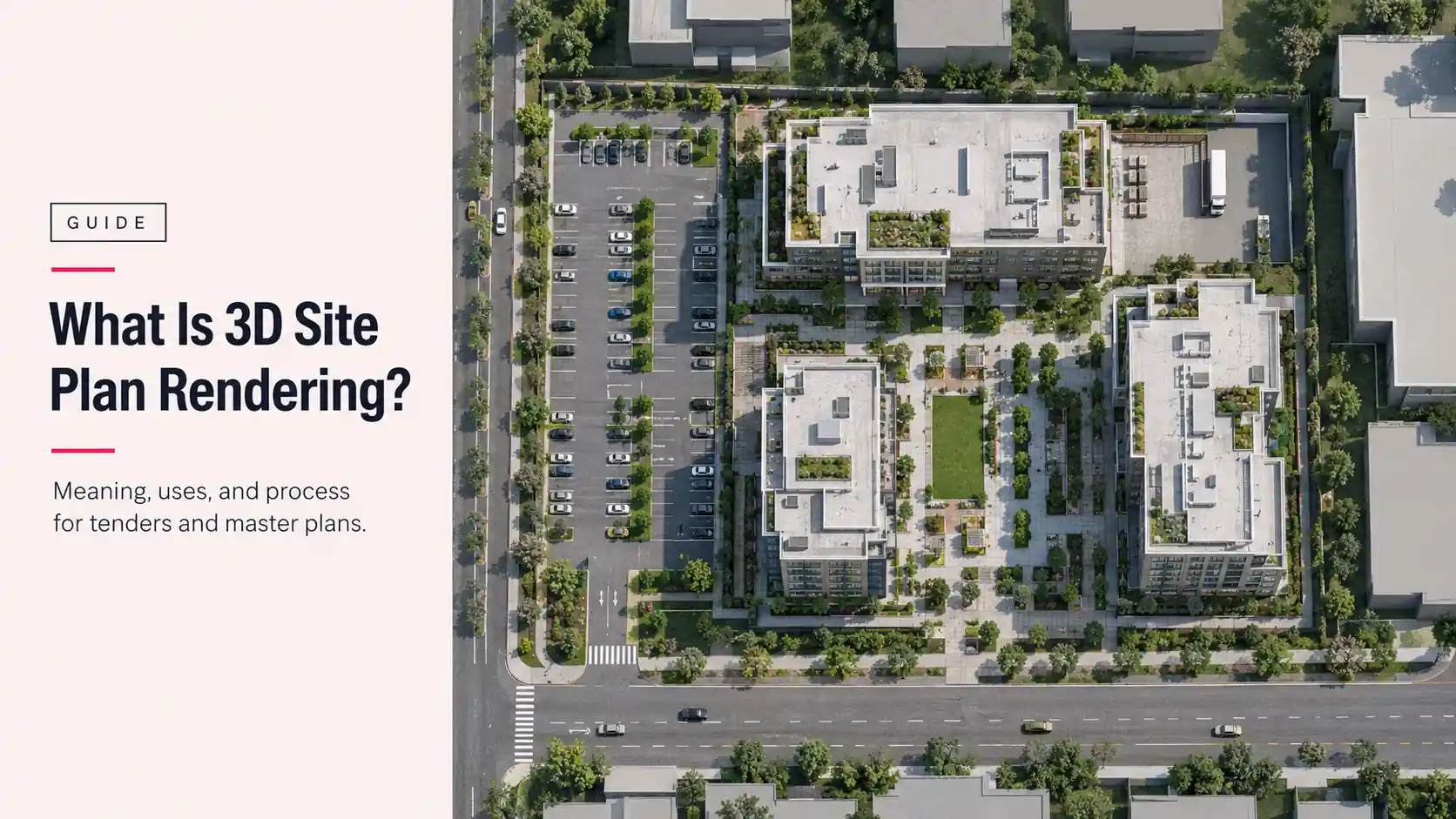
Planning boards and neighbors want to see the real impact on the street. Accurate aerials and 3D site plan renderings matter more than lifestyle imagery at this stage.
Multi-phase master plan
A community that launches over five years needs one visual language from phase one to phase five. Choose a partner that can keep models, materials and camera conventions on file and still has capacity when two phases market at once. Ask for examples where the same studio delivered more than one phase of a project, and check that the later images still match the earlier ones in light, color and material.
Hospitality or branded pre-opening
Hotels, branded residences and amenity-heavy mixed-use projects must match an operator’s brand standards. Interior mood, materials and film usually lead, which is where full-service agencies earn their fee.
What Separates a Strong Rendering Partner From an Average One
Image quality is the entry ticket, not the differentiator. Among top 3D rendering companies, the ones developers keep rehiring tend to share four traits.
- Portfolio relevance over portfolio beauty: work on your asset type, scale and buyer profile says more than an award-winning museum render.
- Marketing awareness: the studio understands that a sales-gallery hero, an Instagram crop and a billboard need different framing, and plans views for each channel up front.
- Process and revision control: a clay or massing approval before materials, a fixed number of revision rounds, and a named point of contact who answers within a working day.
- Accuracy you can defend: images built from your drawings and finishes schedule, so buyers, lenders and planning boards see what will actually be built.
A studio that is strong on all four will usually cost less over a full launch than a cheaper one that needs extra rounds, because the cost of a missed launch date is far higher than the difference in per-image price.
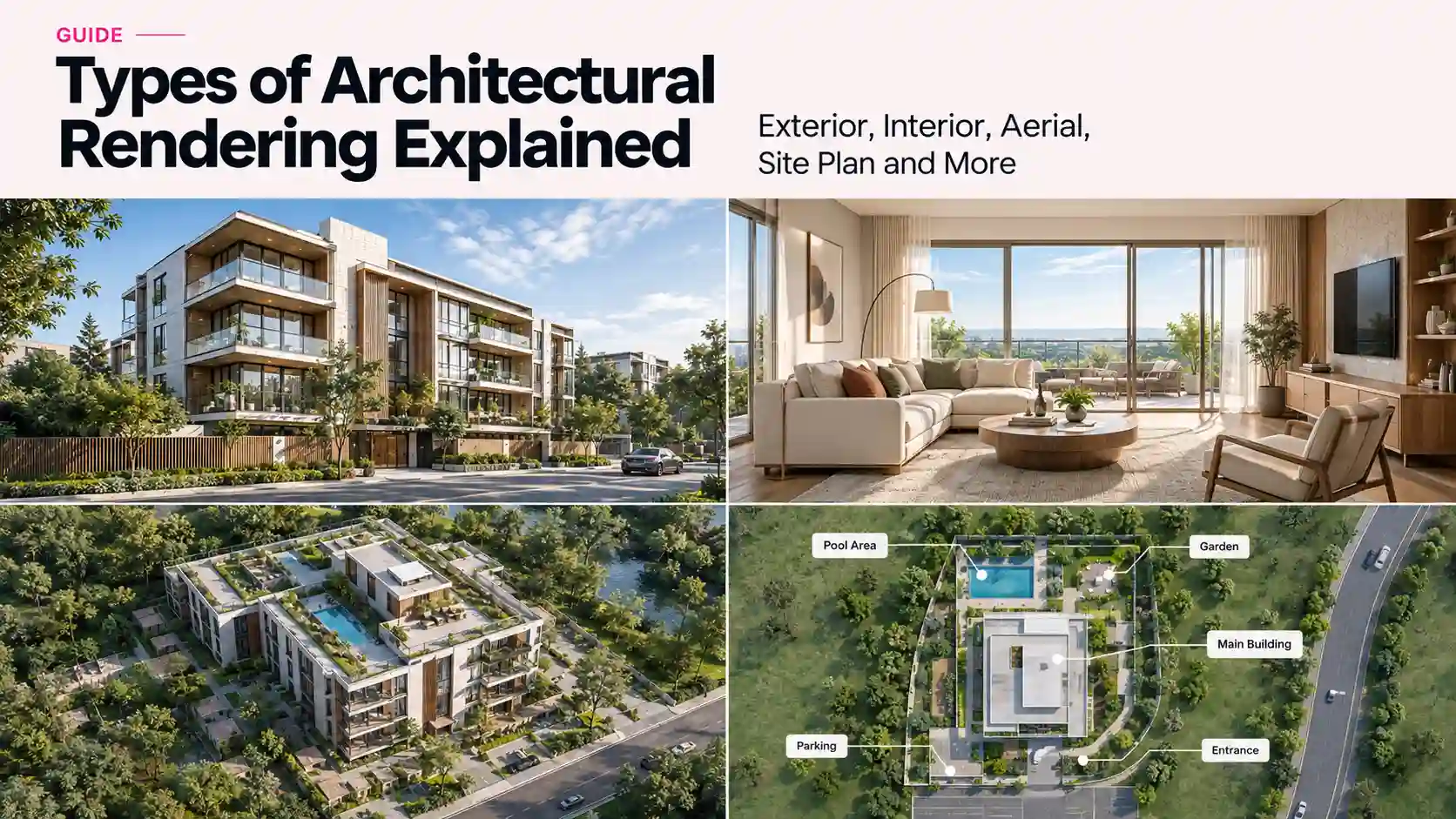
Types of 3D Rendering Services to Compare
“3D rendering company” covers a wide range of deliverables, and the strongest 3D rendering firms for real estate cover most of them in-house rather than subcontracting. Before you compare quotes, confirm which of these each studio actually produces itself:
- Exterior stills: the hero images for the sales gallery, brochure, hoardings and landing page.
- Interior stills: unit types, lobbies and amenities, usually the largest share of a launch package.
- Aerial and site views: context for investors, entitlement hearings and master-plan orientation.
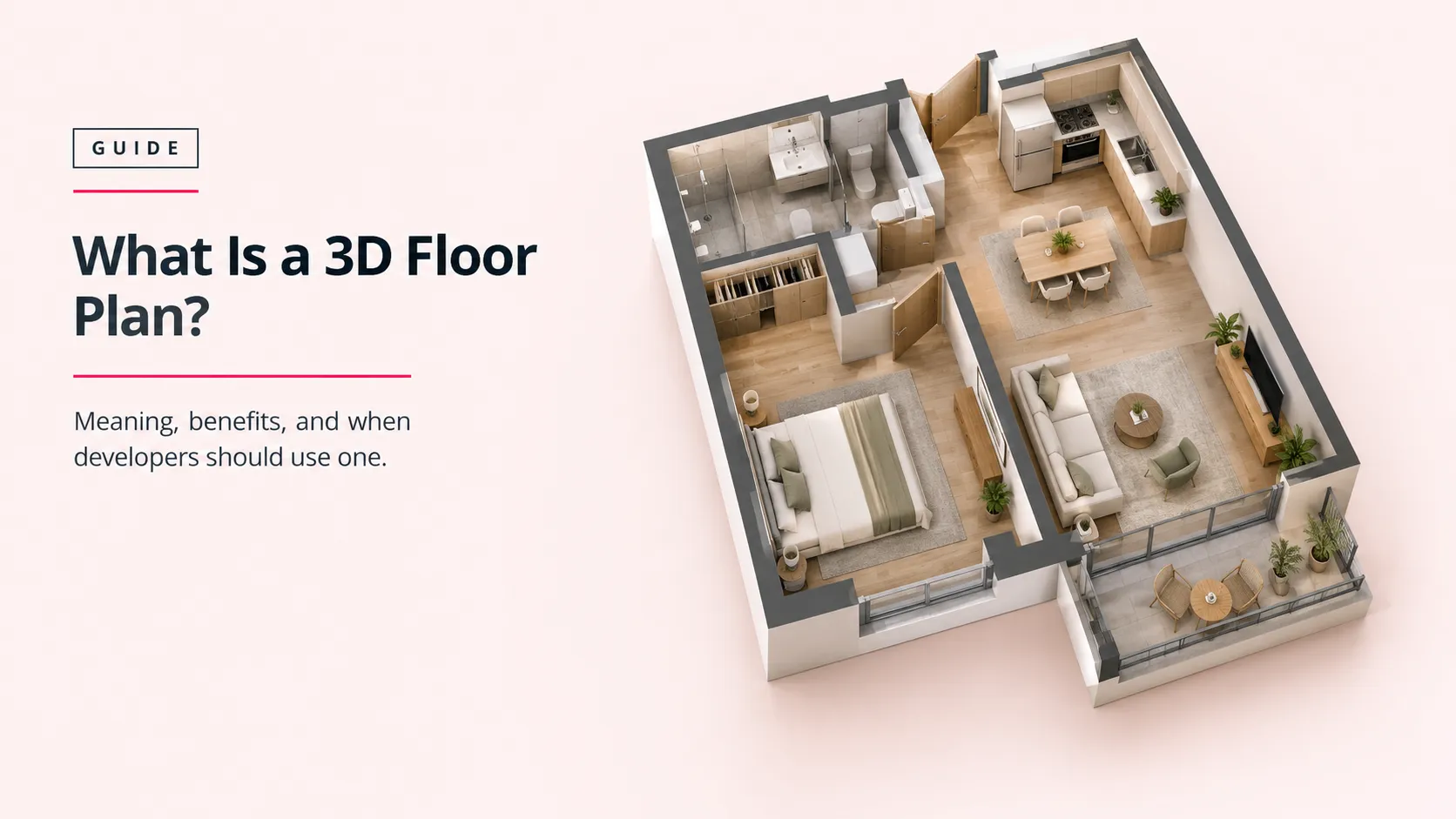
- 3D floor plans: unit-selection tools, listings and leasing collateral.
- Architectural animation: a flythrough for the website hero, broker events and social campaigns.
- 360 panoramas and virtual tours: remote buyers and pre-completion walkthroughs.
- Virtual staging: for completed or near-complete units without the cost of physical staging.
A studio that handles all of these under one roof means fewer vendors to manage and one consistent look across every channel. Gaps are not a deal-breaker, but they tell you where a second vendor, and a second style, will enter your launch.
Why US Developers Invest in Professional 3D Rendering
Off-plan buyers, lenders and planning boards all make decisions about a building that does not exist yet. Professional CGI turns drawings into something each of them can evaluate, which shortens sales cycles, supports pricing, and reduces costly design changes after construction starts. It also gives the marketing team assets months before photography is possible, so the sales gallery, website and broker campaigns can open on the developer’s schedule rather than the contractor’s.
The return comes from accuracy as much as beauty. An image that matches the approved plans protects you from buyer disputes later, while an image that over-promises a view or finish can create them.
US Studio, Offshore Studio, or White-Label Partner?
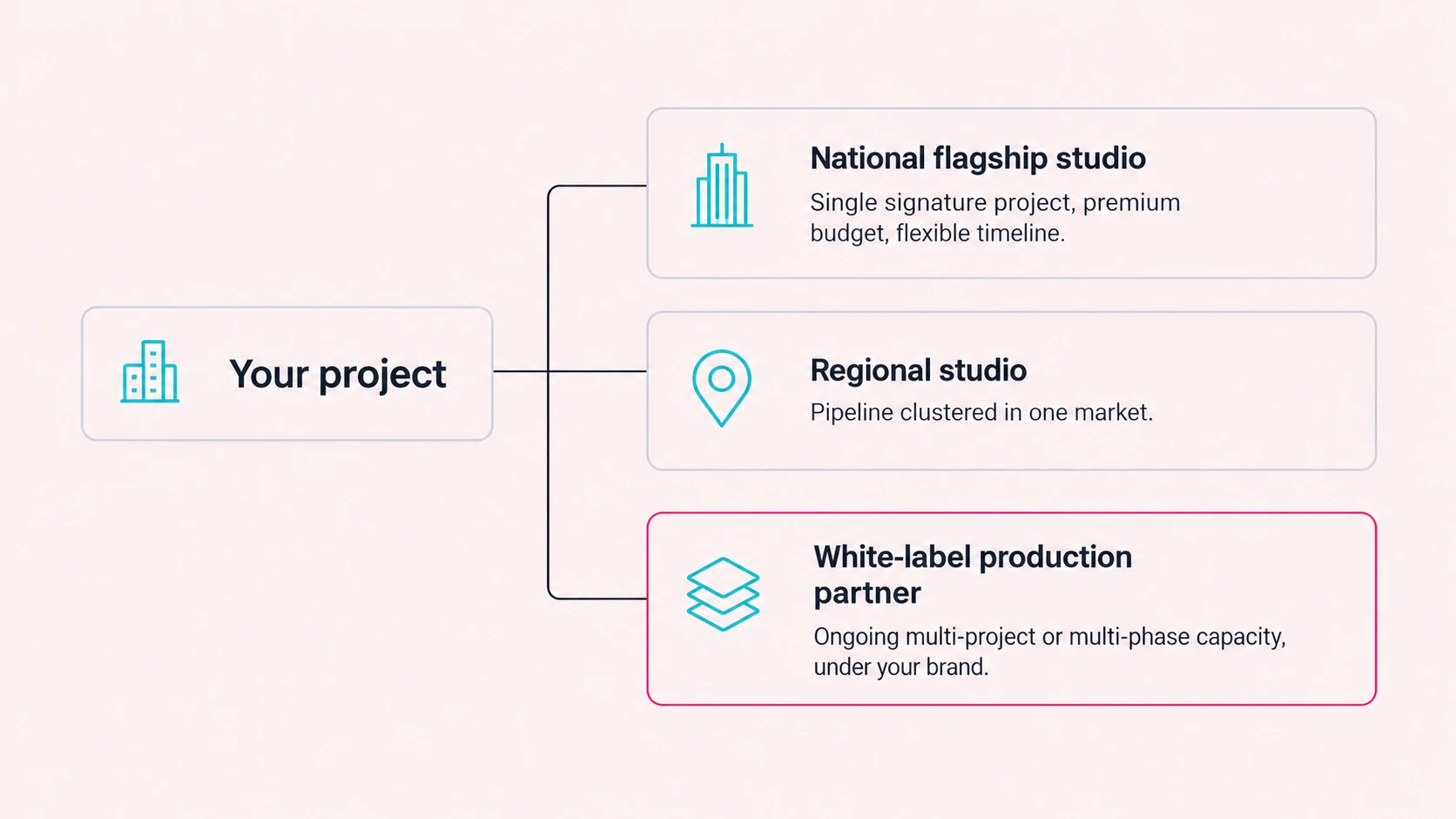
Two of the leading pages ask “should I hire a US studio oroutsource overseas?” only in their FAQs. Among architectural visualization studios in the US and abroad, the question deserves a full comparison, because the operating model affects cost, speed and risk as much as image quality does. If you want to see how the confidential model works in practice, our guide to white-label architectural visualization covers it in detail.
| Factor | US full-service agency | Low-cost offshore studio | White-label production partner |
| Typical pricing | Highest, often quoted as a campaign | Lowest per image | Mid-range per image, predictable |
| Time zone and communication | Same or near time zone | Large gap, slower feedback loops | Structured milestones, overlap hours agreed up front |
| IP, NDA and confidentiality | Usually strong contracts | Varies widely, check carefully | Confidential by design, no studio credit |
| Capacity for volume | Limited by booking calendar | High, but quality can vary | Built to scale with your pipeline |
| Branding and strategy | Included | Rarely offered | Not included, works under your brand |
| Best for | Flagship launches with campaign budgets | One-off, low-stakes images | Ongoing launches, agencies and multi-phase programs |
How Much Do 3D Rendering Companies in the USA Cost?
Published price ranges for the best 3D rendering companies in the USA vary widely because studios price different scopes. The ranges below come from our architectural rendering cost guide, which breaks down standard and premium tiers by service type.
| Deliverable | Standard tier | Premium tier |
| Exterior still, residential | $400 to $1,500 | $1,500 to $3,000 |
| Exterior still, commercial | $800 to $2,500 | $2,500 to $5,000+ |
| Interior still | $300 to $1,200 | $1,200 to $2,500 |
| Aerial or bird’s-eye view | $800 to $2,000 | $2,000 to $4,000 |
| 3D floor plan | $150 to $600 | $600 to $1,500 |
| 360 panorama | $400 to $1,200 | $1,200 to $2,500 |
| Animation, per finished minute | $2,500 to $8,000 | $8,000 to $20,000+ |
Rush delivery typically adds 25 to 50 percent, and building the 3D model from PDFs rather than CAD can add $300 to $1,500. Full-service agencies usually quote campaigns as a package, so per-image comparisons with them are rarely like for like. Of the eight studios in this guide, only Archvizly publishes a price list, and the other seven quote on request, so expect a scoping call before you see a number.
What a full launch package costs
Developers rarely buy one image. Here is an illustrative package for a mid-rise condo pre-sale launch, priced at the standard-tier ranges above:
| Package item | Quantity | Estimated range |
| Hero exterior stills | 2 | $800 to $3,000 |
| Unit and amenity interiors | 4 | $1,200 to $4,800 |
| Aerial context view | 1 | $800 to $2,000 |
| 3D floor plans | 6 | $900 to $3,600 |
| 60-second animation | 1 | $2,500 to $8,000 |
| Total | 14 deliverables | $6,200 to $21,400 |
Use this to sanity-check quotes. A quote far below the low end usually means fewer revision rounds, a lower resolution or a model built from guesses rather than your drawings.
How Long Does a 3D Rendering Project Take?
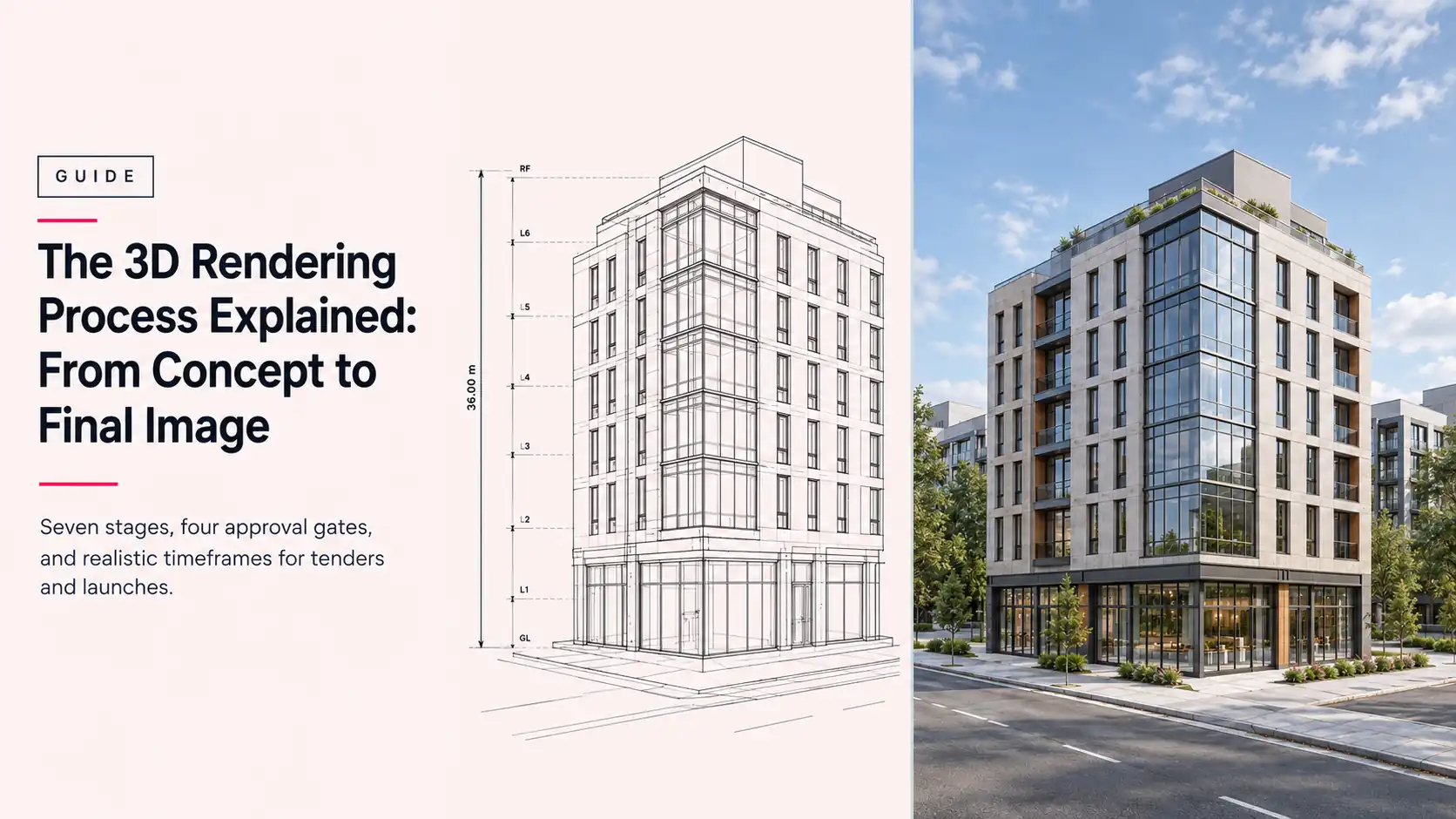
A single still typically takes a few business days of production, but your real timeline is set by approvals. The planning template below counts back from the date your sales gallery or website goes live. Our guide on how long 3D rendering takes covers timelines by project type in more depth.
| Weeks before launch | Milestone | Who signs off |
| 12 | Brief, drawings, finishes schedule and references sent | Development and design leads |
| 11 | Clay or massing renders approved | Architect and developer |
| 10 to 8 | Stills drafted, two revision rounds | Marketing lead and sales team |
| 8 to 5 | Animation produced and approved | Marketing lead |
| 4 | Floor plans and collateral layouts finalized | Sales and leasing team |
| 2 | Final files delivered for print and web | Marketing agency |
Build in buffer for your own internal sign-offs. In practice, approvals from several stakeholders delay more launches than production does.
Keeping a Multi-Phase Development Visually Consistent
Master-planned communities and multi-building developments rarely launch at once. The studio you pick for phase one has to hold the same quality and look when phase three breaks ground years later, and flex up when two phases market at the same time.
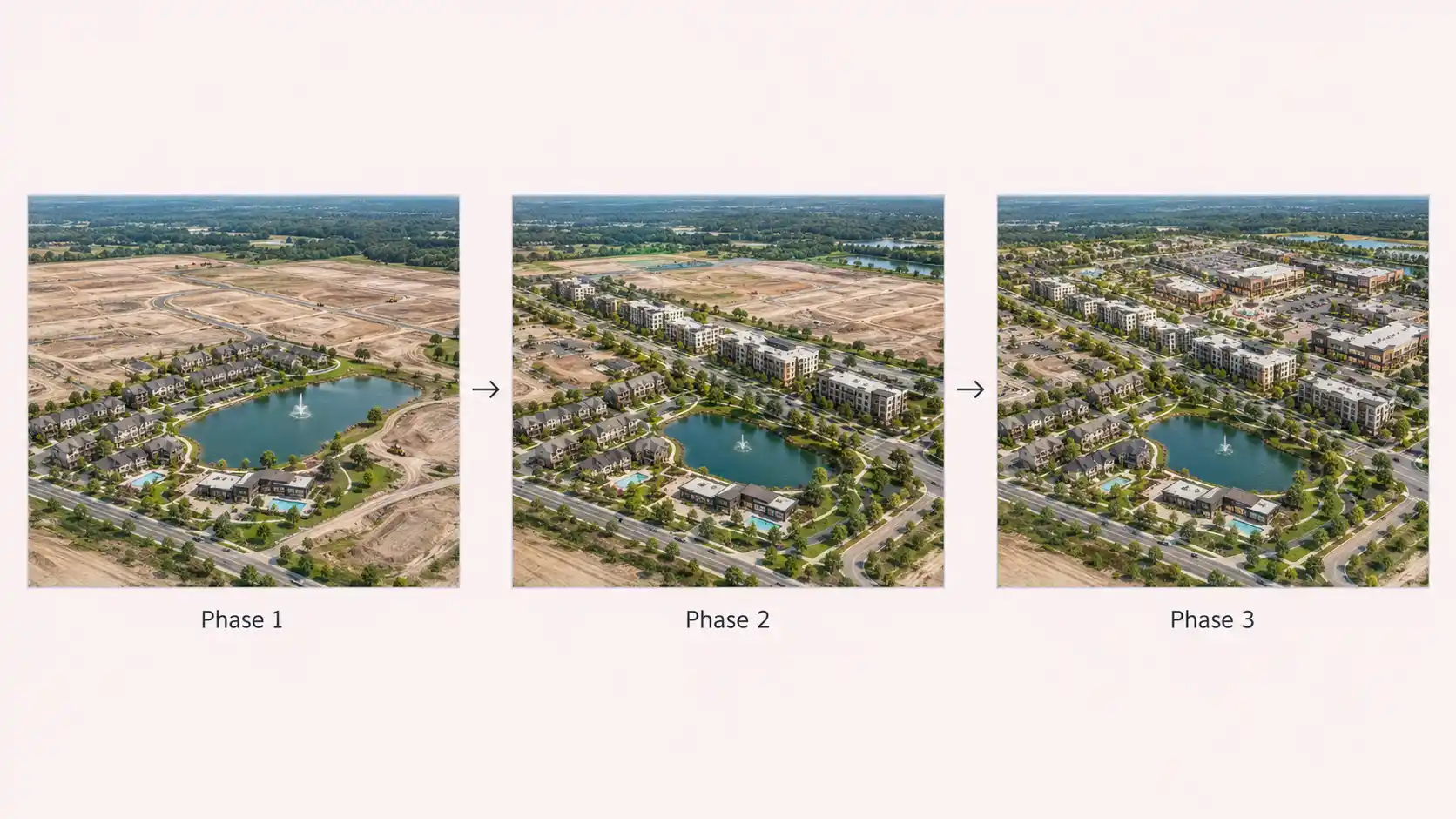
- Lock a visual style guide: camera heights, time of day, material library and post-production grade, documented after phase one.
- Keep the master model: make sure the base model and materials are archived and delivered to you, not just the final images.
- Plan capacity, not just price: ask how the studio staffs overlapping phases and what happens if your lead artist leaves.
- Reuse before you rebuild: later phases should cost less because site, landscape and context are already modeled.
This is where an ongoing production partner has a structural advantage over a one-project relationship. Browse our portfolio of developer work to see how one visual standard carries across phases and asset types.
How to Choose a 3D Rendering Company in 5 Steps
- Define the stage and the job: pre-sale, raise, entitlement or pre-opening, plus the channels each image must serve.
- Prepare a complete brief: drawings, finishes, views and deadlines. Our 3D rendering brief checklist lists what to send for an accurate quote.
- Shortlist three studios across models: rather than three of the best 3D rendering companies in the USA that all work the same way, compare one agency, one regional studio and one production partner.
- Compare quotes like for like: same views, resolution, revision rounds and file deliverables.
- Run a paid pilot image: one view with your real drawings shows process, accuracy and communication before you commit the full launch.
Questions to Ask a 3D Rendering Company Before Hiring
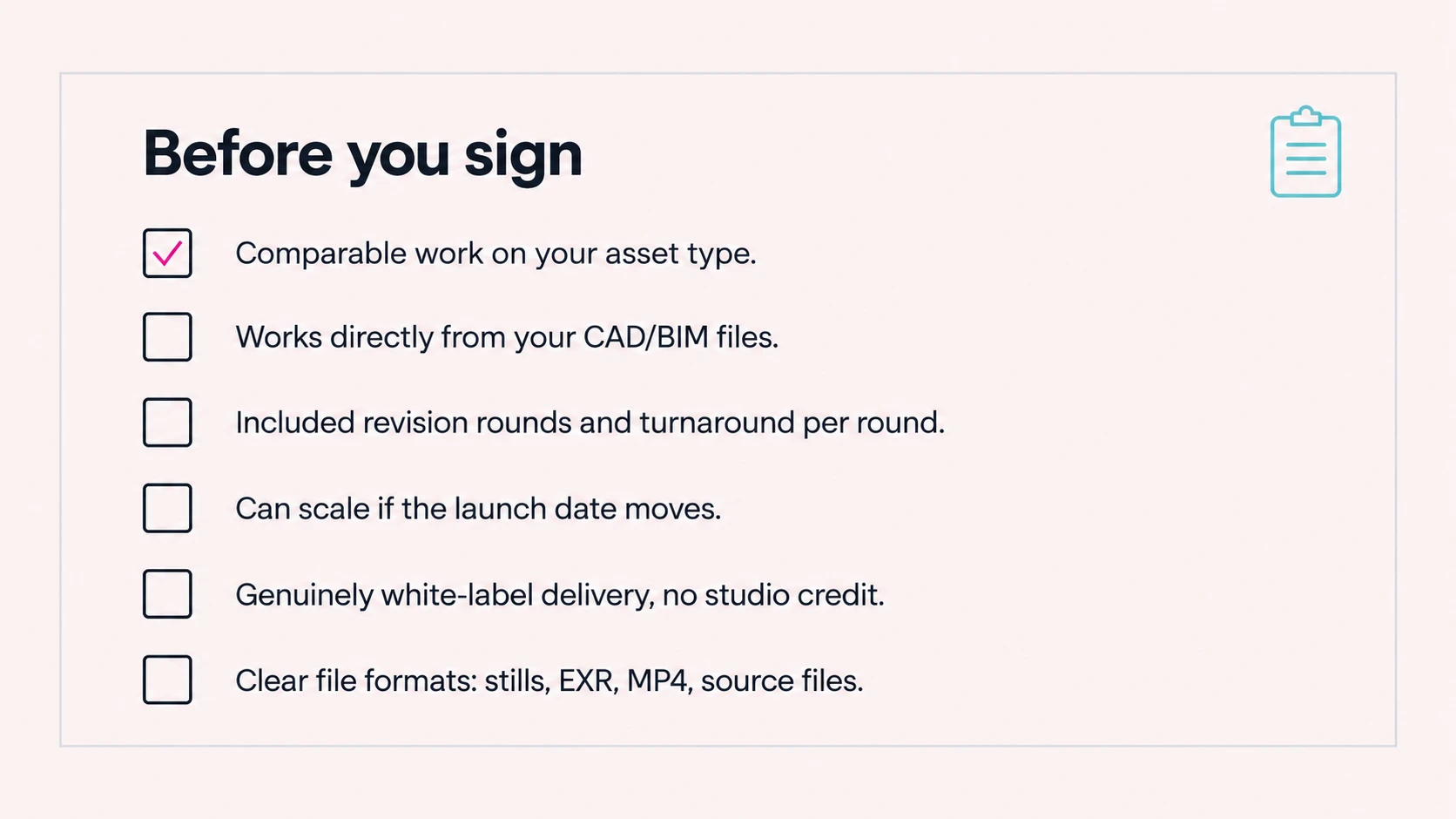
Run every studio on your shortlist, including the ones above, through these questions:
- Can you show comparable work on my asset type, whether high-rise condo, garden multifamily, hospitality or mixed-use?
- Do you work directly from our CAD, Revit or BIM files, or will you re-model from PDFs?
- How many revision rounds are included, and what is the turnaround per round in business days?
- Can you scale output if our launch moves up, or if a later phase needs the same look as phase one?
- Will the work ship under our brand with no studio credit or watermark if we need white-label delivery?
- Which file formats do you deliver, and do we receive the source model and materials?
- Who owns the images and the model, and are there usage limits for print, web, billboards or resale?
- Will you sign our NDA before we share unreleased plans?
Red flags to watch for
- A portfolio with no work on your asset type or market.
- Vague revision terms such as “reasonable changes” with no number of rounds.
- A price far below the market range with no explanation of what is excluded.
- No clay or massing approval step before materials and lighting.
- Refusal to hand over source files, or unclear usage rights.
Our longer guide on what to look for in a 3D rendering company walks through each point if you are building a formal RFP.
Common Mistakes When Choosing a Rendering Studio
- Choosing on one hero image: the hero shot is the easiest image to make look good. Ask to see full launch sets, including interiors and floor plans.
- Briefing too late: studios cannot compress approval time. Starting 12 weeks before launch avoids paying rush fees.
- Ignoring file ownership: without the model, phase two starts from zero.
- Treating AI-generated images as launch-ready: AI tools help with early concepts, but buyers and lenders need images that match the approved plans. Our comparison of CGI vs AI rendering explains where each one fits.
FAQ: Best 3D Rendering Companies in the USA
What are the best 3D rendering companies in the USA for real estate developers?
The strongest options depend on your development stage. Full-service agencies such as DBOX, Neoscape, VISUALHOUSE and Kilograph suit flagship campaigns with branding budgets, while studios such as Steelblue, BINYAN and The Boundary are strong for film or immersive sales tools. For pre-sale volume and multi-phase programs, a white-label production partner such as Archvizly is usually the most predictable choice.
How much do 3D rendering companies in the USA cost?
Standard-tier stills typically run from about $300 to $1,500 per image depending on type, with commercial exteriors and aerials higher and animation priced per finished minute. A full launch package of roughly 14 deliverables often lands between $6,000 and $21,000 at standard rates, while full-service agencies usually quote campaigns as a package.
How long does a 3D rendering project take?
A single still usually takes a few business days of production, but a complete launch set needs about 8 to 12 weeks once approvals, revision rounds and animation are included. Plan back from your launch date and start with the brief roughly 12 weeks out.
Should I hire a US rendering studio or outsource overseas?
A US agency gives you time-zone overlap and campaign strategy at the highest price. A low-cost offshore studio is cheapest but riskier on quality, communication and IP. A white-label production partner sits between them, with structured milestones, confidentiality and capacity for ongoing launches.
What should I send a rendering studio for an accurate quote?
Send architectural drawings or CAD/BIM files, a finishes and materials schedule, reference images, the list of views you need, target deliverables and your launch date. The more complete the brief, the more accurate the quote and the fewer revision rounds you will need.
Are still renderings enough for a development launch?
Stills cover the brochure, website and listings, but most competitive launches add at least one animation and a 360 tour or virtual showroom for remote buyers. Decide based on where buyers first meet the project and what your sales team needs in the gallery.
What is white-label rendering and when does it make sense?
White-label rendering means a production studio works confidentially behind the scenes and the visuals ship under your brand with no studio credit. It makes sense for developers, agencies and architecture firms that need steady capacity across several projects without building an in-house team.
Can one studio handle a multi-phase development?
Yes, if it archives your models and materials, documents a style guide after phase one, and has the capacity to produce overlapping phases. Confirm all three before signing, because switching studios midway usually shows up as a visible change in style.
Choosing Your US Rendering Partner: Key Takeaways
- Start from your development stage, not a generic list of the best 3D rendering companies in the USA.
- Decide early between a full-service agency, a regional studio and a white-label production partner.
- Compare quotes like for like and budget the whole launch package, not single images.
- Count back 12 weeks from launch and protect your approval steps.
- Secure source files, usage rights and an NDA before the first image is made.
If your pipeline includes more than one phase, more than one asset type or a launch date that could still move, a production partner built for that kind of scaling is worth a direct conversation. Start a project with Archvizly to see how our production timeline fits your next launch.